Whole-genome evidence links online parrot trade to human psittacosis, novel ST388
Whole-genome sequencing tied parrots bought online to a severe human case of psittacosis in Zhejiang Province, China, revealing a novel sequence type, ST388.
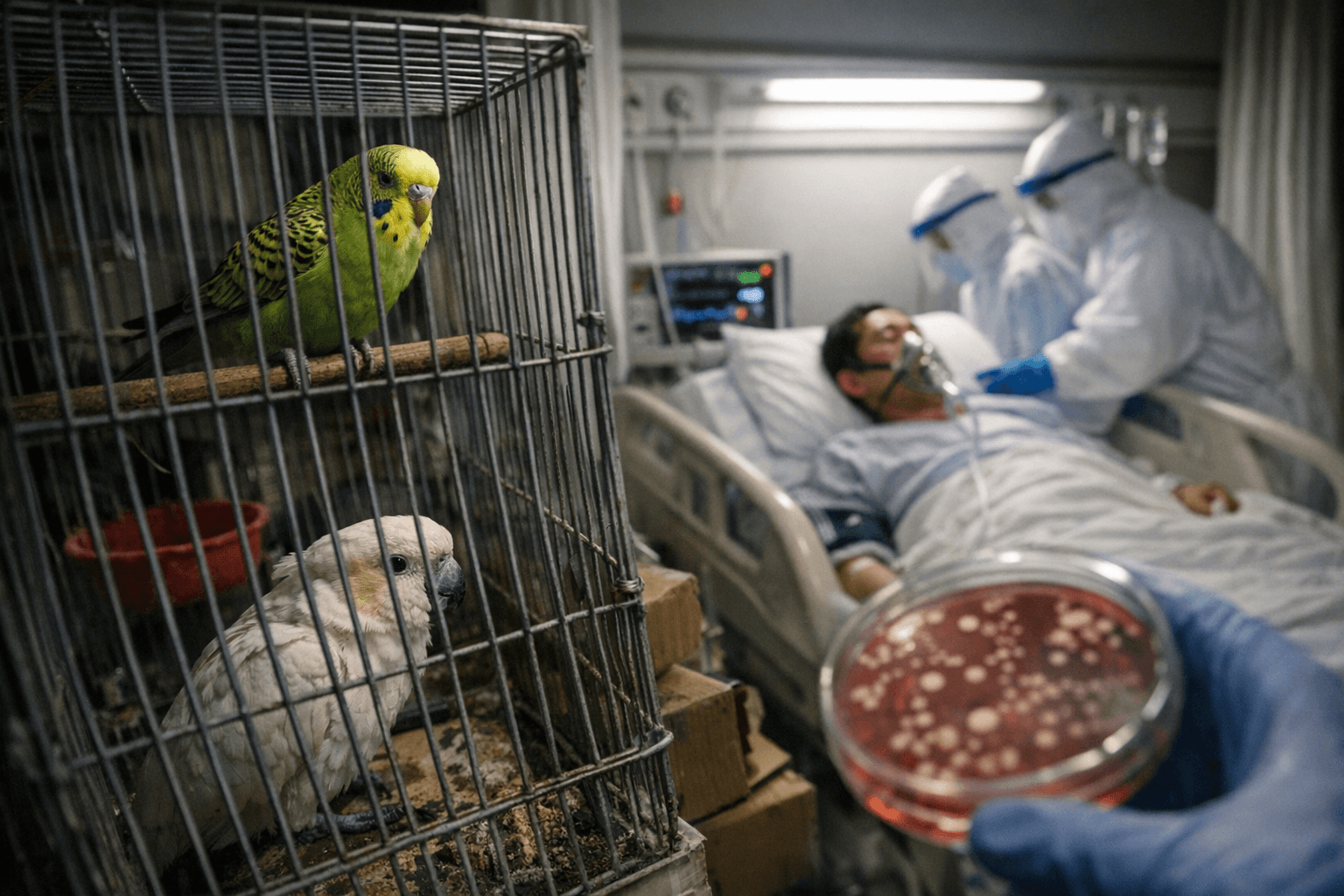
Whole-genome analysis has linked parrots purchased via the internet to a severe human case of psittacotic pneumonia in Zhejiang Province, China, and identified a previously unreported strain. Comparative genomic analysis revealed ">99.99% average nucleotide identity across all samples, providing definitive evidence of parrot-to-human transmission." Investigators recovered 13 high-quality Chlamydia psittaci genomes from the sick patient, the asymptomatic parrots, and the home environment.
The study found that "the patient's only avian exposure was through parrots recently purchased online." Using targeted probe-based capture sequencing designed to recover genomes from low-biomass, hard-to-culture samples, the team reconstructed pathogen genomes directly from clinical and environmental material and determined that "the causative strain was identified as a novel sequence type (ST388) within the known virulent genotype A." The authors state that "This investigation provides the first whole-genome confirmation of psittacosis transmission via online pet commerce."
For parrot owners and sellers, the findings sharpen practical risks: unvaccinated or asymptomatic pet birds can carry Chlamydia psittaci without obvious signs, and an online purchase can link that infection directly back to a household case. Verify seller health documentation, request veterinary certificates, quarantine new birds for observation, and seek medical care if you develop fever, cough, or flu-like symptoms while disclosing recent bird exposure to clinicians. The paper also warns that "The direct zoonotic risks associated with the growing online trade of live pets remain in adequately understood." It further notes that "It establishes a practical genomic framework for investigating similar sporadic zoonoses and underscores the urgent need for targeted surveillance of this emerging and risk communication in this growing digital marketplace."
The Zhejiang case sits against a longer history of parrot-associated psittacosis. Historical studies note that parrot exports and trade during the 1930s helped spark the widespread outbreak now known as the "Great Parrot Fever," and that parrots were "also causally linked to several human cases of psittacosis/ornithosis" in later decades. Genomic work on older sequence types such as ST24 has revealed complex phylogeography, but researchers caution that "any phylogenomic dating should be interpreted carefully, particularly with a lack of additional C. psittaci ST24 genomic data from New Zealand," highlighting ongoing surveillance gaps.
The Frontiersin article is by Wenwu Yao et al.; correspondence is listed to Wenwu YAO. The manuscript was received 29 Dec 2025 and accepted 27 Jan 2026, and is published under a CC BY copyright attributed to "© 2026 YAO, Shi, Song, Wang, Wu, Zhao, Chen, Kong, Song and Wu."
The study leaves unanswered details relevant to follow-up reporting and public-health action: the patient’s age and outcome, the number and species of parrots, the online platform used, and any public-health measures taken are not reported in the excerpts provided. Still, the genomic evidence and the novel ST388 call for tighter seller transparency, routine veterinary screening of traded birds, and targeted surveillance to reduce the risk that an internet purchase becomes a household infection.
Know something we missed? Have a correction or additional information?
Submit a Tip