Why Learned Hand's Spirit of Liberty still matters today
Hand’s warning was never about old paper rights alone. It still measures whether voting, juries, and naturalization train restraint, duty, and tolerance.

Learned Hand treated liberty as a discipline, not a license. That is why his Central Park speech still speaks to a country where rights are often defended as private possessions and democracy depends on habits that look ordinary until they are tested.
The speech was born from a civic rite
Hand was born on January 27, 1872, in Albany, New York, and died on August 18, 1961, in New York City. By the time he spoke on May 21, 1944, he had spent decades on the bench, first as a federal district judge in New York from 1909 to 1924, then on the U.S. Court of Appeals for the Second Circuit from 1924 until his official retirement in 1951, with service as chief judge beginning in 1939.
That legal life mattered because the speech did not come from a politician or a campaign stage. It came from a judge speaking at a wartime civic gathering in New York City’s Central Park, where about 1.5 million people are described as having gathered and where Hand aimed his remarks especially at roughly 150,000 newly naturalized citizens. The scale gave the address an unmistakable public meaning: citizenship was being celebrated not as a private status but as a shared act of membership.
The setting also grew out of a national observance Congress created in 1940. Franklin D. Roosevelt designated Sunday, May 19, 1940, as the first “I Am an American Day,” urging observance for people who had attained their majority or had been naturalized within the previous year. The federal proclamation framed citizenship as a responsibility as much as a right, and that context sits behind Hand’s remarks in 1944.
What Hand was trying to correct
Hand’s lasting argument was that liberty is not simply freedom to do as one likes. He warned that unchecked freedom can erode liberty for other people, which means a society can lose its freedom while still repeating the word. That idea remains unsettling because it shifts the burden from slogans to behavior: liberty survives only when people accept limits, even when no court orders them to.
This is why the speech has never been only a legal text, even though Hand was one of the most admired judges of his era. He was speaking as someone who understood the law’s boundaries and its dependence on the public mind. A constitution can set the frame, but it cannot supply the self-restraint, tolerance, and civic responsibility that make the frame usable.
Commentators and judges have repeatedly returned to that point because the speech does not treat liberty as a thrill or a shortcut. It treats it as a moral habit. Hand had already explored similar themes in a 1930 address on tolerance, which helps explain why the 1944 speech feels less like a sudden wartime sermon than the clearest version of a long-held view.
Why the address still travels
The speech endures because it gives a vocabulary for democratic failure that is larger than any single crisis. It explains how a public can drift toward authoritarian habits without formally discarding elections or courts: by celebrating willfulness, rewarding cruelty, and mistaking noise for freedom. Hand’s warning makes liberty a test of conduct, not just a legal category.
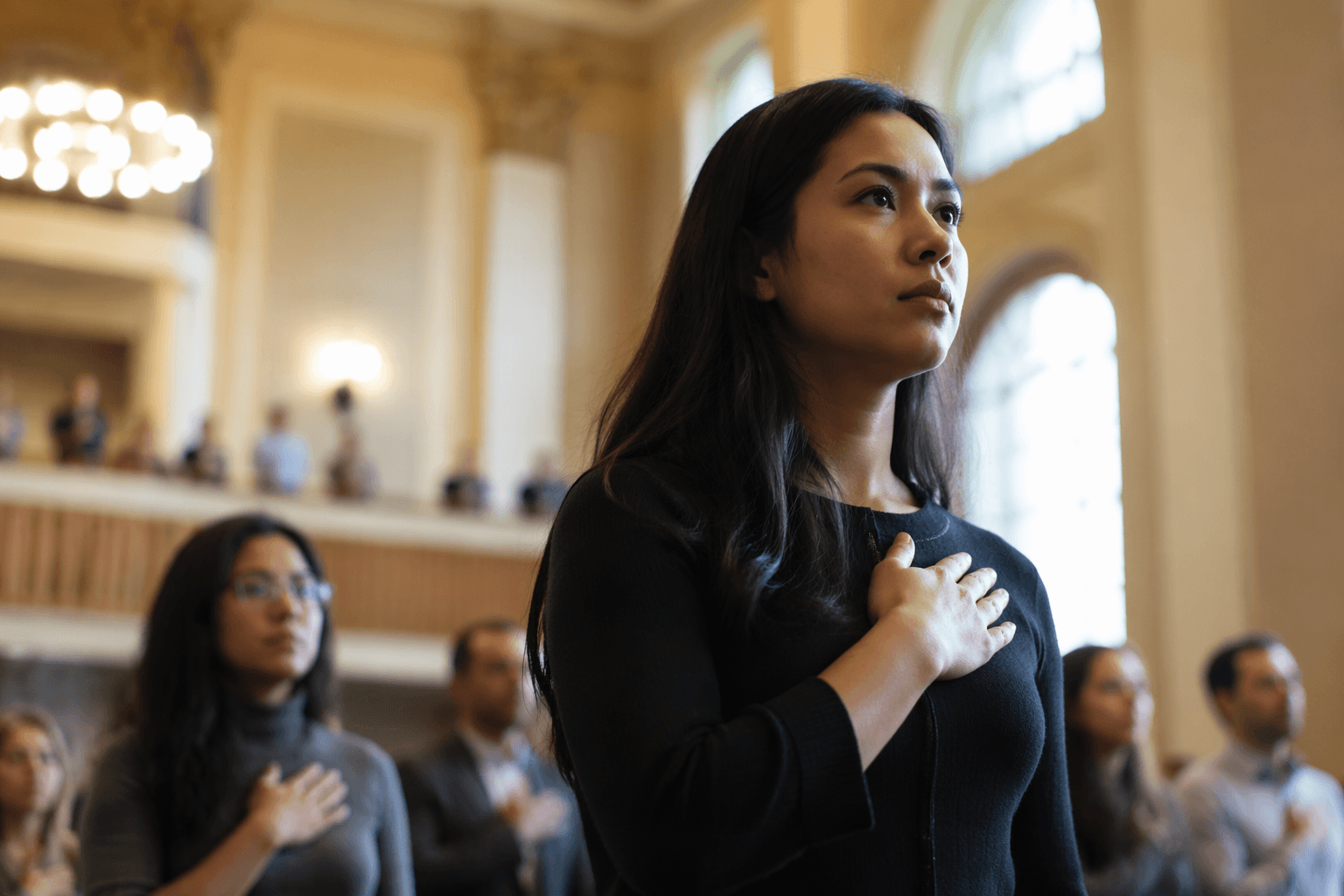
- naturalization ceremonies that welcome new citizens while naming the responsibilities of membership,
- voting systems that depend on participation, patience, and respect for outcomes,
- juries that ask ordinary people to deliberate across differences,
- courts that require argument to outrun impulse,
- and public offices that still depend on the idea that power should be answerable to law.
That is also why the speech continues to matter in contemporary civic life. The institutions and habits that most closely embody Hand’s spirit are the ones that make people practice restraint in public:
Each of those institutions carries the same basic lesson that Hand emphasized in Central Park. Liberty is not self-executing. It survives when people accept that other people have rights too, and when public life rewards self-command instead of ego.
Where democratic resilience is visible now
The most convincing modern proof of the Spirit of Liberty is not found in rhetoric. It appears when strangers still enter citizenship through lawful ceremony, when local and national elections continue to turn on counting rather than force, and when courts remain places where disagreement is channeled into argument instead of intimidation. Those are the civic habits that keep democracy legible to people who have never met one another.
Hand’s audience in 1944 included thousands of new Americans, and that detail still matters because it shows where democratic renewal begins: with inclusion paired to duty. The observance Roosevelt created in 1940 recognized not only citizenship but its responsibilities, and Hand sharpened that idea into a warning that still fits the present. A free society is visible whenever public institutions train people to govern themselves before they try to govern others.
That is the modern test of Hand’s legacy. The Spirit of Liberty lives wherever a community chooses tolerance over domination, self-restraint over impulse, and civic responsibility over permanent grievance.
This article was produced by Prism’s automated news system from verified source data, official records, and press releases, then run through automated quality and moderation checks before publishing. The system is built and supervised by the people who set the standards it runs under. Read our full AI policy.
Did this article answer your question?