Why Nepal keeps a 45-minute time zone from India
Nepal’s 45-minute offset is not a quirk. It is a quiet declaration of sovereignty, tied to geography, history, and the country’s place between India and China.
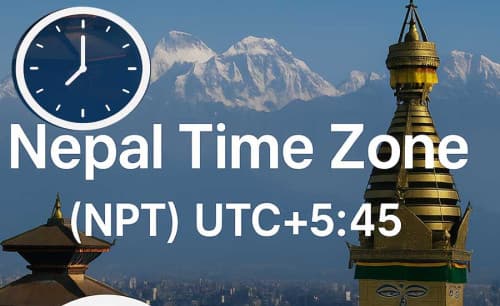
Why Nepal chose a time zone of its own
Nepal’s clock runs on a logic that is both practical and political. Nepal Standard Time is UTC+5:45, which puts the country 15 minutes ahead of India and makes it one of only three time zones in the world with a 45-minute offset from UTC. In a region where borders, trade routes, and daily life are closely intertwined, that quarter-hour matters because it signals that Nepal’s national schedule is not simply borrowed from a larger neighbor’s. It is Nepal’s own.

The result is easy to miss until it affects a train connection, a call across the border, or a digital meeting that must be pinned to the minute. Nepal does not observe daylight saving time, so the country’s offset stays fixed throughout the year. That stability reinforces the broader message behind the time zone: Nepal’s official time is meant to stand on its own, not fluctuate with seasonal adjustments or mirror India’s system.
A small difference with a larger meaning
Time zones are usually built in roughly 15-degree slices of longitude, a standard that emerged when railways made local solar time too chaotic for modern transportation and commerce. Nepal’s quarter-hour offset fits that broader logic, but it also departs from the cleaner half-hour and whole-hour patterns most countries use. The unusual result is not an error or a rounding problem. It is a deliberate choice that sits at the intersection of geography, statecraft, and identity.
That choice matters because Nepal is wedged between India and China and stretches roughly 800 km east to west. Its capital is Kathmandu, but the country’s physical shape and mountain terrain have long made centralized administration and national cohesion a challenge. In that context, timekeeping becomes more than a utility. It becomes part of how the state presents itself: distinct, independent, and not defined by the rhythms of its neighbors.
The history behind Nepal Standard Time
Nepal’s current clock did not appear overnight. Historical sources say the country followed India’s UTC+5:30 from 1920 through 1955. Later, Nepal shifted its clocks by 15 minutes, creating the present UTC+5:45 offset. timeanddate.com places the formal change at midnight on January 1, 1986, when clocks were advanced to 12:15 a.m. local standard time.
That sequence shows how time policy can evolve in stages rather than through a single dramatic break. Nepal moved from aligning with India’s system to marking out a more independent standard, and the 15-minute shift was enough to make the difference visible every day. Even a small change in official time can carry large symbolic weight when it is tied to sovereignty, borders, and a nation’s relationship with its neighbors.
Why the meridian matters
The logic of Nepal’s time zone also rests on geography. Nepal’s time zone meridian was set at 86° east longitude, associated with the mean solar time of Mount Gauri Shankar. The mountain is about 100 km from Kathmandu, which gives the meridian a clear national reference point rather than an imported one. India’s standard meridian, by contrast, is 82°30′ E, passing through Mirzapur, Uttar Pradesh.
Those meridians are close enough that the countries share broad regional time patterns, but different enough to matter. Nepal’s decision makes clear that timekeeping is not only a technical calculation. It is also a way of choosing which landscape and which reference point define the nation. By anchoring time to a mountain within its own orbit of geography, Nepal tied the daily clock to a specifically Nepali frame of reference.
How the 15-minute gap shows up in daily life
The practical effect of Nepal’s offset is simple: when it is noon in Nepal, it is 11:45 a.m. in India. That small gap can shape everything from phone calls to travel itineraries, especially in border regions where families, workers, and traders move back and forth. A 15-minute difference is not as disruptive as a full hour, but it still demands attention in scheduling, ticketing, and coordination.
For business, that means meetings with Indian counterparts require precision. A departure board, a bank transfer, or a logistics plan cannot assume that “close enough” will work, because a quarter-hour difference can be the difference between arriving early, arriving late, or missing a handoff entirely. In digital settings, the need is even sharper. Calendars, operating systems, and messaging platforms all have to recognize Nepal’s offset correctly or risk creating small but costly errors.
Travelers feel the same effect immediately. Border crossings, flights, and hotel check-ins all depend on reading the clock correctly, and Nepal’s time zone can trip up anyone who assumes that neighboring countries must share the same official time. The difference is modest, but it is exacting, which is part of what makes it so revealing.
Sovereignty expressed in minutes
Nepal’s time zone is easy to describe as a curiosity, but that description misses the point. The 45-minute offset reflects a country that is landlocked, mountainous, and historically shaped by the pressure of larger powers, yet still intent on defining itself on its own terms. In that sense, the clock is a civic statement as much as a schedule.
A nation does not need a dramatic time difference to express independence. In Nepal’s case, 15 minutes is enough. The offset says that geography can be standardized without being absorbed, and that a country wedged between India and China can still decide what time it is for itself.
This article was produced by Prism’s automated news system from verified source data, official records, and press releases, then run through automated quality and moderation checks before publishing. The system is built and supervised by the people who set the standards it runs under. Read our full AI policy.
Did this article answer your question?