Why the U.S. economy keeps outperforming peers despite global shocks
The U.S. is still outpacing peers because consumers, immigrants and productivity have held up demand, but tariffs and sticky inflation are narrowing the payoff.
The U.S. economy is still beating many peers, but the reasons are more specific, and more fragile, than the headline suggests. Growth has been supported by a labor market that keeps adding jobs, households that keep spending, and a labor force enlarged by immigration, even as tariffs, slower labor-force growth and sticky inflation threaten to erode the edge.
Why the U.S. still stands out
The International Monetary Fund’s latest outlook argues that the global economy is still dealing with the aftershocks of a major shift in U.S. trade policy and a broader transition to a new international trading system. Even so, the U.S. has remained ahead of many advanced economies: the IMF’s July 2025 update projected U.S. growth at 1.9% for 2025, compared with 1.5% for advanced economies as a group.
That outperformance is not a story of runaway strength. The Bureau of Economic Analysis said real GDP rose at a 3.8% annual rate in the second quarter of 2025, then slowed to 1.4% in the fourth quarter and 1.6% in the first quarter of 2026. The pattern points to an economy that has cooled from its fastest pace, but has not broken under pressure the way many forecasters once feared.
Consumer demand has been the first line of defense
Household spending remains one of the clearest reasons the expansion has held together. Reuters reported in September 2025 that consumer spending rose slightly more than expected in August as households traveled and dined out, a reminder that demand is still flowing through services as well as goods. That kind of spending matters because it keeps business revenues, hiring and tax receipts moving even when trade policy and global demand are less predictable.
The Treasury added a second layer of support in mid-2025, saying total payroll job growth averaged 150,000 per month in the second quarter, up from 111,000 per month in the first quarter. It also said lower headline inflation had produced a large first-half increase in real wages. That combination helps explain why the economy could keep expanding even as growth slowed: income gains and employment gains still gave households enough room to spend.
Immigration has quietly widened the labor supply
A major part of the U.S. advantage has come from labor supply, not just labor demand. The Bureau of Labor Statistics said foreign-born workers made up 19.1% of the civilian labor force in 2025, and their labor-force participation rate was 66.3%. That matters because a larger, active workforce lets the economy produce more without instantly colliding with labor shortages.
The contribution is showing up in growth and fiscal math. The Congressional Budget Office said the recent immigration surge boosts economic growth and lowers deficits over the 2024-2034 period. The Dallas Fed estimated that higher immigration boosted payroll job growth by 70,000 jobs per month in 2022 and by 100,000 per month in 2023 and early 2024. In other words, immigration has not only filled vacancies, it has also expanded the economy’s speed limit.
There is a catch. Federal Reserve researchers warned in April 2026 that labor-force growth could be near zero starting in 2026 because of weak population growth, low net immigration and aging, calling that weakness unprecedented in recent U.S. history. If that proves right, one of the most important buffers behind the U.S. rebound will be fading just as the economy needs it most.
Productivity has done more of the heavy lifting than many realize
The productivity side of the story is just as important. The Bureau of Labor Statistics said nonfarm business labor productivity rose 2.4% in the second quarter of 2025 after falling 1.8% in the first quarter. That swing is significant because productivity growth allows wages and output to rise without igniting the same level of inflation pressure.
This is one reason the U.S. can keep outperforming even when global shocks hit. The Organisation for Economic Co-operation and Development said in 2025 that the world economy had been more resilient than expected, helped by supportive macro policies, improved financial conditions and rising AI-enabling investment and trade, though growth was expected to slow in 2026. The U.S. has been part of that wider resilience, but has also benefited from deeper capital markets, faster adoption of new technology and a labor market that has absorbed shocks more effectively than many peers.
Policy has helped, but it has also complicated the outlook
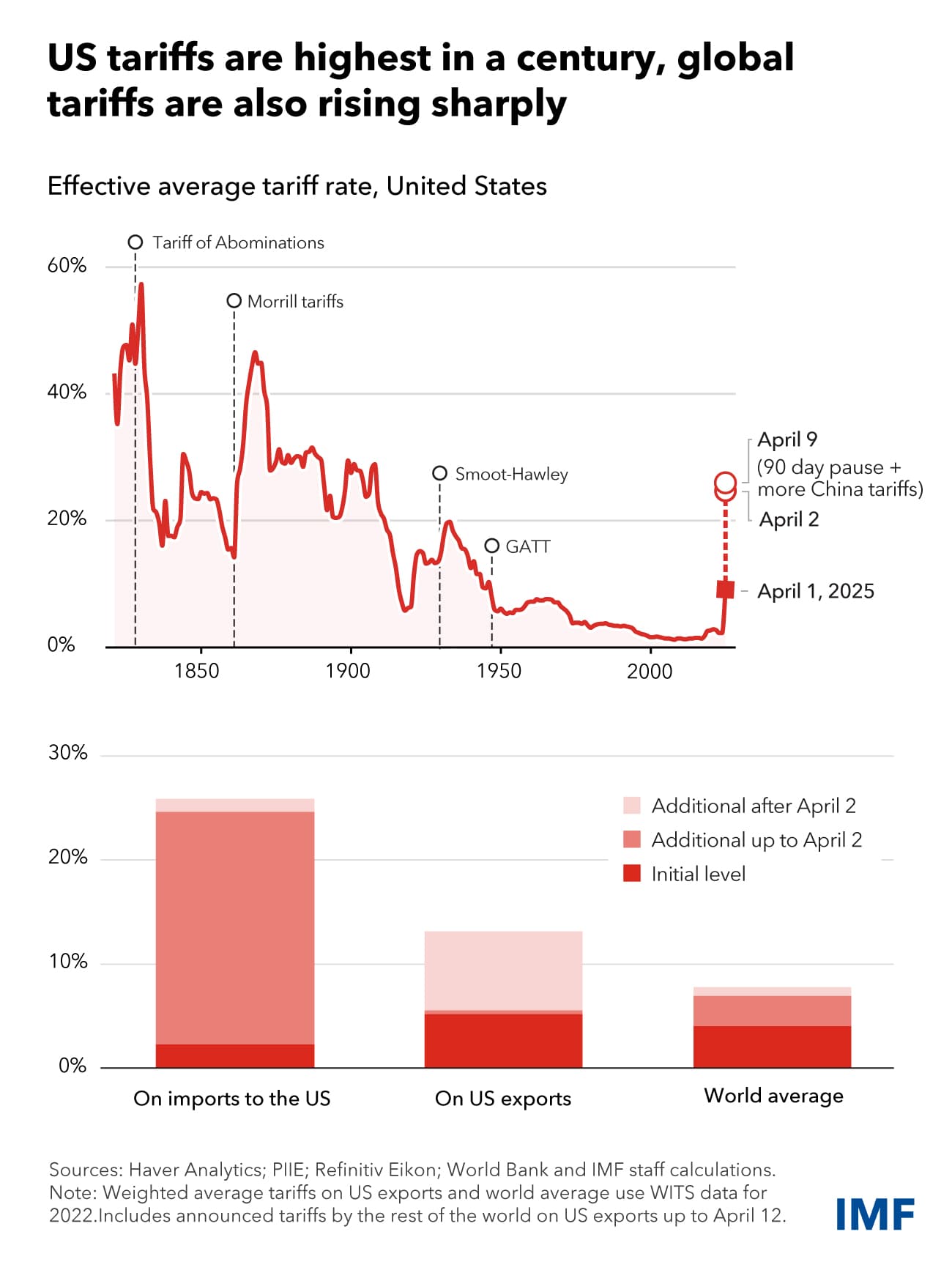
The IMF’s April 2026 World Economic Outlook noted that the U.S. effective statutory tariff rate was about 5.3 percentage points below the level assumed in its October 2025 forecast, after later court rulings and executive actions. That matters because lower-than-feared tariffs reduce the immediate drag on trade and inflation, but they also highlight how much of the policy environment remains in flux. For businesses, uncertainty over tariffs can still delay investment, disrupt supply chains and force companies to hold back on hiring plans.
At the same time, inflation is not yet fully back in the background. The Bureau of Economic Analysis said the personal consumption expenditures price index was up 3.8% from a year earlier in April 2026, and the IMF said U.S. inflation was still expected to run above target even as global inflation eased. That is the uncomfortable mix behind the resilience narrative: growth is still positive, but the price level is still biting into household budgets.
The gains are real, but they are not yet broad enough
The hardest question is whether national outperformance is translating into lower stress and wider gains for households. The answer is partly yes, because real wages improved as inflation cooled and payrolls kept growing. But it is not a clean victory, because labor-force participation had eased earlier in 2025 even as prime-age participation rose, which suggests that the recovery has not lifted every group equally.
That is why the resilience label should be handled carefully. The U.S. has been supported by a combination of resilient consumer demand, better productivity and a bigger labor supply than many peers. Yet the very supports that kept growth alive, immigration, spending and tariff relief, are all vulnerable to reversal, while inflation remains sticky enough to keep pressure on household budgets. The economy is still outperforming, but the durability of that edge will depend on whether wage gains, job growth and productivity can outlast the policy shock that helped create them.
This article was produced by Prism’s automated news system from verified source data, official records, and press releases, then run through automated quality and moderation checks before publishing. The system is built and supervised by the people who set the standards it runs under. Read our full AI policy.
Know something we missed? Have a correction or additional information?
Submit a Tip