Will Harris Reveals Five Weather Modeling and Routing Tips for Offshore Passages
Will Harris’s approach turns synoptic charts into an actionable routing backbone—plan departures around fronts, compare multiple model runs, and keep routing simple at the nav station to cut weather risk on offshore legs.
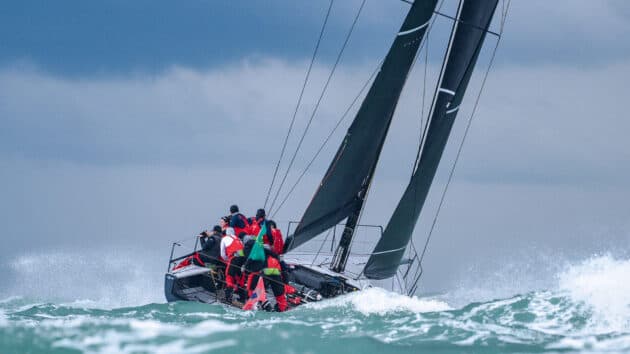
Andy Rice’s Yachting World piece of 26 February 2026 distils professional navigator Will Harris’s method for turning weather analysis into sharper offshore routing decisions. The payoff Harris promises in the article is practical: use synoptic charts and simple, repeatable checks at the nav station to reduce exposure to bad weather and make departure timing a tactical advantage. The feature sits alongside other Yachting World coverage of high‑stakes racing and records — a useful frame when you remember boats like Sodebo ran the Jules Verne in 40d 10h 45m — because small routing edges add up to large gains offshore.
Lesson 1: Treat the synoptic chart as the backbone of every plan Harris’s approach, as presented in the Yachting World article, starts with the synoptic chart: not as an academic exercise but as the first filter that tells you where the big things — fronts, lows and blocking highs — will be moving during your passage. The piece explicitly calls the guidance “aimed at sailors looking for concrete ways to use synoptic chart,” and that framing matters: instead of staring at isolated model runs, Harris uses the chart to set the strategic picture — where a frontal zone will cross your track, and whether that timing creates a weather window. On an IMOCA like Malizia — the same boat where Harris was photographed at the nav station during The Ocean Race 2023 — that strategic view is what separates a safe, predictable overnight from a night of continuous gear strain.
Lesson 2: Compare model runs, then simplify the decision Yachting World’s headline for the article — “Expert navigator tips: How to master weather models for a winning edge” — highlights Harris’s emphasis on models without turning them into a data swamp. The practical lesson the article distils is to compare runs from multiple model cycles and look for persistent signals rather than single, headline‑grabbing extrema. Harris’s method, as Rice reports, is less about worshipping one output and more about watching the signal strengthen or fade across successive updates; that consistency is what you act on when you’re plotting a course off the coast or across an ocean. For small crews on production boats, that means giving yourself a simple rule: if three successive runs agree on a front’s timing, treat it as probable and plan accordingly.
Lesson 3: Time your departure to dodge frontal exposure One concrete fix readers can act on immediately — and a recurring theme in the Yachting World piece — is the careful timing of departures to avoid being in the wrong part of a front during the passage. Harris’s routing approach uses the synoptic chart to predict when the worst winds of a front will be in a given ocean sector, and then layers that timing into a departure decision at the dock. That’s the kind of planning that racing teams deploy and that cruising skippers can use to protect a family‑crewed passage: shift your start by 12–24 hours to avoid a frontal passage during your dark hours, and you convert a potentially stressful night into a manageable day sail. The article illustrates this as a repeatable tactic that reduces both fatigue and gear risk.
Lesson 4: Keep the nav station workflow lean and actionable The photo captioned “Will Harris at the nav station of the IMOCA Malizia in the 2023 iteration of The Ocean Race” underscores a practical point in Rice’s piece: the nav station is where information must become action. Harris’s workflow, as presented, favors a short, daily routine of chart checks, model comparisons and a single routing update that the watch leader can follow — not a constant stream of last‑minute re‑routing. At the nav station this means a small kit is enough: current synoptic chart printouts, your latest GRIB downloads, a routing printout or tablet with the chosen track, and a paper backup. That lean setup keeps decision latency low and keeps the crew focused on sail trim and sea state rather than chasing data. A simple safety caution Rice highlights is to maintain a paper or offline backup of your chosen plan; electronics fail, and the nav station is where redundancy matters.
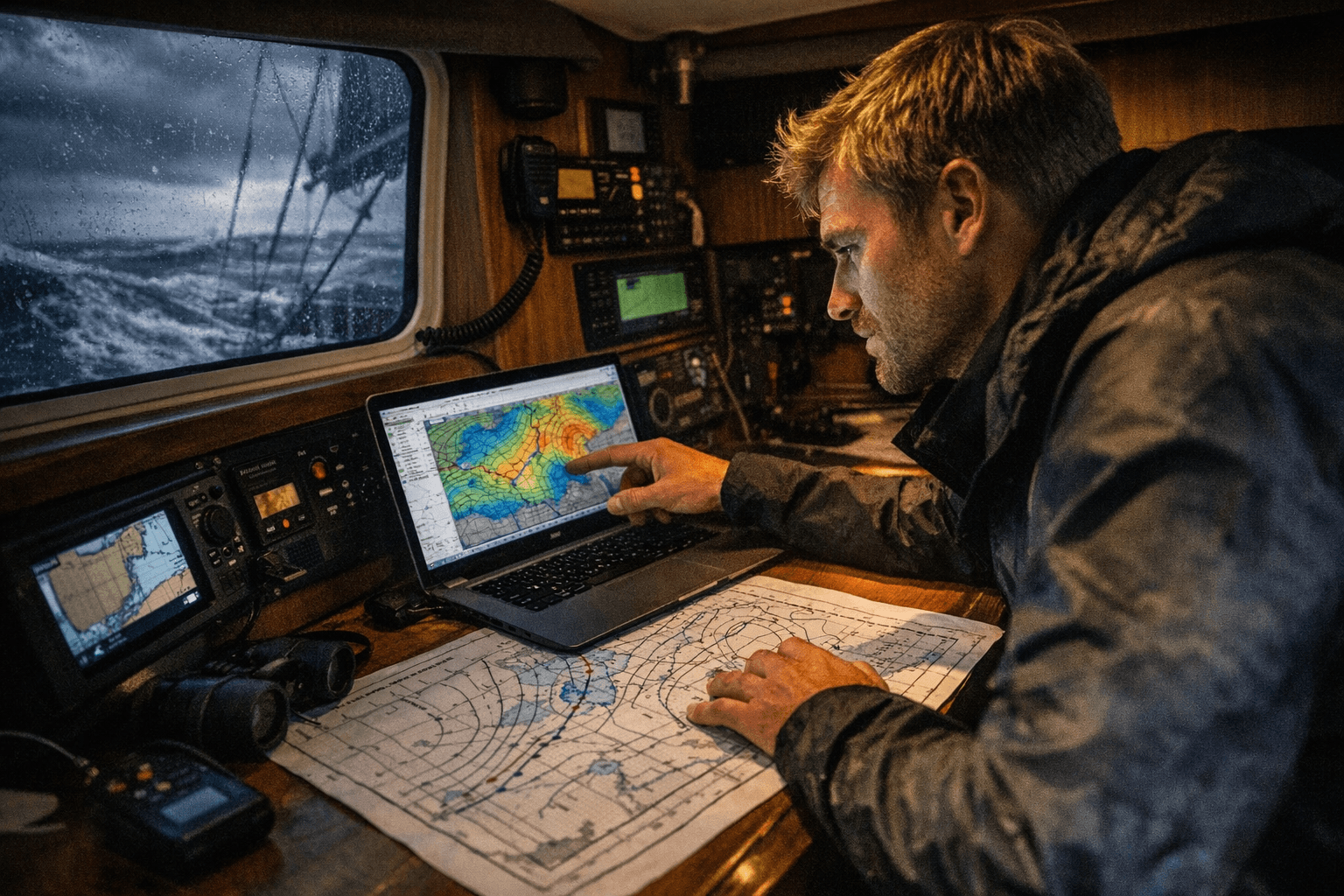
Lesson 5: Factor human limits and the high‑stakes context Rice’s article places Harris’s technical tips in a human and competitive context familiar to Yachting World readers — between SailGP headlines and round‑the‑world records — to remind us that weather decisions are never purely technical. Harris’s routing method, as distiled in the piece, explicitly accounts for crew rest, watch systems and whether the team can safely implement a plan at 0200 in the morning. The reporting ties that human element back to performance: a routing that saves a small number of hours but forces repeated night‑time sail changes may be worse overall. In short, Harris routes for the boat and the people aboard it, not just for the shortest theoretical ETA.
- Start with the synoptic chart as your daily strategic briefing.
- Compare at least two consecutive model cycles before committing to big changes.
- Time departures to avoid frontal passages during watch‑heavy hours (shift start by 12–24 hours where appropriate).
- Keep one concise routing update that the skipper and watch leaders can follow, plus a paper backup.
- Prioritize crew rest and safety over shaving hours of passage time.
Practical checklist and quick wins from the nav table
Rice’s Yachting World feature gives sailors a usable set of steps to begin applying Harris’s methods immediately. On the table at the nav station, aim to make these actions part of your routine:
These are low‑cost, high‑impact habits; implementing them requires time at the planning table rather than expensive hardware upgrades. As Rice’s piece frames it, the real edge comes from disciplined habits at the nav station — the same station where Harris sat aboard IMOCA Malizia during The Ocean Race 2023.
Closing: a navigator’s mindset, not a secret formula What readers get from Andy Rice’s 26 February 2026 distillation of Will Harris’s practice is not a secret algorithm but a way of working: use the synoptic chart to set strategy, watch for agreement across model runs, time departures to reduce exposure, keep the nav station workflow simple, and put human limits into the routing decision. Those five lessons are practical, repeatable and scalable — whether you’re prepping a short offshore hop or plotting a transoceanic leg that aims to make the difference between a comfortable passage and constant strain. The article sits among contemporary Yachting World coverage of high‑stakes sailing — from SailGP stories to records like Sodebo’s Jules Verne time — as a reminder that good weather work at the nav station is where many of those big margins are won.
Know something we missed? Have a correction or additional information?
Submit a Tip

