Wing Propulsion Boosts Efficiency and Accessibility of Cruising Catamarans
Testing of the ModX 70 on December 31, 2025 confirmed its wing-driven propulsion and hydro-generation deliver striking efficiency, enabling the first luxury bluewater cruising catamaran to operate entirely without fossil fuels. These systems, proven on high-performance foilers like SailGP AC72s and America's Cup AC75s, promise easier handling, onboard energy independence, and a potential widening of access to bluewater cruising.
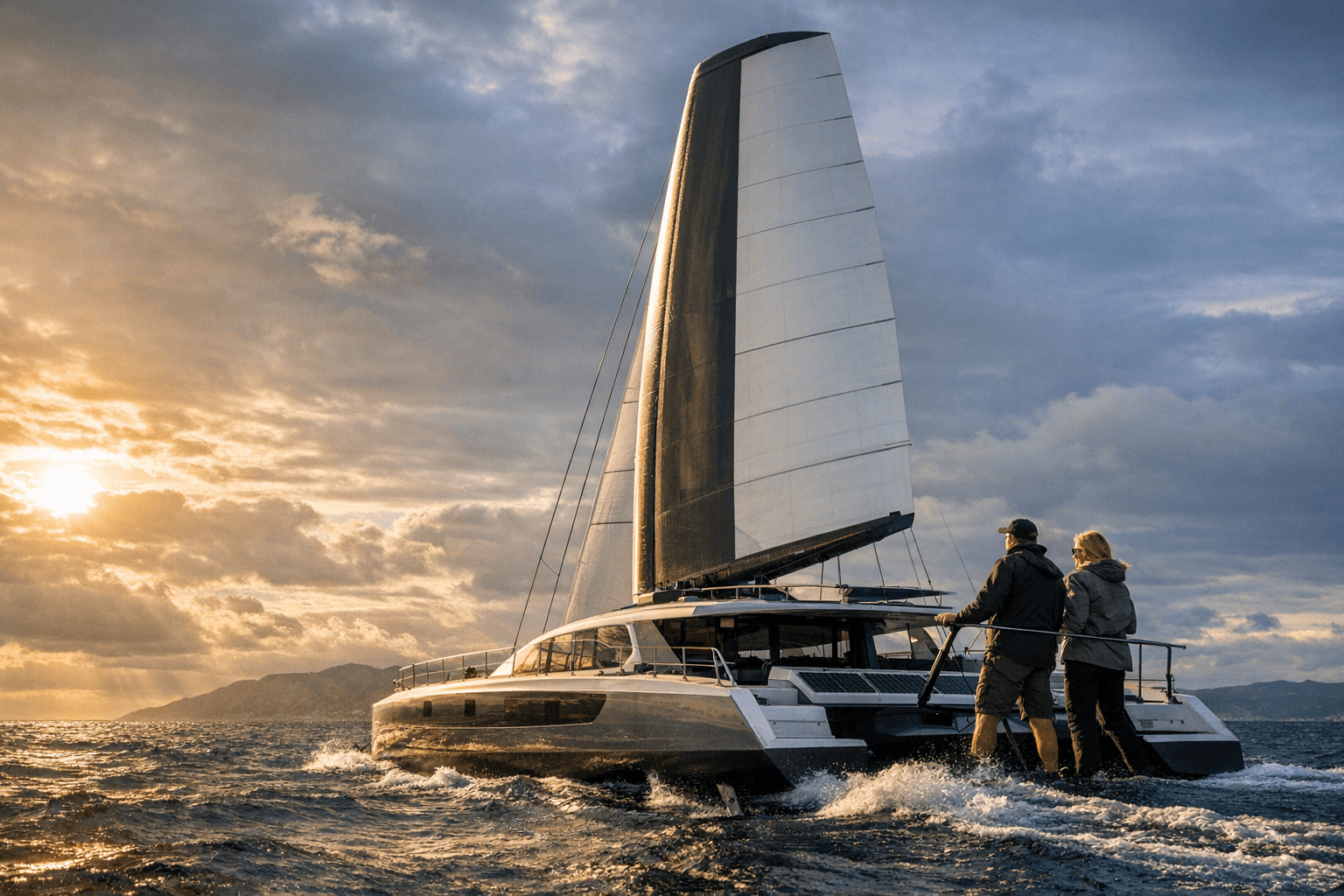
On December 31, 2025 I tested the ModX 70, the first luxury bluewater cruising catamaran designed to run completely without fossil fuels, and the experience underscored how transformative wing propulsion and hydro-generation can be for cruising yachts. The ModX 70’s rigid wing surfaces not only provide propulsion efficiency but also drive hydro-generators that replenish onboard electrical energy, supporting hotel loads and propulsion systems while underway.
The practical payoff is clear: steady average speeds around fifteen knots—a benchmark observed on vessels like Energy Observer—are sufficient to sustain continuous energy production. Energy Observer was only able to produce hydrogen once wings were installed, showing how consistently maintained speed profiles convert directly into usable onboard power. That capability opens real options for long-range passages with minimal fossil-fuel dependence, quieter operation, and reduced generator runtime.
Wing technology is not new to sailing, but its migration from elite racing to cruising marks a shift in priorities. SailGP AC72s and the America's Cup AC75s have long used wings to push extreme performance and explosive maneuvers; cruising designs prioritize stability, efficiency, and easier handling. On the ModX 70 the wings simplified sail handling and enabled a level of automation in maneuvers not commonly found on traditional cruising catamarans. That simplification can lower the skill barrier for crews, making bluewater passages more achievable for smaller or less experienced teams and offering charter operators a safer, more user-friendly platform.
Several wing types are already on the market and more are expected by 2026, giving owners choices in design, control systems, and retrofit potential. For owners, builders, and charter operators this technology affects decisions about battery capacity, control electronics, maintenance regimes, and crew training. Hydro-generation performance depends on maintaining steady speeds, so passage planning and power budgeting remain critical.
As wing systems proliferate, they could help broaden participation in cruising while improving sustainability across the community. Expect to see more catamarans adopting wings for energy independence and easier handling as the technology matures. Wishing you fair winds and a sustainable season.
Sources:
Know something we missed? Have a correction or additional information?
Submit a Tip