Wireless Charging Pucks Save Time, Hassle, and Floors From Cable Chaos
A $15 Anker charging puck eliminated cable clutter without sacrificing speed. Here's how wireless charging pucks work and which standard is right for you.

The cable that slides off the nightstand at 2 a.m. and disappears into the darkness. The USB-C cord that ends up kicked under the desk by noon. Anyone who has ever hunted for a charging cable on the floor knows exactly why a wireless charging puck feels like a minor miracle. Wireless chargers have evolved into highly convenient accessories, offering benefits that go beyond mere speed, including eliminating cable clutter, effortless docking, and multi-device charging capabilities. The puck, that small disc you set your phone on and forget about, is the simplest expression of that promise.
What a Wireless Charging Puck Actually Does
The mechanics are straightforward. At its core, a wireless charger uses the principle of inductive charging: a charging pad generates an electromagnetic field, and the receiver coil in your device converts that energy to recharge your battery. The puck form factor keeps this simple. You place your phone, the coils find each other, and charging begins. No ports involved. Worn-out cables and broken charging ports are two of the most common quality issues with smartphones, but wireless charging eliminates both: no cables to wear out and no mechanical stress on charging ports, reducing electronic waste in the process.
Because port usage is reduced, wireless charging naturally helps slow down port deterioration, which matters a great deal on flagship phones where the USB-C port doubles as the only connector for everything from data transfer to headphone adapters.
Why Magnetic Alignment Changed Everything
Early wireless pads worked, but they were punishing about placement. Most older wireless chargers are round pucks that allow placement anywhere on the pad, meaning there is a high chance coils won't be perfectly aligned, reducing the overall efficiency of energy transfer. The result was slow, hot charging that could feel worse than just using a cable.
The Qi2 standard addresses this directly with a circular magnetic ring around each coil, a design borrowed from Apple's MagSafe, which eliminates the alignment problem. One easy-to-spot difference from previous-generation chargers is a raised magnetic circle that holds phones in place with the magnetized backs of iPhones 12 and newer, Google Pixels 10 and newer, and Android devices with compatible accessory cases.
The physics behind alignment problems are stark. Testing with a non-MagSafe-aligned setup found it took nearly four hours to charge an iPhone 15 Pro placed off-center, with battery temperatures remaining above 40°C for most of the charge cycle, which is bad news for battery longevity. A magnetically aligned Qi2 puck avoids that entirely.
The Qi2 Standard: What It Means in Practice
Qi2, launched in 2023, and its updated version Qi2 25W (Qi v2.2.1), launched in July 2025, are taking wireless charging to the next level, delivering faster, more convenient, and more energy-efficient charging.
What sets Qi2 apart is its ability to deliver up to 15 watts of charging power, compared to the maximum 7.5W typically offered by the original Qi standard. The newer Qi2.2 (also referred to as Qi2 25W) pushes that ceiling higher. Qi2 25W delivers nearly 70% more charging power than its predecessor and can safely charge a smartphone battery from 0 to 50% in about 30 minutes.
Device compatibility has grown rapidly. Qi2 adoption advanced rapidly in 2025, with over 1,200 new certified products becoming available, and it is expected that nearly four billion Qi2 products will ship within the next five years. iPhone models starting from the iPhone 15 series officially support the Qi2 standard, enabling faster 15W wireless charging speeds when paired with a Qi2 charger. On the Android side, major Android smartphones are joining the Qi2 ecosystem for the first time with the Qi2 25W launch.
Crucially, the standard is backward-compatible. Devices that support Qi2 25W can still be used with older Qi and Qi2 wireless chargers, with charging speed slightly slower on previous-generation pads, but no need to replace existing gear right away.
The Anker MagGo: Qi2 for $15
The case for making the switch gets significantly easier when the hardware costs less than a restaurant meal. Anker's MagGo wireless charging pad delivers full Qi2 speeds for $15, making it one of the most accessible entry points into magnetic wireless charging available. The pad is Qi2 certified for 15W charging and features strong built-in magnets that snap to compatible iPhones and magnetic cases for a precise, hassle-free experience. It includes a 5-foot extended cable, giving a wider range for positioning across a desk or nightstand.
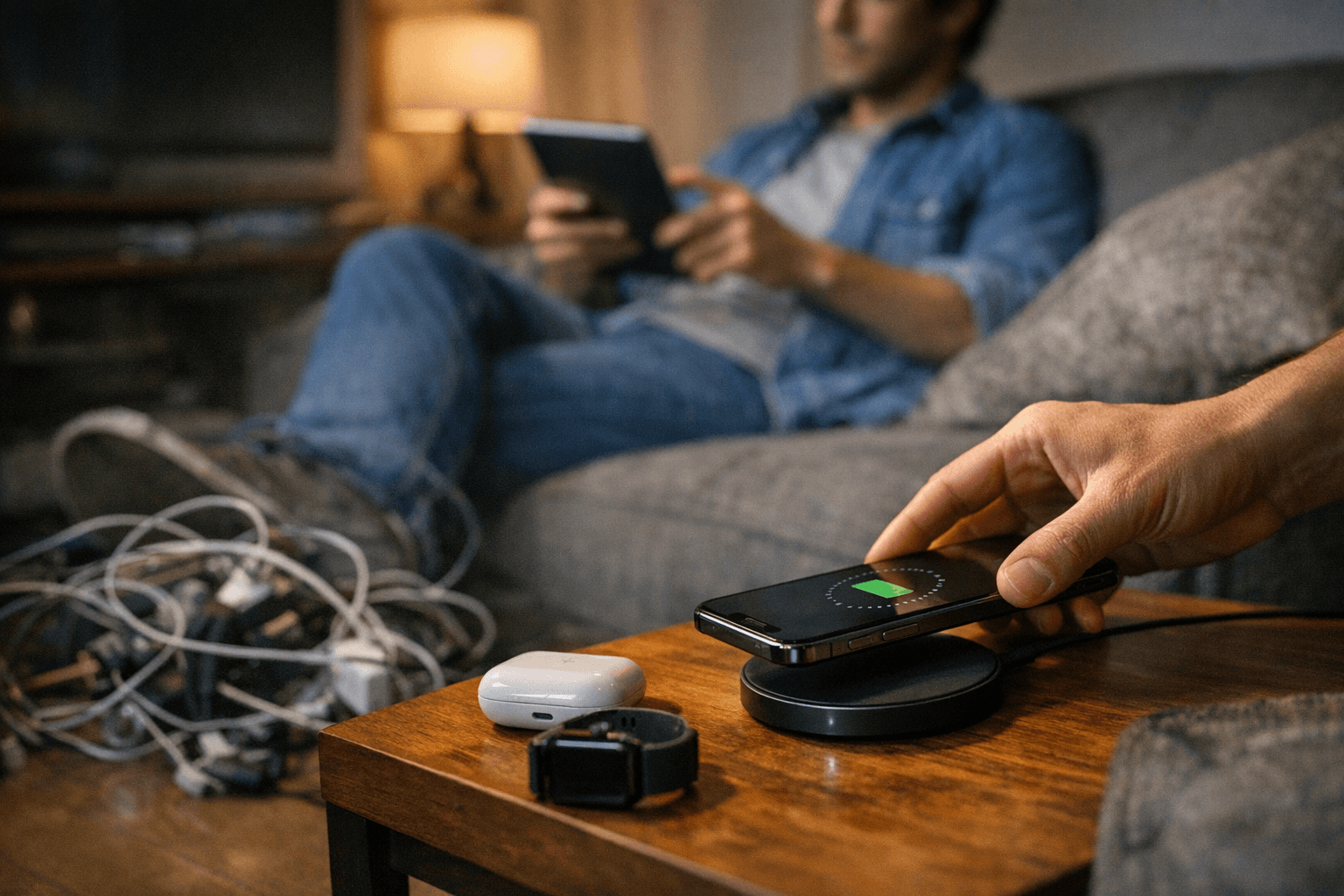
Within Anker's lineup, the MagGo focuses on proven wireless charging fundamentals, including Qi2 certified 15W charging with ActiveShield 2.0 technology and strong magnets that hold secure even with magnetic cases. It is not the bleeding edge, but for a single-device bedside or desk setup, it delivers everything most people actually need.
For those who want to charge a phone, Apple Watch, and AirPods simultaneously, Anker's 3-in-1 options scale up the concept. The Anker MagGo Wireless Charging Station is a travel-friendly 3-in-1 charger that uses Qi2 for 15W iPhone charging and standard Qi for 5W Watch and AirPods charging. Real-world testing showed the iPhone reached 50% in 45 minutes using Anker Qi2 wireless charging, twice as long as wired charging but a reasonable time by any measure.
Heat, Safety, and What to Watch For
Higher wattage and heat go hand in hand. A fan is one major improvement in advanced Qi2 implementations, as thermal management has been a common challenge in earlier wireless charging systems. A fan greatly reduces heat generated, keeping both the charging pad and phone cooler and reducing the risk of overheating that slows charging speeds.
Certification matters more than most buyers realize. 68% of uncertified chargers on Amazon fail safety tests at 25W loads according to Wireless Power Consortium data. Stick to certified brands. Looking for the official Qi2 logo on packaging is the fastest way to verify a charger meets the standard.
For those considering Qi2 25W pads for a device that does not yet support 25W: an iPhone 15 will charge on a Qi2 25W pad, but capped at 15W. Paying premium prices expecting full future-proofing for a current device is not necessary.
The Broader Landscape: Pucks Beyond the Desk
Wireless puck chargers are showing up in more contexts than nightstands. Nissan became the first automaker in the U.S. to offer Qi2 wireless charging, available in the 2026 Pathfinder and 2026 Murano. CES 2026 highlighted Qi2 25W's potential for tablets, wearables, handheld gaming devices, smart home hubs, and industrial handhelds, indicating the standard is evolving into a multi-application wireless power platform rather than a smartphone-only solution.
Travel-oriented puck designs are following suit. ESR's CryoBoost Foldable 3-in-1 Magnetic Charging Station features a compact all-in-one design that keeps cables organized, folds down to just 15.8mm, and was recognized as one of TIME's Best Inventions of 2025.
What to Look for When Buying
A few things worth checking before purchasing:
- Qi2 certification: Look for the official logo on packaging to confirm the charger has been tested by an independent lab and meets the standard
- Cable length: Anker's $15 MagGo includes 5 feet of cable; shorter cables limit placement flexibility on larger desks or headboards
- Wattage and your device: If you're on an iPhone 15 or newer, or an Android flagship from late 2024 onward, full 15W Qi2 will work; older phones will fall back to lower speeds
- Active cooling: For sustained 25W performance, prioritize chargers with visible cooling vents or active fans
- Case compatibility: Non-magnetic phone cases such as thick OtterBox Defender cases are not compatible. Cases made of metal and attachments such as magnets, cards, or keys will also interfere with charging.
The floor cable problem turns out to have a tidy $15 solution. For anyone still fishing a USB-C cord off the ground every morning, the puck has been waiting.
This article was produced by Prism’s automated news system from verified source data, official records, and press releases, then run through automated quality and moderation checks before publishing. The system is built and supervised by the people who set the standards it runs under. Read our full AI policy.
Did this article answer your question?