Workers Race to Build AI Skills as Employers Demand Proficiency
AI literacy is now a baseline, but the skills employers pay for go beyond prompting tools. Workers who can prove real productivity and judgment will stand out.
AI is becoming a baseline, not a bonus
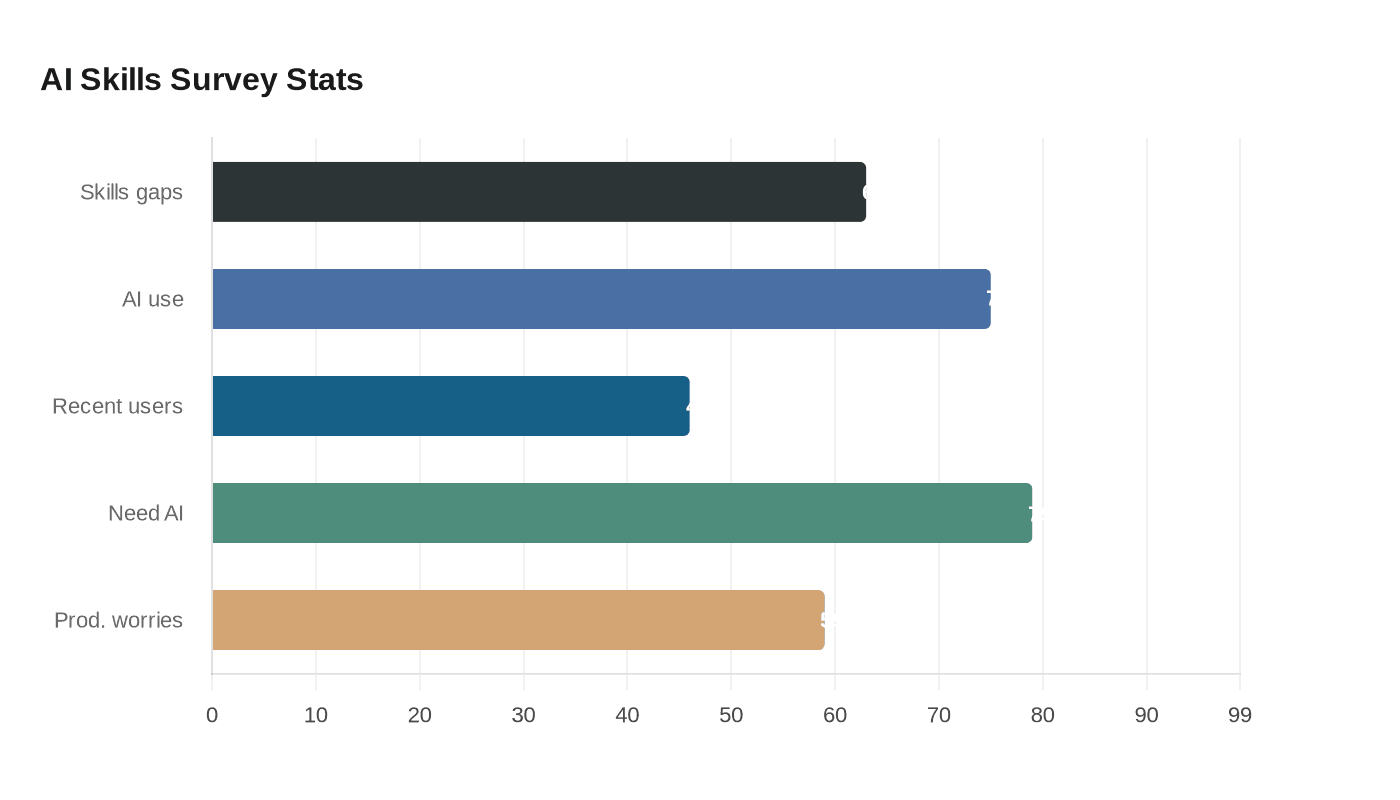
The labor market is absorbing AI fast enough that “AI skills” now mean two different things: résumé-ready familiarity and the deeper ability to use technology to produce measurable work. The gap matters because employers are not treating AI as a niche specialty anymore. In the World Economic Forum’s 2025 Future of Jobs Report, 63% of surveyed employers said skills gaps are the main barrier to business transformation, and nearly 40% of the skills required on the job are expected to change by 2030.
That same report projects 170 million new jobs and 92 million displaced jobs by 2030, a net gain of 78 million. The message for workers is clear: the economy is not simply deleting jobs, but it is aggressively rewriting them. AI, big data, and cybersecurity are rising in importance, while creative thinking, resilience, flexibility, agility, and collaboration remain essential, which means the most durable workers will combine technical fluency with human judgment.
Start with the skills that actually move the work
The fastest way to get value from AI training is to learn how to use it on tasks that already consume time. Microsoft and LinkedIn’s 2024 Work Trend Index found that 75% of global knowledge workers already use AI at work, and 46% of generative AI users said they had started less than six months earlier. That tells you the real adoption story is not about specialists alone; it is about mainstream workers layering AI into everyday office work.
The practical first layer is not advanced coding. It is learning how to apply AI to drafting, summarizing, brainstorming, organizing information, and speeding up repetitive tasks without losing quality control. The report found users said AI helps them save time, focus on important work, and become more creative, which is the right standard to aim for: faster output, better prioritization, and higher-quality thinking.
Learn the workflow, not just the tool
A résumé line that says you “use AI” is weak unless you can show where it fits into a process. Employers are looking for workers who can turn a tool into a workflow: input, review, edit, verify, and deliver. That means understanding when AI is useful, when it is unreliable, and how to keep human oversight in the loop.
A solid early learning path looks like this:
- Use AI to draft or summarize, then edit for accuracy and tone.
- Compare multiple outputs and choose the best one, rather than accepting the first response.
- Build repeatable prompts for recurring tasks, such as meeting notes, sales follow-ups, or research summaries.
- Track the time saved and the quality improved, because measurable impact is what employers notice.
The real payoff is proof, not buzzwords
Workers often overestimate how much employers care about tool familiarity and underestimate how much they care about execution. Microsoft and LinkedIn found that 79% of leaders said their company needs to adopt AI to stay competitive, but 59% also said they worry about quantifying productivity gains. That is an opening for employees: if leaders cannot easily measure the payoff, workers who can show concrete results gain an edge.
Instead of saying you know AI, show what it changed. A strong portfolio can include a before-and-after example, a short case study, or a simple project that demonstrates faster turnaround, cleaner documentation, or better analysis. The goal is to make your competence visible without needing a formal credential.
How to prove competence without a certificate
Formal training can help, but the market is already rewarding self-directed workers who can demonstrate capability. The U.S. Department of Labor’s AI Literacy Framework, released on February 13, 2026, gives a useful signal here: the government is now treating AI literacy as a workforce issue, not just an academic one. The framework lays out five foundational content areas and seven delivery principles, reflecting input from employers, training providers, and other stakeholders.
That matters because it suggests employers want a common baseline, not a narrow badge. To prove competence on your own, build evidence around tasks that matter in actual jobs:
- A cleaned-up spreadsheet or analysis workflow that uses AI to speed up routine work.
- A writing sample showing AI-assisted drafting with strong human revision.
- A process note explaining how you checked facts, avoided errors, and protected confidentiality.
- A short project log that shows the time saved and the quality preserved or improved.
The OECD reinforces why this approach matters. It says AI is increasing demand both for specialized AI professionals and for workers with general AI understanding, while warning that current training supply may not be enough to meet demand. In other words, there is room for workers who are not engineers but can still apply AI responsibly and effectively.
Ignore the hype and focus on the durable skills
A lot of “learn AI” advice sounds impressive but does little to improve employability. Memorizing tool names, chasing every new feature, or treating prompting as a magic trick will not carry much weight if you cannot solve real problems or explain your decisions. Employers are not hiring people to recite AI terminology; they are hiring people who can use AI to improve output without creating new risks.
The most overstated claims tend to fall into three buckets:
- That knowing one popular tool is enough to future-proof your career.
- That prompting alone is a skill set large enough to stand on its own.
- That AI replaces the need for judgment, communication, or collaboration.
The more reliable approach is broader and more practical. Learn enough about the tools to use them well, but spend more time on verification, process design, and communication. Those are the skills that make AI output useful inside a business.
What workers should learn first
The best sequence is simple: get comfortable with AI-assisted drafting, then learn verification, then learn how to tie the tool to a business result. That order reflects what the labor market is actually demanding. The World Economic Forum’s projections show a world of churn and opportunity at once, and the Microsoft and LinkedIn survey shows adoption is already widespread among knowledge workers, which means the competitive advantage is shifting from access to execution.
The workers most likely to benefit are not the ones who can say AI a lot. They are the ones who can produce cleaner work, faster decisions, and clearer documentation, while still bringing the human strengths that machines cannot replace. In a labor market where skills are changing quickly, that combination is what turns AI literacy into career leverage.
This article was produced by Prism’s automated news system from verified source data, official records, and press releases, then run through automated quality and moderation checks before publishing. The system is built and supervised by the people who set the standards it runs under. Read our full AI policy.
Did this article answer your question?