World logs second-hottest May on record as heat surges
May was the world’s second-warmest on record at 1.42°C above pre-industrial levels, with western Europe hit by an unusually early heatwave.

The planet has just logged another warning sign: May was the second-warmest on record globally, with average temperatures 1.42°C above the 1850-1900 pre-industrial baseline. Only May 2024 was hotter, underscoring how extreme heat keeps arriving outside the most obvious peak warming conditions and even before the full force of El Niño has played out.
Europe was in the middle of that pattern. The continent recorded its seventh-warmest May and its third-warmest spring, while western Europe endured an unusually early and intense heatwave in the final days of the month. Copernicus said the strongest anomalies were concentrated across western France, England and Wales, where daily average temperatures rose more than 10°C above normal.
The heat was not confined to land. Copernicus said May was also the second-warmest May on record for the global ocean, with mean sea-surface temperatures of 20.97°C, plus or minus 0.06°C. That was just below May 2024, which stands at 20.99°C, plus or minus 0.05°C. The hottest waters were in the tropical Pacific, where exceptionally high sea-surface temperatures signaled a climate system shifting toward El Niño.
That shift matters because El Niño typically lifts global temperatures and disturbs rainfall patterns, adding fuel to already elevated background warmth. Copernicus said climate change and the developing El Niño pattern helped push land and sea temperatures higher, while fatal floods in China and Turkey showed how the same month can swing between heat and destructive rainfall.
The reading also lands close to a key policy line. Copernicus’ temperature indicator says the Paris Agreement aims to keep warming well below 2°C above pre-industrial levels and to pursue efforts to limit it to 1.5°C. A single month near that threshold does not mean the world has crossed it permanently, but it does show how often the climate is pressing against it.
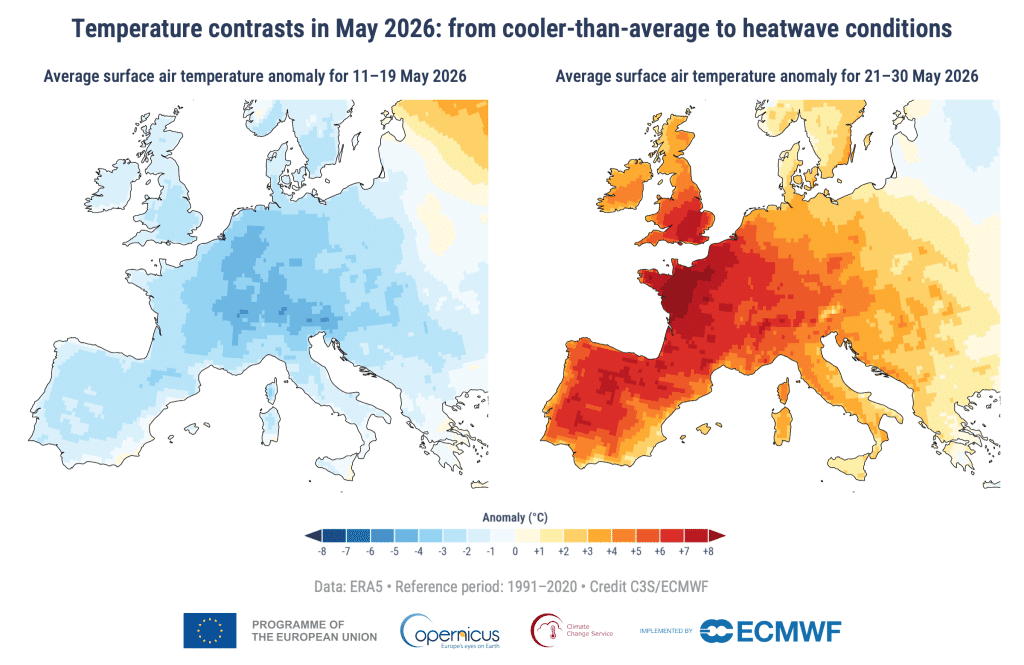
For governments and businesses, the implications are practical and immediate: more pressure on power grids, transport systems and water supplies, greater health risks during heat spikes, more strain on crops, and a higher wildfire threat as summer advances. Copernicus and the European Centre for Medium-Range Weather Forecasts have repeatedly shown that Europe, the world’s fastest-warming region, is already feeling climate change through seasonal extremes rather than just long-term averages. May’s heat fit that pattern with uncomfortable clarity.
This article was produced by Prism’s automated news system from verified source data, official records, and press releases, then run through automated quality and moderation checks before publishing. The system is built and supervised by the people who set the standards it runs under. Read our full AI policy.
Did this article answer your question?