World press freedom hits lowest point in 25 years, RSF says
Press freedom fell to a 25-year low, with more than half of countries now in RSF’s worst two categories. The slide is hitting democracies too, including the United States.
Press freedom has sunk to its lowest point in 25 years, and the warning is no longer confined to authoritarian states. Reporters Without Borders ranked 180 countries and territories across political, legal, economic, sociocultural and security conditions for journalism, then found that more than half now fall into the “difficult” or “very serious” categories for the first time in the index’s history. The average score across all countries and territories was also at its lowest ever. RSF-related coverage says the share in those bottom two categories has climbed to 52.2 percent from 13.7 percent in 2002, while the share of the world’s population living in places rated “good” for press freedom has collapsed from 20 percent to less than 1 percent.
That decline carries clear democratic consequences. When governments can weaken journalism through restrictive laws, national security claims and expensive legal harassment, voters lose reliable information about corruption, public health, war, elections and the use of public money. RSF said the legal indicator saw the steepest fall in the 2026 index, driven especially by misuse of national security laws and SLAPPs, or strategic lawsuits against public participation. Anne Bocandé said the response has to include ending criminalization of journalism, confronting abuse of national security laws and SLAPPs, and imposing meaningful sanctions. The organization’s message was blunt: the erosion is structural, and inaction allows it to continue.
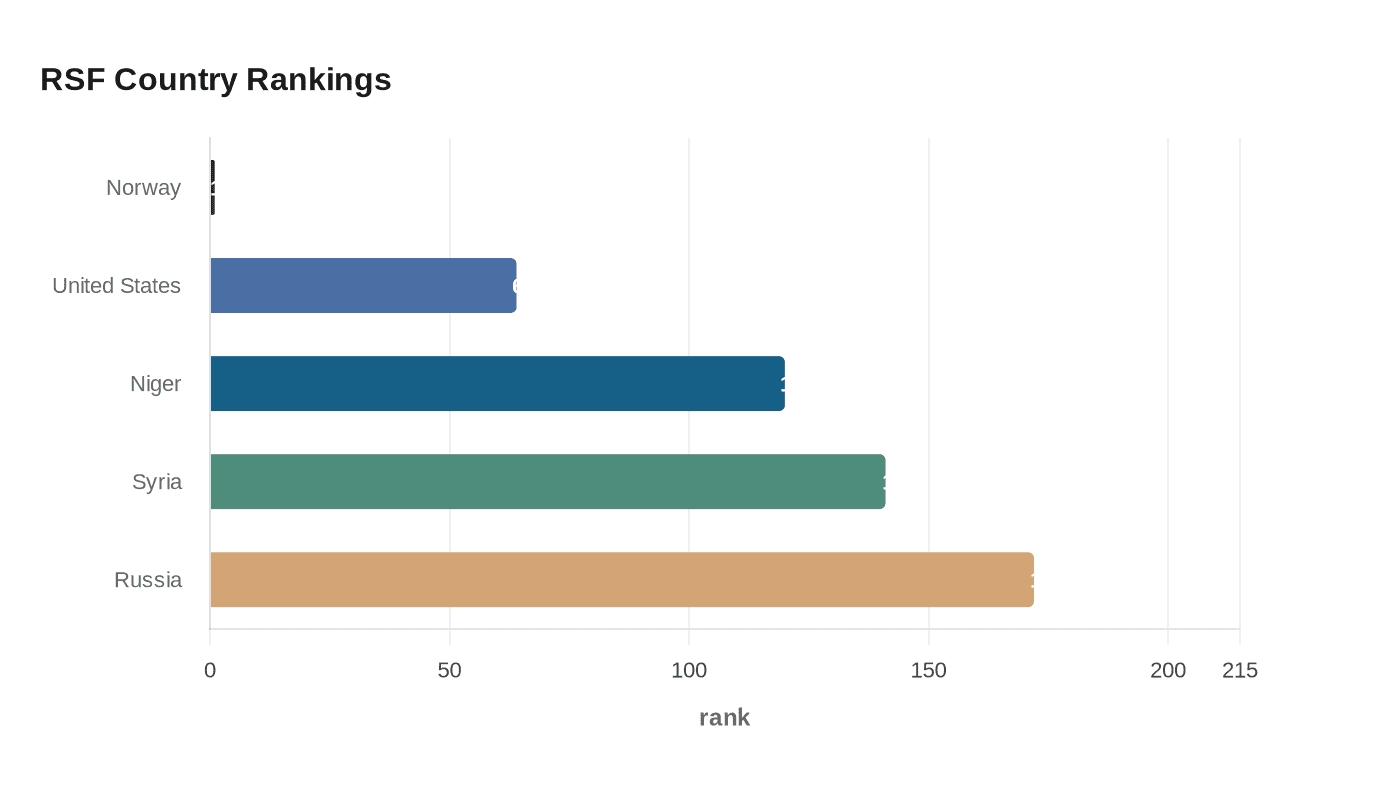
The United States was not spared. RSF said the country fell seven places to 64th, citing systematic attacks on journalists, the detention and expulsion of Salvadoran journalist Mario Guevara, and deep cuts to U.S. international broadcasting funding. RSF said Guevara was arrested while reporting on June 14, 2025 and later held for months before deportation proceedings moved ahead. The same year, funding for Voice of America, Radio Free Europe/Radio Liberty and other U.S. Agency for Global Media outlets was included in the 2026 appropriations bill signed by President Trump on February 3, a reminder that even established democracies can put pressure on public-interest news institutions.
Elsewhere, the picture was even darker. Russia ranked 172nd and had 48 journalists behind bars as of April 2026, while RSF said the Kremlin has become a specialist in using laws on terrorism, separatism and extremism to choke off reporting, including against journalists in exile. Niger recorded the steepest decline of the year, dropping 37 places to 120th as violence and repression tightened across the Sahel. Norway stayed first for the tenth straight year, and only seven Northern European countries remained in the “good” category. Syria rose 36 places to 141st after the ouster of Bashar al-Assad, but RSF still described its media environment as deeply constrained after more than 15 years of conflict.
This article was produced by Prism’s automated news system from verified source data, official records, and press releases, then run through automated quality and moderation checks before publishing. The system is built and supervised by the people who set the standards it runs under. Read our full AI policy.
Did this article answer your question?