World's oldest captive gorilla Fatou marks 69th birthday in Berlin
Fatou turned 69 at Berlin Zoo, where keepers served a sugar-free meal to the aging gorilla whose longevity exposes the demands of care in captivity.
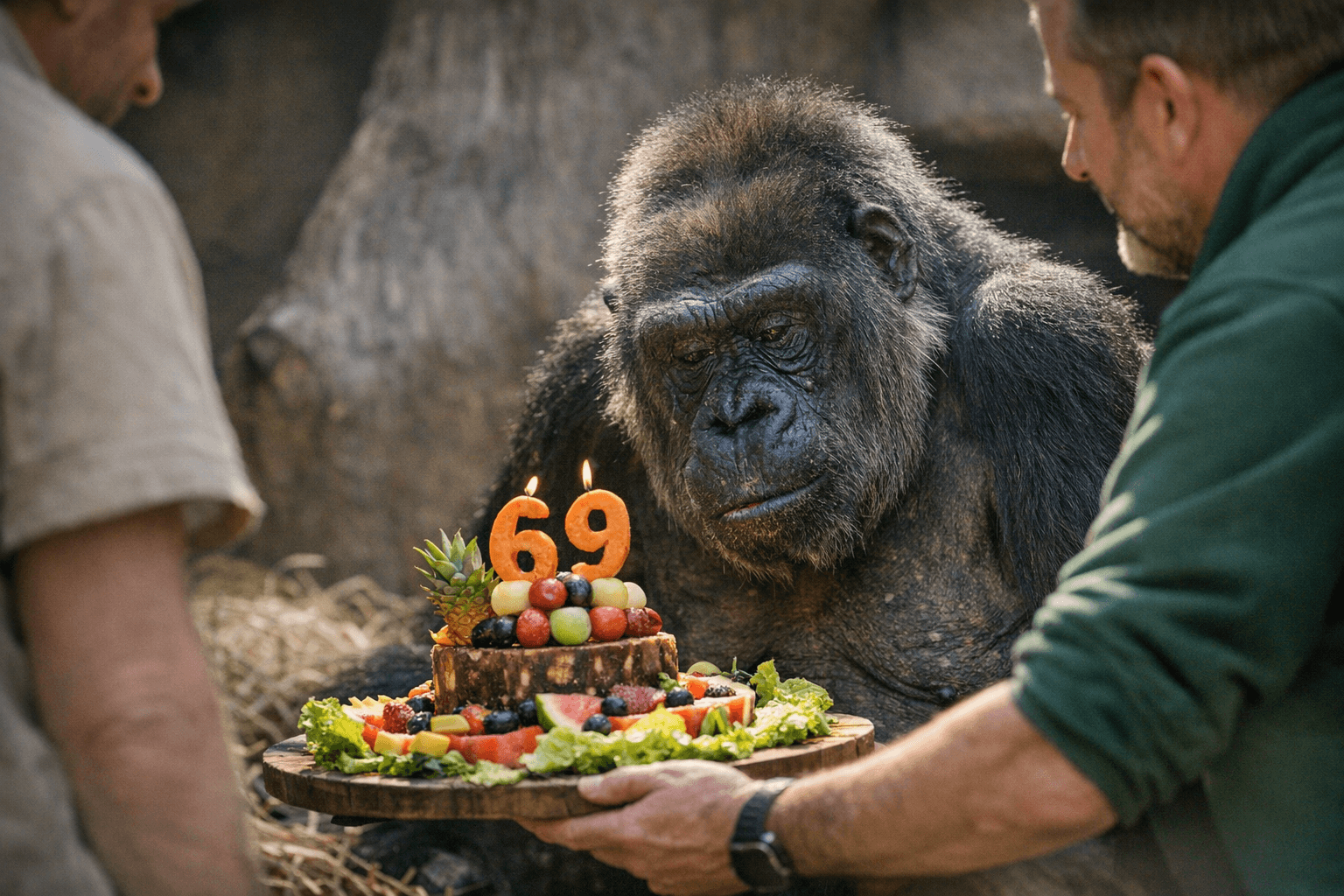
Fatou, the world’s oldest known gorilla living in captivity, spent her 69th birthday on a carefully chosen meal of cherry tomatoes, beets, leeks and lettuce at the Berlin Zoo, a reminder that extraordinary age in a zoo comes with extraordinary care. Keepers skipped birthday cake because sugar is not healthy for the aging western lowland gorilla.
Fatou is believed to have been born in West Africa in 1957, though her exact birth date is unknown, so the Berlin Zoo designated April 13 as her official birthday. She arrived in what was then West Berlin in 1959, when she was estimated to be about 2 years old, and has now lived at the zoo for more than 65 years, making her the institution’s longest-residing tenant.
Her longevity is remarkable partly because of what it has required. Fatou has lost all her teeth and suffers from arthritis and hearing loss, conditions that are common markers of aging but especially consequential for an animal that depends on specialized feeding, monitoring and daily human care. Christian Aust, the Berlin Zoo’s primate supervisor, has described her as friendly with keepers, if still a bit stubborn.
The record also puts her age in context. Guinness World Records says gorillas in captivity typically live about 40 to 50 years, which makes Fatou’s lifespan highly unusual. Before Fatou, the oldest known gorilla in human care was Colo, a western gorilla born on Dec. 22, 1956, who lived her entire life at the Columbus Zoo and Aquarium in Columbus, Ohio, and died in 2017 at 60 years and 27 days.
Fatou’s birthday has become a recurring event at the Berlin Zoo, drawing visitors and attention to an animal whose life spans generations of keepers and guests. That public fascination can easily be mistaken for a conservation success story on its own, but her case shows something more complicated: captivity can extend a gorilla’s years, yet those added years depend on sustained veterinary attention, age-specific diets and constant welfare oversight. Fatou’s 69th birthday is a milestone, but it is also a measure of how much care aging great apes require once they are confined far from the forests where they evolved.
This article was produced by Prism’s automated news system from verified source data, official records, and press releases, then run through automated quality and moderation checks before publishing. The system is built and supervised by the people who set the standards it runs under. Read our full AI policy.
Did this article answer your question?