Wuhan Self-Driving Cars Hit by Widespread System Failure, Authorities Confirm
More than 100 Baidu Apollo Go robotaxis stopped dead on Wuhan roads Tuesday night, trapping passengers on elevated ring roads as police received hundreds of calls for help.
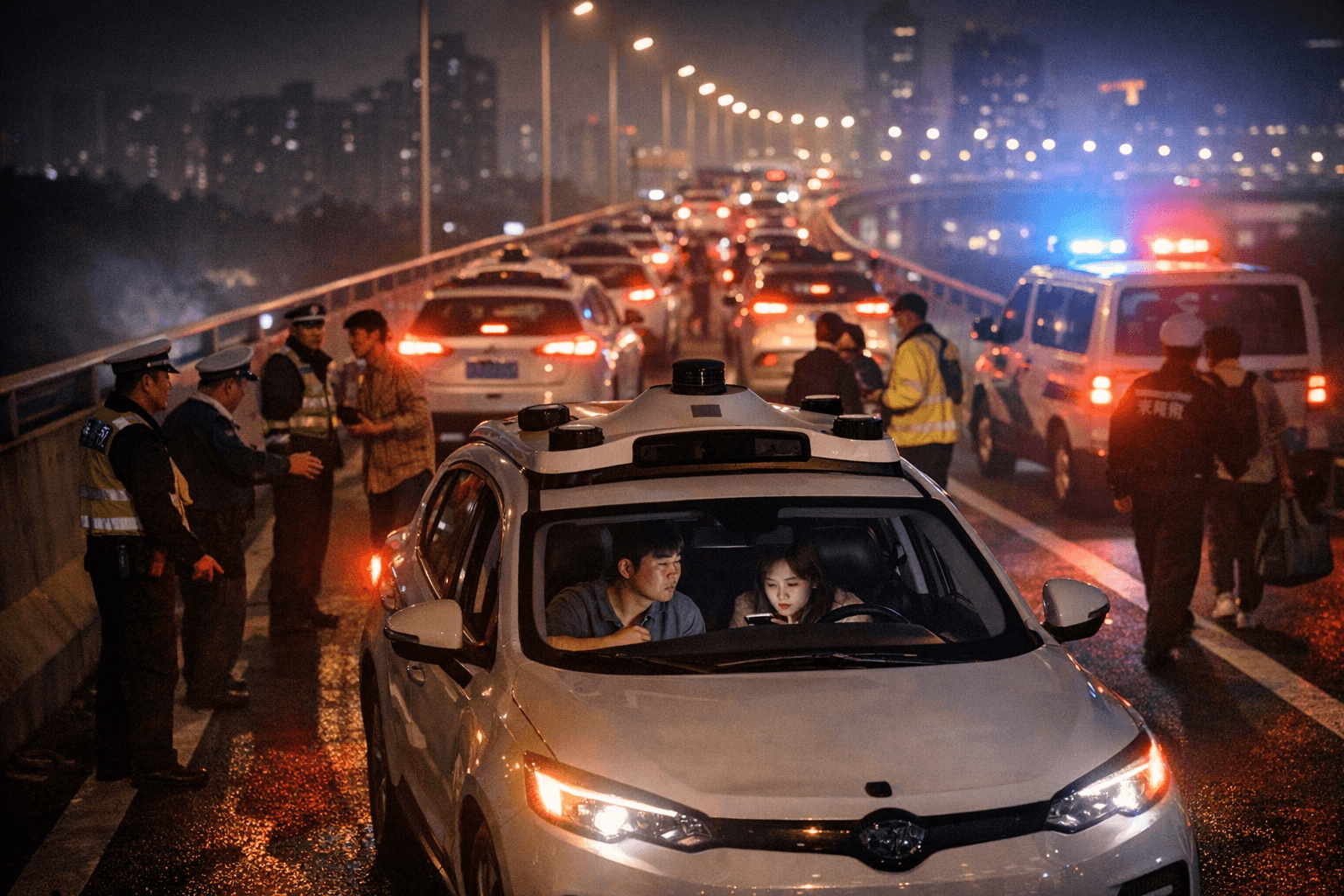
More than 100 driverless taxis ground to a halt simultaneously across Wuhan on Tuesday night, stranding passengers inside stationary vehicles on elevated ring roads and busy thoroughfares as Wuhan police confirmed the cause was a "system failure" in the fleet operated by Baidu's Apollo Go service.
Police began receiving calls at around 8:57 p.m. local time as Apollo Go robotaxis froze mid-journey across the city, leaving riders unable to proceed but, in many cases, also afraid to exit. A traffic police officer confirmed in a video published by Shanghai-based outlet The Paper that at least 100 vehicles were affected, noting that while car doors could be opened, passengers called police for help because their taxis had stopped in the middle lanes of elevated ring roads with fast-moving traffic passing on both sides. Some passengers were stranded for nearly two hours before traffic police and Apollo Go staff reached them. No injuries were reported.
The incident is the first time a mass shutdown of robotaxis has been reported in China. Apollo Go's customer service attributed the outage to "abnormal driving system" caused by network issues, but police said the cause remained under investigation as of Wednesday.
The timing could not be more consequential for Baidu. Wuhan serves as the company's flagship deployment city and hosts China's largest Apollo Go fleet, with more than 1,000 fully driverless vehicles operating across its streets. Local regulations were specifically designed to facilitate autonomous vehicle expansion, permitting driverless cars on highways and airport routes. The city of nearly 14 million people has functioned as a proving ground for the technology, making the outage particularly damaging to the broader commercial case Baidu has built around it.
Apollo Go reported more than 20 million cumulative rides globally as of February 2026, with the service deployed across 26 cities worldwide. In the fourth quarter of 2025, the platform fulfilled 3.4 million fully driverless orders, a figure more than 200 percent higher than the same period a year earlier. The company has been expanding aggressively beyond China, launching fully driverless commercial operations in Dubai just one day before the Wuhan incident.
The breakdown follows a pattern of safety setbacks for autonomous ride services. Last December, a Baidu robotaxi operated by partner company Hello was involved in an accident in Zhuzhou, prompting local authorities there to suspend robotaxi operations entirely. The Zhuzhou incident involved a single vehicle in a relatively small city; Tuesday's outage affected more than 100 vehicles simultaneously in one of China's largest urban centers. Operations in Wuhan have since resumed, but the investigation into what caused the network disruption to cascade across so large a portion of the active fleet remains open.
This article was produced by Prism’s automated news system from verified source data, official records, and press releases, then run through automated quality and moderation checks before publishing. The system is built and supervised by the people who set the standards it runs under. Read our full AI policy.
Did this article answer your question?