Xanadu Quantum Completes SPAC Deal, Lists as XNDU on Nasdaq and TSX
Christian Weedbrook's Toronto quantum startup closed a $3B+ SPAC deal and begins trading today as XNDU, the first publicly listed photonic quantum computing company.

Christian Weedbrook was initially "cautious" about SPACs. A year later, his Toronto-based photonic quantum computing company closed a merger valuing it at more than US$3 billion and began trading on two stock exchanges simultaneously.
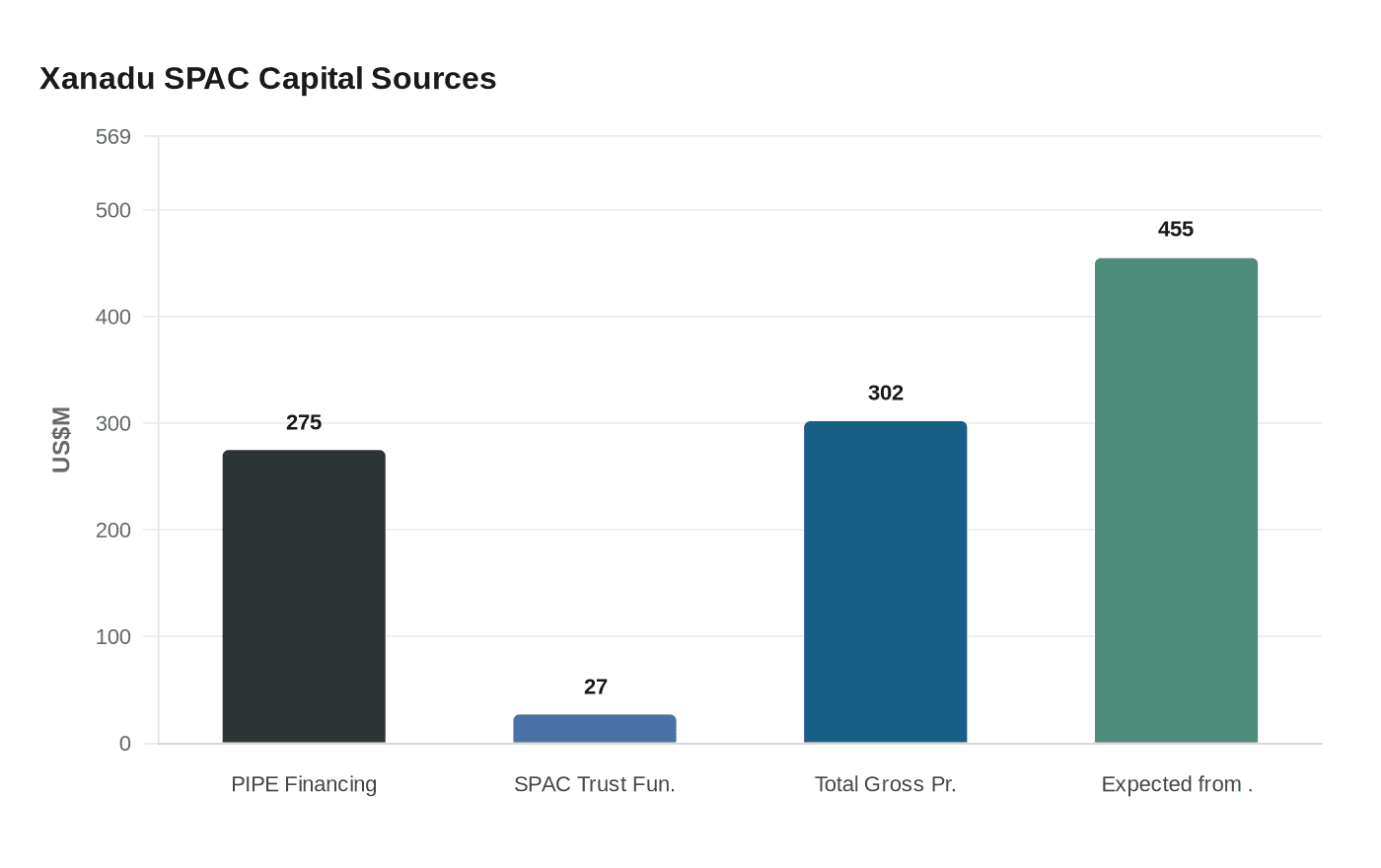
Xanadu Quantum Technologies Limited completed its business combination with Crane Harbor Acquisition Corp. and the combined entity, including a US$275 million PIPE financing, began trading on the Nasdaq and the Toronto Stock Exchange under ticker XNDU on March 27, 2026. The company is positioned to be the first publicly listed pure-play photonic quantum computing firm, with a focus on building scalable, networked systems and enabling commercial quantum applications.
The transaction delivered gross proceeds of approximately US$302 million to the company, consisting of funds held in Crane Harbor's trust account and proceeds from a fully committed PIPE financing. That figure sits alongside a broader deal structure: the SPAC merger is valued at more than US$3 billion, and the company expected to fetch US$455 million from the listing.
The path to market was not straightforward. As Crane Harbor units traded below their US$10 issue price in the lead-up to the vote, 88.1 per cent of the SPAC's holders opted to redeem their share of the US$227 million it had raised, leaving just US$27 million to cover barely half of the US$45 million deal costs. Weedbrook compensated with speed: the company received five letters of interest from SPAC sponsors, raised US$275 million in private equity in public investment within four weeks, and added Advanced Micro Devices Inc. to its list of investors, which Weedbrook said "validated" his decision. Ninety per cent of the PIPE capital came from new investors, including AMD, BMO Global Asset Management and CIBC Asset Management.
Crane Harbor's shareholders approved all necessary proposals at an extraordinary general meeting. "We're excited to help Xanadu continue pursuing its mission of widely accessible, fault tolerant quantum computing," said Crane Harbor CEO Bill Fradin. "We look forward to completing the transaction and providing Xanadu with a strong capital base and public-market platform to support its commercial roadmap and further strengthen its leadership in photonic quantum computing."
Prior to closing, Weedbrook was the sole shareholder of Xanadu, holding 100% of total voting power through a single Class A Multiple Voting Share. Post-combination, he holds 46,432,703 Class A Multiple Voting Shares, representing approximately 15.58% of total outstanding shares and roughly 17.92% of voting power. Georgian-managed funds hold an aggregate 29,514,154 Class A shares and 200,000 Class B shares, representing approximately 9.97% of total shares and 11.40% of voting power.
The strategic rationale goes beyond the balance sheet. The SPAC merger offers a fresh cash influx as Xanadu accelerates its US$1 billion quest to build a large-scale commercial quantum computing data centre in Toronto, and Weedbrook said he hopes going public will make Xanadu an attractive investment for Canada's large pension funds. "Now that we're public, that mechanism for liquidity is available to them," Weedbrook said. "You get treated more seriously as a public company."
Beyond the SPAC proceeds, Xanadu is also pursuing up to CAD$390 million in investment through Project OPTIMISM, a collaborative initiative with the governments of Canada and Ontario, though that stream remains subject to due diligence and final agreement.
Xanadu's technology wager distinguishes it from competitors who rely on cryogenic environments. The company pioneers a light-based approach to develop scalable, modular, and networked quantum computers that compute at room temperature. In 2022, its Borealis system became one of the first to demonstrate quantum advantage by performing, in milliseconds, a task that would have taken 9,000 years on a supercomputer.
The quantum SPAC wave is not without cautionary data points. Colorado-based Infleqtion debuted on Nasdaq in February with US$550 million in gross proceeds and a 15% first-day gain, but its share price has since fallen 30%. Three quantum computing companies have either listed or finalized listing plans in the first three months of 2026 alone, a pace the sector has never seen. Pasqal and IQM Finland have both announced SPAC listings valued at US$2 billion and US$1.8 billion respectively, later this year.
Canada's main stock exchange had not recorded a Canadian technology IPO since 2021. Xanadu's listing is hopefully a "sign of things to come," Weedbrook said. The company has promised to deliver the world's first quantum data centre by 2030, and with more than US$257 million in net cash now on hand, the clock on that commitment has started.
This article was produced by Prism’s automated news system from verified source data, official records, and press releases, then run through automated quality and moderation checks before publishing. The system is built and supervised by the people who set the standards it runs under. Read our full AI policy.
Did this article answer your question?

