You Don't Need a Rocket to Experience the Overview Effect
Fewer than 700 humans have seen Earth from space, but the cognitive shift astronauts describe can be triggered by VR, nature, and mindfulness right here on the ground.

When NASA astronaut Don Pettit returned from the International Space Station, he didn't immediately reach for a press release or a telescope. He asked a question that sounded almost philosophical: "Are you going to try to live your life a little differently? Are you going to really choose to be a member of this community of Earth?" Fewer than 700 humans in history have ever traveled to space. The rest of us never got the chance to be asked that question from orbit. A growing body of research suggests we should be asking it anyway.
What the Overview Effect Actually Is
The term itself was coined in 1987 by Frank White, a space philosopher and author who spent years interviewing returning astronauts and found a pattern no one had formally named. Since the first edition of his book, "The Overview Effect: Space Exploration and Human Evolution," the phrase has become the standard vocabulary for describing what happens psychologically when a human being observes Earth from outside its atmosphere. A fourth edition, featuring original interviews with 31 astronauts, was published in 2019. The core experience is deceptively simple: you look back at Earth, and something in your understanding of reality permanently reorganizes.
The shift isn't merely aesthetic. Astronaut Ron Garan, who wrote about his own experience returning from orbit, drew explicit parallels to Buddhist monks and philosophers who share a conviction that Earth is one world and its inhabitants are one people. Researchers confirm this is not metaphor. A 2016 study by psychologist David Yaden and colleagues at the University of Pennsylvania, published in the journal Psychology of Consciousness, analyzed accounts from astronauts across multiple countries and identified recurring themes with remarkable consistency: unity, vastness, connectedness, and the sense of an overwhelming, life-changing perceptual shift. Separately, research documented by Voski in 2020 found marked shifts in astronauts' environmental attitudes and behaviors following spaceflight, suggesting the effect reaches beyond emotion into lasting behavioral change.
The Science of Awe
What makes the Overview Effect so powerful, and so replicable, is its relationship to a more familiar emotion: awe. Awe is the emotional state most closely associated with the Overview Effect, and it turns out awe is not reserved for orbit. PMC research has identified five key processes through which awe operates on the human brain and body: shifts in neurophysiology, a measurable diminishment of self-focused thinking, increased prosocial behavior, greater social integration, and a heightened sense of meaning. Each of these has well-being benefits that can be triggered without ever leaving the planet.
Yaden and his colleagues noted this explicitly: awe, the engine behind the Overview Effect, can be induced by far more accessible experiences on Earth. Sunsets, mountain ranges, vast oceans, even certain pieces of music or architecture have all been documented as awe triggers. The astronaut version may be the most intense delivery mechanism, but it is not the only one.
The Skeptic's Case
It is worth acknowledging what the research cannot yet fully prove. Not every simulation of the Overview Effect produces the same depth of transformation. A study published in the journal Frontiers in Virtual Reality in 2024 found that a short seven-minute VR overview experience produced no measurable effect on pro-environmental behavior. The longer, more immersive fifteen-minute version, particularly when paired with meditative music and narrative voiceover, did show meaningful increases in participants' sense of connection to the planet. Duration, immersion, and context matter. The cognitive shift astronauts describe after weeks in low Earth orbit or, more dramatically, after viewing Earth from the Moon, is unlikely to be fully replicated in a headset on a lunch break. But partial replication, researchers argue, still carries real value.
VR as a Portal
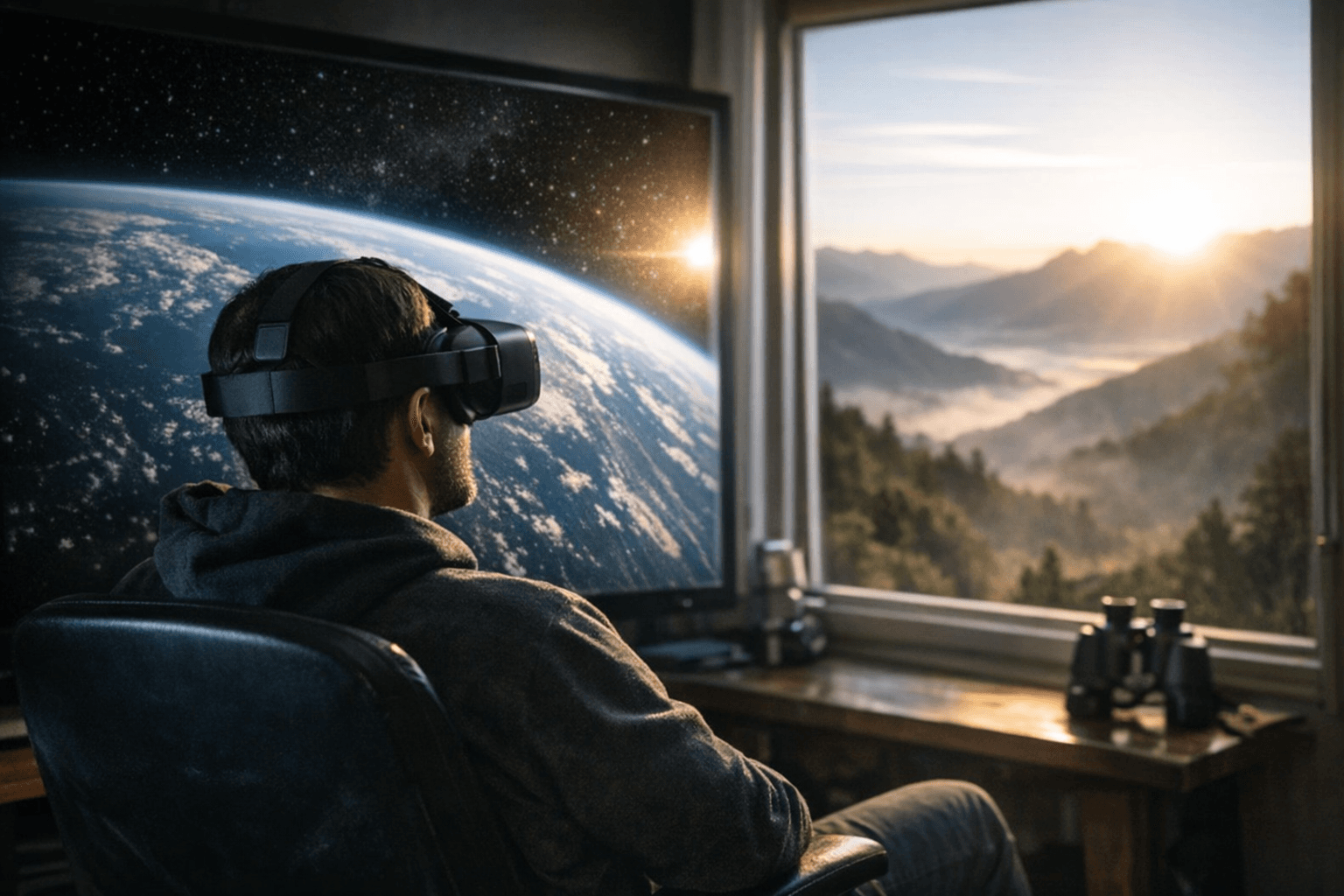
Despite those caveats, the most technologically ambitious effort to democratize the Overview Effect is happening in virtual reality. A 2024 study published in Springer Nature's journal Virtual Reality found neurophysiological evidence that VR can replicate components of the Overview Effect, producing measurable changes in well-being, appreciation for the planet, and feelings of personal responsibility for it. This wasn't self-reported sentiment but neurophysiological data, a meaningful methodological distinction.
The iSpace Lab at Simon Fraser University in British Columbia, led by researcher Bernhard Riecke, is at the center of this work, actively investigating whether immersive environments can trigger the cognitive and emotional benefits of spaceflight awareness without requiring a spacecraft. Applied programs like EarthScapeVR are already translating this research into practice, with early findings pointing to benefits across physical, mental, and emotional well-being. The premise is straightforward: if the brain cannot fully distinguish between seeing Earth from a cupola window and seeing it through a precisely calibrated immersive environment, the downstream psychological effects may be more similar than different.
Nature Immersion and Awe Walks
For those without access to VR labs, the most accessible pathway runs through the outdoors. A 2023 Harvard study found that just fifteen minutes in a natural setting produces measurable improvements in mental health. That threshold, fifteen minutes, is low enough to matter practically: it fits inside a lunch break, a school recess period, a morning commute rerouted through a park.
"Awe walks," a practice that involves slow, deliberate strolls with attention paid to textures, colors, and natural patterns, have been shown to lift mood and ease stress. The mechanism aligns precisely with what Yaden's research identifies as the core of the Overview Effect: a reorientation of attention away from the self and toward something larger. As one National Geographic-cited researcher put it, "even small moments of awe and calm accumulate and can be comparable to longer periods of sustained relaxation." You don't need a forest or a coastline; the practice works in city parks, on tree-lined streets, anywhere that invites attention outward.
Meditation, Dialogue, and the Contemplative Connection
Philosopher and ecologist Joanna Macy, featured in the documentary "Planetary," has stated plainly that going to space is not a prerequisite for experiencing the Overview Effect. The same perceptual shift, she argues, is available through sustained contemplative practice. This isn't a fringe claim. At a dialogue held at the Harvard Medical School's JBM Conference Center, NASA Commander Sunita Williams and spiritual teacher Sadhguru explored the connections between the awareness that spaceflight produces and the states accessed through deep meditation. The conversation placed two very different paths to the same destination in direct dialogue, and the parallels were significant enough that the institutions involved treated it as a serious scientific and philosophical exchange, not a novelty.
Ron Garan's observation that his post-spaceflight perspective mirrored that of Buddhist monks is part of the same pattern. The geography of the shift differs; the destination appears to be the same.
Why This Matters Beyond Personal Well-Being
Environmental psychology has documented extensively how the spaces we inhabit shape mood, behavior, and psychological health. Most people in the developed world now spend the majority of their time indoors, increasingly mediated through screens rather than direct sensory contact with the physical world. The cognitive consequence, researchers argue, is a narrowing of perspective, a contraction of the sense of self and its relationship to the larger systems it depends on.
The Overview Effect, whether accessed through spaceflight, VR, immersive nature, or contemplative practice, works against that contraction. The five processes that awe activates, from neurophysiological change to prosocial behavior to heightened meaning, are precisely the capacities that both personal well-being and collective environmental engagement require. The behavioral changes documented in returning astronauts, including shifts in environmental attitudes and values, suggest that the insight isn't just emotionally satisfying. It is functionally consequential.
Don Pettit's question from orbit turns out to be available at sea level, in a park, in a headset, in a meditation cushion, or on a slow walk where you stop to notice the grain of bark on a tree. The choice he described, to live differently, to claim membership in a community that includes the whole of Earth, does not require a launch window.
This article was produced by Prism’s automated news system from verified source data, official records, and press releases, then run through automated quality and moderation checks before publishing. The system is built and supervised by the people who set the standards it runs under. Read our full AI policy.
Did this article answer your question?