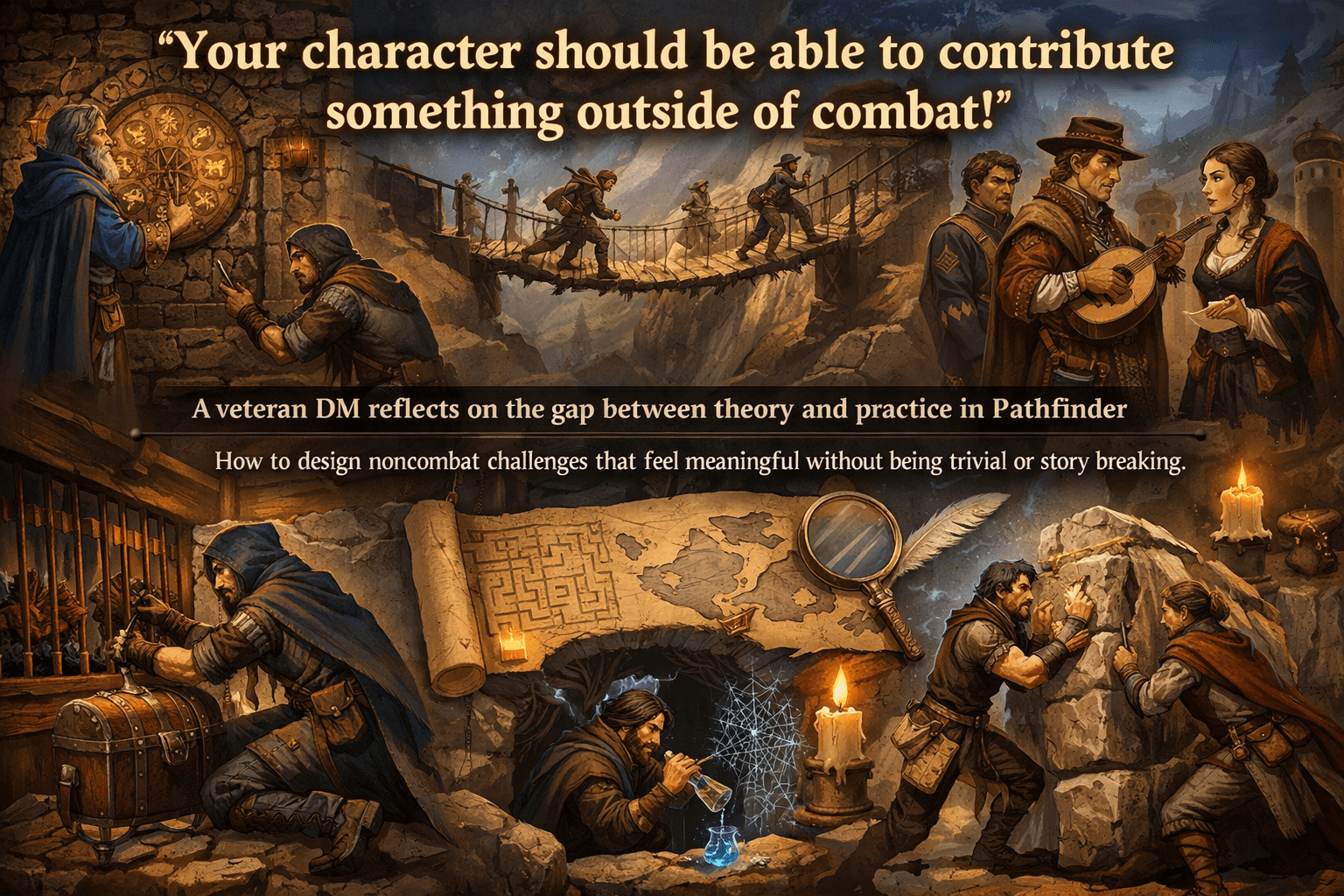
"Your character should be able to contribute something outside of combat!"
A veteran DM reflects on the gap between theory and practice in Pathfinder How to design noncombat challenges that feel meaningful without being trivial or story breaking
I'm an experienced DM that switched to Pathfinder some time ago. To get a better sense of the system, I've started watching a lot of optimization content, and I noticed how certain creators really emphasize out-of-combat utility, especially through skills or spells (like Helpful Steps).
This kinda surprised me. At our table, these abilities come up very rarely, and even when they do, they usually don't move the needle that much. Serious noncombat obstacles are rare, and are usually solved with mundane tools (esp. rope/pitons) or simple Athletics checks. I never ran traps in 5e and have barely used them in pf2e. I do call for skill checks in roleplay, but not often (usually reserved for a "hard sell").
I have a really hard time designing noncombat challenges -- they often feel either completely trivial or totally insurmountable, with little in between. Fail states are also an issue -- other than time (which is not always a concern), there's damage (just another variation on "time" due to generous resting rules in pf2e), and then it pivots all the way to "instant death" or "the story will not proceed until you solve this problem."
What does your table do? How often does your game involve serious noncombat challenges? If you run them, what's a good example of a "typical" challenge -- not something crazy, but an average sort of problem that gave you/your party a hard time?
Know something we missed? Have a correction or additional information?
Submit a Tip