Zelenskiy insists Donbas territorial question will headline Abu Dhabi talks
Zelenskiy said the status of Donbas will be a top priority at U.S.-brokered trilateral talks in Abu Dhabi, a test of diplomacy and international law with broad geopolitical stakes.
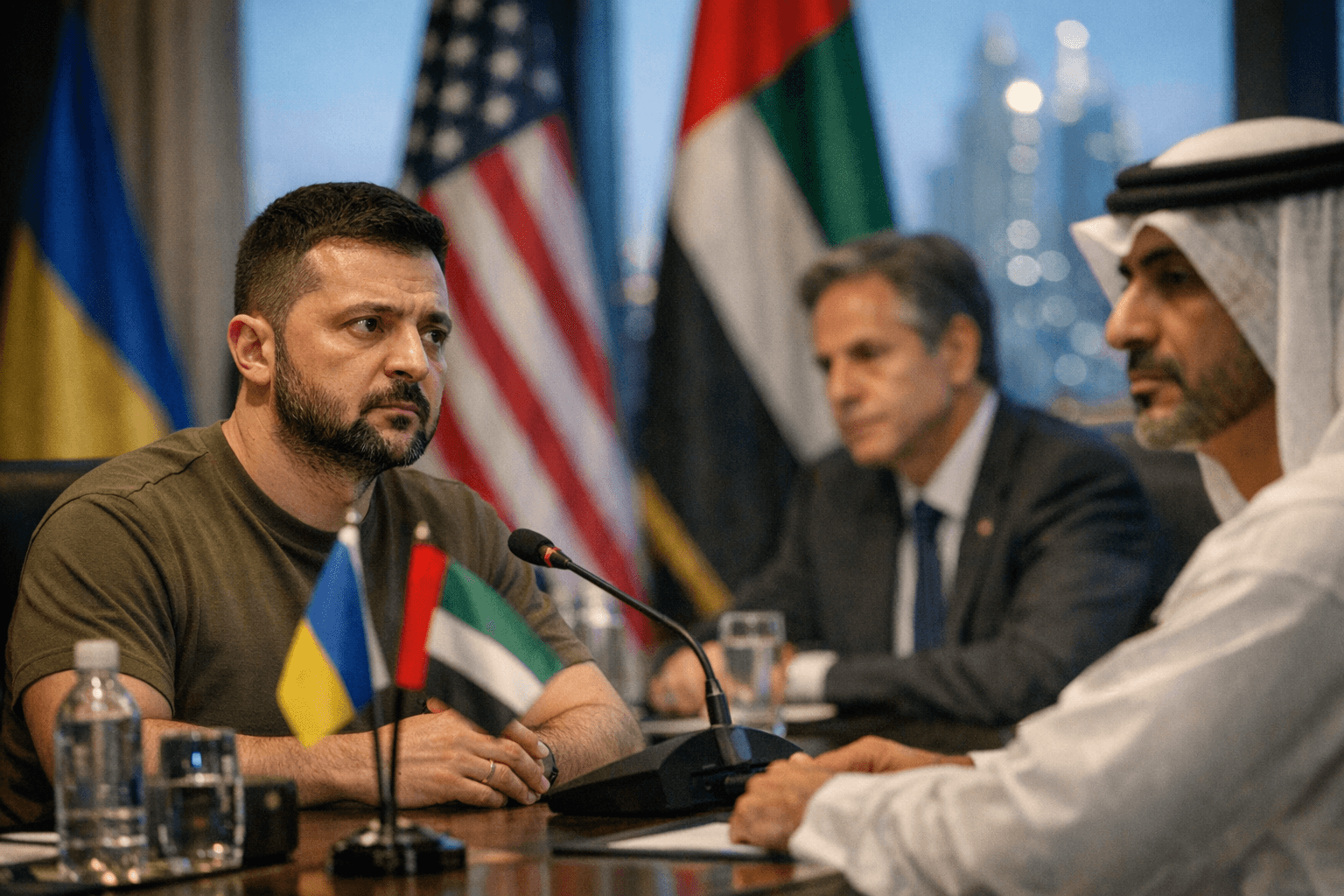
President Volodymyr Zelenskiy said the vital question of territory, notably the Donbas region, will be a top priority at U.S.-brokered trilateral talks in Abu Dhabi on Jan. 23–24, putting the most sensitive element of the conflict at the center of a high-stakes diplomatic encounter. The meeting brings together Ukraine, Russia and the United States in a rare three-way setting designed to explore pathways toward de-escalation and a lasting settlement.
The Abu Dhabi format underlines Washington’s willingness to convene direct dialogue between Kyiv and Moscow while positioning a Gulf host as a neutral venue capable of accommodating both Western partners and Moscow’s diplomatic presence. For Kyiv, raising the territorial question first signals that any negotiation must address sovereignty and the fate of lands that Ukraine regards as integral to its statehood. For Moscow, the talks will test whether it can convert battlefield gains or claims into a negotiated settlement that Western powers find acceptable.
The Donbas region has been a focal point of armed confrontation and diplomatic wrangling since 2014, and its status became more contested after Russia’s large-scale invasion in 2022. Territorial questions in that area raise legal and political obstacles that extend well beyond bilateral bargaining. Under international law the principle of territorial integrity is central to Ukraine’s case, while any concessions under military pressure would prompt scrutiny from allies worried about precedents for forced border changes.
The trilateral meeting comes amid sustained diplomatic activity across capitals seeking to limit further escalation and to protect global economic and security interests. Washington’s role as broker reflects its strategic interest in stabilizing Europe while preserving sanctions leverage and security guarantees for Ukraine. European governments and NATO have watched the initiative closely, assessing whether engagement can produce durable results without rewarding aggression.
The choice of Abu Dhabi as host highlights the Gulf’s expanding diplomatic reach. The United Arab Emirates has become a venue of choice for complex negotiations, leveraging relationships with both Western capitals and Moscow. Hosting sensitive talks signals the Gulf’s ambitions to act as mediator in conflicts with global ramifications, while also offering a controlled environment for discreet diplomacy.
Any progress in Abu Dhabi likely will be incremental and contingent on parallel confidence-building measures. Possible advances could include localized ceasefires, mechanisms for verification, prisoner exchanges, and frameworks for future talks on final status. Even if the immediate session fails to resolve core disputes, the talks may create talking points and technical channels that reduce the risk of misunderstandings and inadvertent escalation.
The human and geopolitical stakes are stark. Civilians in contested areas continue to bear the costs of conflict, and unresolved territorial questions complicate reconstruction, refugee returns and regional stability. The outcome of these talks therefore matters not only to the parties at the table but to a broader international order grappling with the question of how to uphold sovereignty norms when territorial control is contested by force.
How the parties frame compromise, verification and enforcement will determine whether Abu Dhabi becomes a stepping stone toward a negotiated peace or another diplomatic interlude that fails to change dynamics on the ground. The world will be watching whether high-level diplomacy can bridge the gap between military realities and the legal principles that underpin the postwar order.
This article was produced by Prism’s automated news system from verified source data, official records, and press releases, then run through automated quality and moderation checks before publishing. The system is built and supervised by the people who set the standards it runs under. Read our full AI policy.
Did this article answer your question?