Zelenskyy Replaces SBU Head, Names Freeland Adviser Ahead Of Paris Talks
President Volodymyr Zelenskyy announced a sweeping reshuffle on Jan. 5, replacing the head of Ukraine’s Security Service and installing new senior aides as he prepares for high‑level talks in Paris on international security guarantees. The moves aim to sharpen Ukraine’s negotiating position and align security and economic strategy, with potential implications for Western aid, investor confidence and the country’s fiscal outlook.
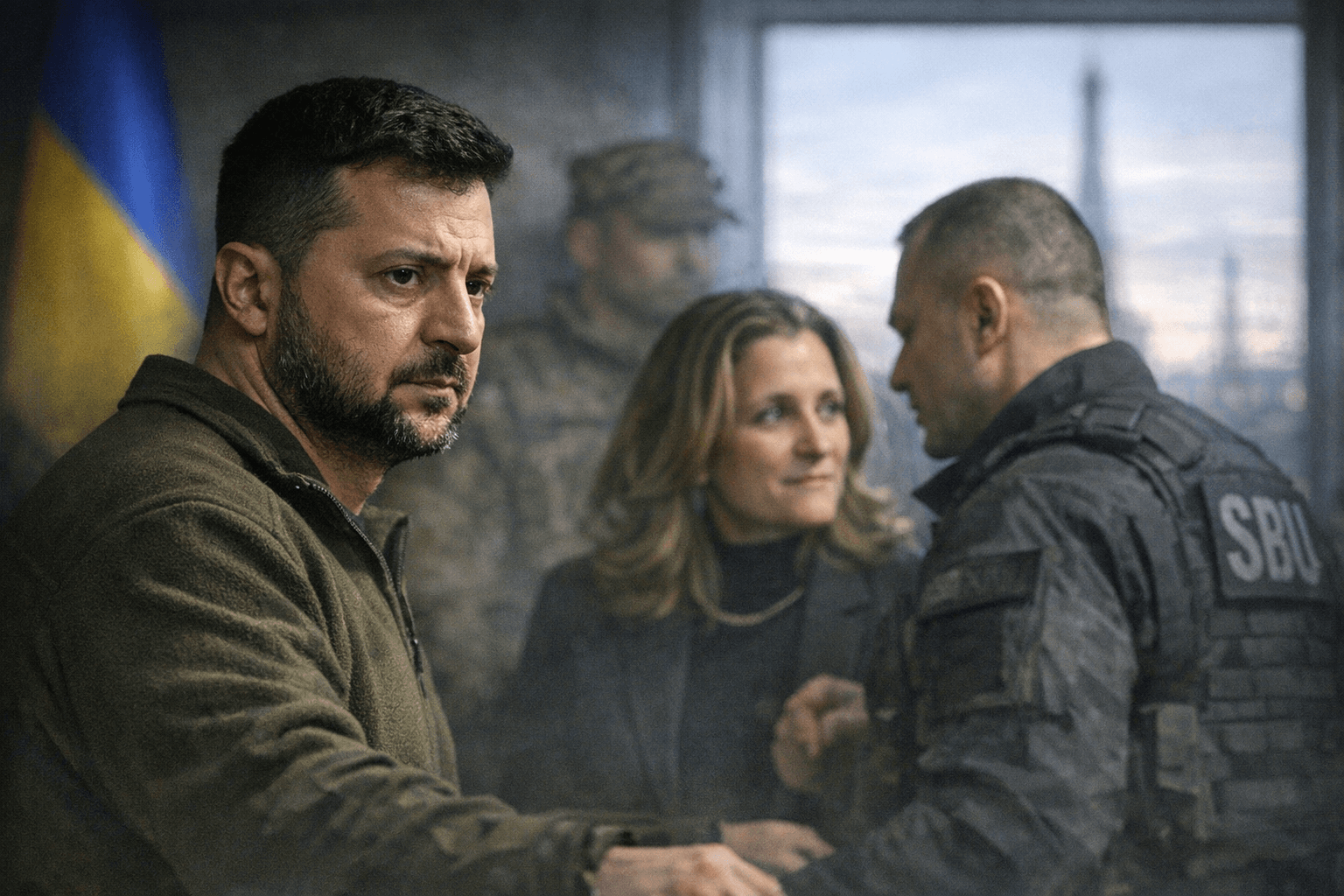
President Volodymyr Zelenskyy on Jan. 5 formalized a top‑level reshuffle that replaced the Security Service chief and installed new senior advisers as Kyiv races to Paris for talks with a roughly 30‑nation "coalition of the willing" on mechanisms to prevent a repeat of Russia’s 2022 invasion. The presidential decree published on the official website named Ievhen Khmara as acting head of the SBU after Lt. Gen. Vasyl Maliuk announced his resignation on the agency’s site.
The personnel changes extend beyond the security service. In the days before the Jan. 5 decree, Zelenskyy appointed Lt. Gen. Kyrylo Budanov, head of Ukraine’s military intelligence, as his new chief of staff. The president also named former Canadian deputy prime minister Chrystia Freeland as his economic development adviser; Zelenskyy described Freeland as an expert with "significant experience in attracting investment and carrying out economic transformations." Freeland has been a noted critic of Russian President Vladimir Putin.
The timing is unmistakable: officials and accounts indicate the reshuffle is calibrated to present a unified Ukrainian leadership in Paris, where leaders will seek to finalize guarantees intended to deter any future aggression if a peace accord is signed. Zelenskyy’s office has framed the moves as part of the largest top‑level overhaul in about six months, intended to concentrate the administration on security, the development of defense forces and the advancement of peace negotiations, responsibilities centered in the president’s office.
Maliuk’s tenure at the SBU was marked by a string of high‑profile operations that Kyiv credits with striking Russian military capabilities. Among them, Operation Spiderweb was cited as damaging or destroying 41 Russian military aircraft in coordinated strikes on four air bases, a result Ukrainian accounts characterized as one of the agency’s most notable successes during Maliuk’s leadership. The transition to Khmara, formerly head of the SBU’s "A" Special Operations Center, signals continuity in operational experience even as the agency’s leadership changes.
The appointments carry both diplomatic and economic implications. Bringing Budanov into the presidential inner circle consolidates military intelligence influence over strategic decision making at a moment when negotiating leverage and credible deterrence are inseparable. Naming Freeland provides a direct bridge between Kyiv and Western economic policy networks and could be intended to bolster investor confidence ahead of discussions aimed at unlocking security‑linked financing and postwar reconstruction flows.
For markets and public finances, the stakes are tangible. A credible set of international guarantees and follow‑on commitments from the coalition could narrow Ukraine’s war‑risk premium, ease pressure on sovereign financing and mobilize private capital for reconstruction. Conversely, if talks yield only limited assurances, Kyiv may face renewed calls to prioritize defense spending, complicating fiscal consolidation and delaying large‑scale investment.
Zelenskyy leaves for Paris with retooled staff and a clearer division of labor between security and economic strategy. The immediate test will be whether the reshuffle strengthens Ukraine’s hand in talks and accelerates the international commitments Kyiv seeks, or whether it marks a shift toward a more securitized posture that reshapes budget priorities during the conflict’s fourth year.
This article was produced by Prism’s automated news system from verified source data, official records, and press releases, then run through automated quality and moderation checks before publishing. The system is built and supervised by the people who set the standards it runs under. Read our full AI policy.
Did this article answer your question?