Abbotsford Canucks Close Season With Development Gains Despite Losing Record
Abbotsford finished 24-37-4-3, but Ty Mueller's 35-point surge and Danila Klimovich's second-half breakout show a farm system building depth the standings can't capture.
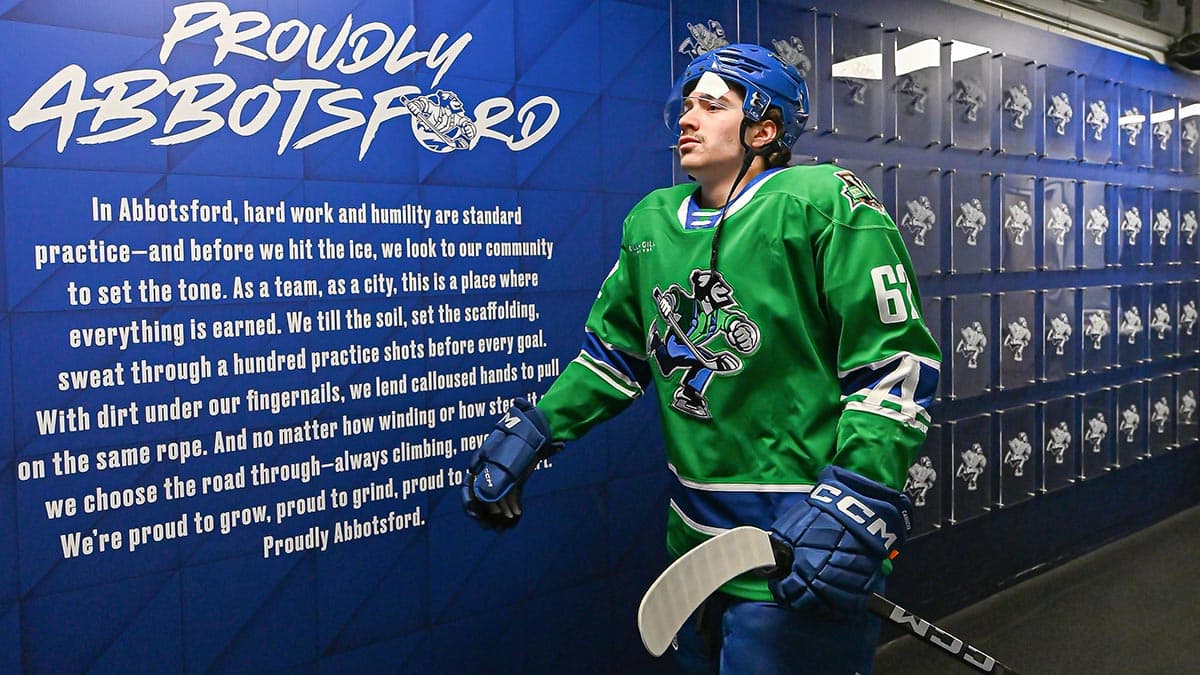
Defending the Calder Cup is hard. Defending it with a roster gutted by injuries, NHL call-ups, and a deliberate pivot toward youth is nearly impossible, and Abbotsford didn't come close to trying. The 2025-26 Canucks finished their home schedule at 24-37-4-3, ranked 30th in the AHL, and will close the road trip without a playoff berth in sight. The team that hoisted the Calder Cup less than a year ago is now in full developmental mode, and the more useful question isn't why the results collapsed, but what the organization actually built along the way.
Measured against a development scorecard rather than a standings column, the picture looks considerably better.
Prospect Minutes and Role Expansion
The most telling growth metric this season was role size. Abbotsford deliberately dressed a younger forward corps, giving prospects the kind of deployment that pushes development faster than any amount of controlled practice time. Danila Klimovich is the clearest case study. The Belarusian winger opened the season by going goalless in his first 17 games, but responded with 15 goals on the year, sitting tied for second on the team in that category. By late in the season, Klimovich had recorded eight points over a six-game stretch, climbing to fourth on the team with 27 points after that slow start. That kind of second-half surge, built on expanded power-play usage and high-leverage zone time, is exactly the trajectory a development staff wants to see.
College free agent Bennett Schimek, signed to a one-year deal through 2026-27, made his professional debut this season and recorded his first career AHL goal on March 30 against San Diego. Schimek finished with four career AHL assists, all primary, all delivered via quick, decisive one-touch feeds in the slot. His role grew steadily as the season progressed, and the coaching staff trusted him in meaningful situations well before the calendar flipped to April.
NHL Call-Up Readiness
The most concrete development metric for any AHL affiliate is how many players the parent club trusts enough to recall when the NHL roster needs depth. By that measure, Abbotsford produced two significant validations in the final weeks of the season.
Ty Mueller, a fourth-round pick in 2023 out of the University of Nebraska-Omaha, was recalled by Vancouver on April 2. He had developed into the team's second-leading scorer with 35 points in 59 games, building on his 39-point rookie season that was a key part of Abbotsford's 2025 Calder Cup championship run. The recall, timed ahead of Vancouver's game against Colorado, reflects exactly the kind of trajectory a late-round pick is supposed to follow: a productive AHL rookie season, a Calder Cup, and then a genuine NHL conversation in year two.
Goaltender Jiri Patera was called up to Vancouver on April 5, carrying a 2.72 GAA and a .907 save percentage into the promotion, with one prior NHL start already on his resume from November against the Florida Panthers. Patera's numbers weren't flashy, but they were professional-grade, and the fact that Vancouver turned to him twice in the same season signals genuine confidence in his development arc.
Special Teams as a System Lab
The power play and penalty kill have functioned this year as much as teaching mechanisms as tactical units. Mueller's team-leading 15th goal of the season, scored against Ontario Reign, came on the power play, with Klimovich drawing the puck down low and Schimek delivering the one-touch feed into the slot. The sequence illustrated exactly what Abbotsford's staff has been reinforcing all year: structured zone entries, deliberate puck movement, and finishing from specific positions rather than improvised chaos.

Jack Thompson, acquired at the NHL trade deadline in exchange for longtime Canucks defenseman Jett Woo, who was sent to San Jose, made an immediate impact on the back end. In just seven games after joining the club, Thompson matched Woo's production from 27 games, recording eight points. That efficiency speaks to system fluency: a player stepping into a structured scheme and executing it immediately, which suggests the system itself is teachable and functional even when the roster turns over.
Managing Roster Churn
The injuries and call-ups that defined much of Abbotsford's mid-season stretch were disruptive in the standings and instructive as developmental stress tests. Arshdeep Bains, Jujhar Khaira, and Mueller were all out of the lineup at the same time during the March home stand, forcing Abbotsford to dress only three full forward lines. Younger players who might have expected fourth-line minutes suddenly found themselves skating in top-six roles. The club closed out its home schedule with a two-game set against the Coachella Valley Firebirds, finishing the run with a 3-2 overtime loss in the rematch.
The remaining road schedule, with games at Calgary followed by matchups against Ontario Reign and Coachella Valley, gives the coaching staff final evaluation windows before the offseason begins in earnest.
The Offseason Roadmap
The development gains are real, but the gap between what the process produced and what it needs to produce for Abbotsford to be a competitive AHL team next season is equally clear. Three things need to change for results to catch up.
First, veteran balance. Abbotsford iced a noticeably younger forward corps this season, which accelerated development but cost the team in close games. Adding one or two experienced AHL forwards who can mentor without blocking minutes would allow the club to pursue wins without sacrificing the developmental infrastructure.
Second, goaltending stability. Patera's call-up to Vancouver, while a validation of his progress, leaves Abbotsford navigating its final games with a patchwork crease. Patera posted a 9-12-4 record with a .904 save percentage on the season, numbers that reflect a capable but not dominant anchor. Building a clearer one-two goaltending structure in Abbotsford, with the parent club's blessing, is a prerequisite for sustained competitiveness.
Third, finishing talent. The system works. Mueller's 35 points proved it. Klimovich's second-half production proved it. But the team ranked 30th in the AHL because it couldn't consistently turn structured opportunities into goals early in games. Acquiring a true scoring threat at the AHL level, either through the draft or a targeted signing, would transform what's already a functional development system into one that also wins.
The 2025-26 Abbotsford Canucks will not be remembered for their record. They will be remembered, inside the organization at least, as the year the next wave of Vancouver prospects stopped being prospects and started becoming players. Mueller's recall, Klimovich's evolution, Schimek's debut: each one is a data point in a development model that's working. The offseason challenge is to build enough around that core that the scoreboard finally reflects it.
This article was produced by Prism’s automated news system from verified source data, official records, and press releases, then run through automated quality and moderation checks before publishing. The system is built and supervised by the people who set the standards it runs under. Read our full AI policy.
Did this article answer your question?