Arm wrestling rules spotlight the referee start and strap system
The referee’s start sequence, referee’s grip, and strap rules can decide an arm-wrestling match before the pull begins.
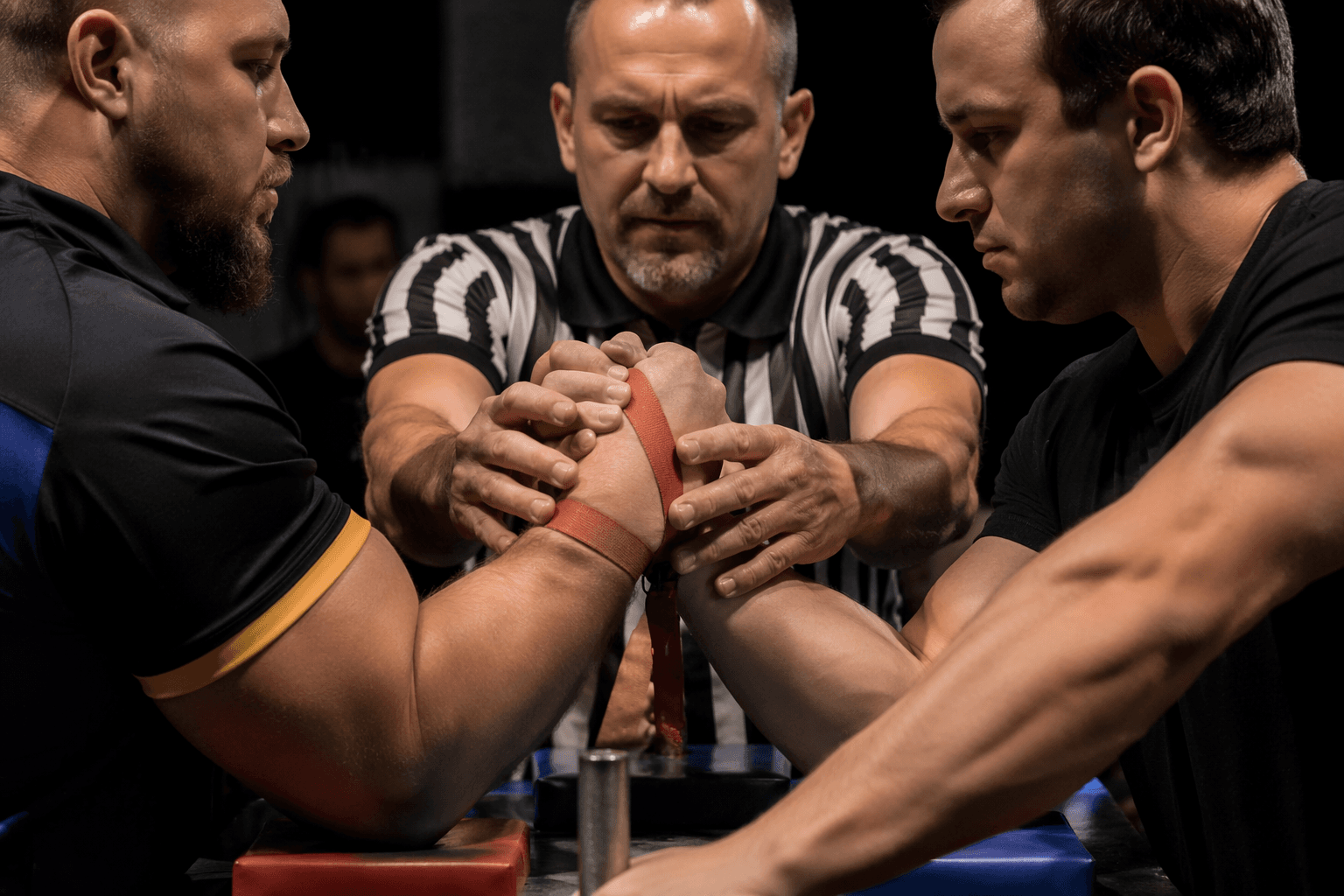
Arm wrestling often looks like a simple test of power, but the real match can start in the hands of the referee. In the modern rulebook, the most delicate work happens before either athlete is allowed to drive, because tiny shifts in grip, elbow placement, and timing can change the outcome before the pull even opens up. That is why the start procedure, the strap system, and video-assisted officiating sit at the center of sanctioned competition.
The start is the first contest
The World Armwrestling Federation’s rulebook treats the setup as a controlled technical phase, not a formality. The referee removes one hand from the grip, gives a thumbs-up signal for about one to two seconds, then removes the other hand at the exact moment the thumbs-up disappears. That sequence replaced the older verbal start cue and makes the legal match begin only after the referee releases the hands.
This matters because the pre-start phase is where leverage is won and lost. An athlete who gets dragged out of position early can be forced into defense before the pull is legally underway, while a clean setup can preserve the lane for a fair hit. The modern rules make that opening sequence part of the sport’s architecture, which is why experienced competitors watch the referee as closely as they watch their opponent.
Referees do more than say go
Arm wrestling officiating is unusually hands-on. The International Federation of Armwrestling uses two officials during a match: a head referee and an assistant or technical referee. The assistant watches for elbow fouls at the start and then monitors for fouls or a pin once the pull begins, while the technical referee can use camera monitors and playback screens to review elbow fouls when cameras are installed at the table.
That replay element changes the feel of the sport. What fans think they saw in real time is not always the final call, especially in a tight elbow drag or a sudden slip near the pad. With video in play, officiating becomes part of the competitive story itself, because the table action can be overturned by what the camera catches after the fact.
The assistant referee can also help set up the strap or the referee grip, but the rules say the official should not block the table area. The same rule set stresses impartiality: officials are expected not to coach or cheer while they are working. That keeps the table stripped down to its essentials, with the referee acting as both traffic cop and safeguard.
Why the strap is part of the sport, not a backup plan
When hands separate cleanly and no foul is issued, the strap is not a gimmick. Under World Armwrestling Federation rules, it is the formal tool used to keep the match alive after a slip-out. In the International Federation of Armwrestling rules, the strap is described as a narrow band, about one inch wide and roughly forty inches long, with a plastic buckle that binds the competitors back together after the slip.
That detail has business and competitive consequences. The strap protects the integrity of the contest by preventing a clean slip from ending a high-stakes match too early, which is especially important in elite brackets where a single technical decision can decide medals, national team points, or title runs. It also rewards athletes who can adapt their style, because a strap match often changes the shape of the battle and punishes one-dimensional pulling.
The same standardization extends beyond the strap itself. WAF says official tables, platforms, and straps can be certified by WAF and continental referee panels, which shows how far the sport has moved toward uniform equipment and consistent enforcement. That kind of certification matters in a global sport because it makes one table in one country look and function like another, reducing the kind of local variation that can distort results.
A rulebook shaped over decades
The current WAF rulebook says the rules originated in September 1994 and were revised repeatedly through April 2020. That long revision history tells a clear story: today’s officiating system was not improvised at the table, it was built over years of refinement. The thumbs-up start procedure is not a novelty either, because the same language appears in earlier editions, showing that the controlled start has been embedded in the WAF system for years.
That gradual formalization has helped arm wrestling present itself as more than a spectacle. The sport still depends on explosive strength, but its legitimacy increasingly comes from the precision of its rule enforcement. The more carefully the start, grip, and strap are standardized, the more the result reflects athletic skill rather than chaos at the table.
IFA’s governance gives the rules a home
The International Federation of Armwrestling presents itself as a democratic non-profit sport organization registered in Zurich, Switzerland, with founding countries Finland, Poland, and Ukraine. Its first General Assembly took place on December 4, 2019, in Rumia, Poland, with 18 national representatives in attendance. Those details show a young but organized federation structure that is still defining the modern international shape of the sport.
Its July 2026 board listing includes Anders Axklo, Anna Mazurenko, Anssi Ainali, Marian Čapla, Denise Wattles, Grzegorz Nowotarski, and Marcin Mielniczuk. That mix of leadership names reflects a transnational governing model rather than a one-country operation, and that matters for a sport whose most contentious moments are often decided by nuanced procedure. The more unified the federation structure becomes, the easier it is to standardize start calls, strap use, and replay review across borders.
What fans should notice at the table
The fastest way to understand a sanctioned arm-wrestling match is to watch the setup as closely as the finish. The referee’s grip, the thumbs-up start, the elbow watch, and the strap decision all shape the lane before brute force has a chance to matter. In elite arm wrestling, the decisive action often begins before the pull does, and the modern rulebook is built around making that opening phase as exact as the finish.
This article was produced by Prism’s automated news system from verified source data, official records, and press releases, then run through automated quality and moderation checks before publishing. The system is built and supervised by the people who set the standards it runs under. Read our full AI policy.
Did this article answer your question?