Headrick's 1967 Frisbee patent helped launch disc golf
Headrick's ridged 1967 patent gave disc golf the stable, repeatable flight that made courses, shot shapes, and competition possible.
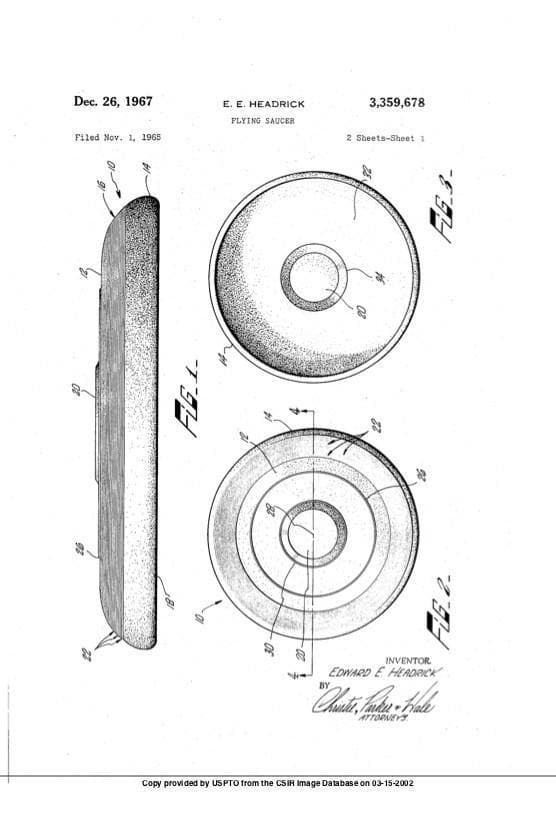
A band of raised ridges on Edward E. Headrick’s 1967 patent gave flying discs the predictable flight that disc golf needed, turning a novelty into equipment that could be standardized, repeated, and built into a sport.
The patent that made controlled flight possible
Headrick’s U.S. patent, No. 3,359,678, was filed on Nov. 1, 1965 and issued on Dec. 26, 1967. The design focused on stabilizing the disc in flight, and the key idea was simple but transformative: the disc needed structure that helped it hold its line instead of wobbling unpredictably.
The patent’s raised rings and rim details made the disc more consistent from throw to throw. Once a disc could be manufactured and flown with repeatable behavior, players could start building games around angles, spin, power, and release rather than fighting a random flight path.
Before disc golf had rules, it had thrown objects
Disc golf did not appear fully formed when Headrick patented his design. WFDF identifies a May 13, 1957 Sports Illustrated article as the first known published reference to Frisbee as a sport, and the article includes a Princeton University faculty member dismissing the pastime as “just another form of spring fever.” People were already throwing discs for fun, but the activity had not yet become an organized sport.
Even earlier, a 1926 disc-golf-like game in Bladworth, Saskatchewan, Canada, used tin lids. The target-throwing idea came before modern plastic and before the standardized flying disc. What Headrick’s patent changed was not the urge to throw at a target, but the reliability of the object in flight.
Once a standardized flying disc existed, the rest of the sport could harden around it. Informal tossing could become course design, and course design could become organized play.
Steady Ed’s role went beyond equipment
The Disc Golf Association credits Headrick with founding disc golf and coining the term “Disc Golf.” He was not just refining a piece of plastic, he was naming the sport and helping define its identity.
By the 1982 PDGA Disc Golf World Championships, the game had moved well past casual flying-disc play and into a formal competitive structure with events, fields, and titles. Professional Disc Golf Association records identify Steady Ed Headrick as player No. 1.
Headrick’s design helped create a product that could be mass-produced, sold consistently, and trusted by players.
Why the patent still shows up in modern disc golf
Today’s disc golf vocabulary still reflects the same design problem Headrick tried to solve. Players talk constantly about mold consistency, rim shape, and flight differences because the game depends on knowing exactly how a disc will behave when it leaves the hand.
Headrick’s patent connects directly to present-day shot shapes. A disc that tracks predictably lets players work hyzers, turnovers, straight drives, and touch approaches with intention instead of guesswork. Competitive disc golf grew around that precision, and course design followed suit, asking players to hit specific lines rather than simply hurling an object and hoping it settles.
Headrick’s influence also reaches beyond disc golf into the wider Frisbee culture that produced freestyle, catch games, and other disc sports. Those branches all grew from the same basic leap in design and manufacturing: a flying disc that could be made the same way and thrown the same way, again and again.
This article was produced by Prism’s automated news system from verified source data, official records, and press releases, then run through automated quality and moderation checks before publishing. The system is built and supervised by the people who set the standards it runs under. Read our full AI policy.
Did this article answer your question?