20 Drone Spec Terms Decoded to Help Racers Cut Through Vendor Confusion
Buying goggles that won't talk to your digital VTX is a 2026 mistake you can't afford; these 20 terms tell you exactly what to ask vendors before you spend.
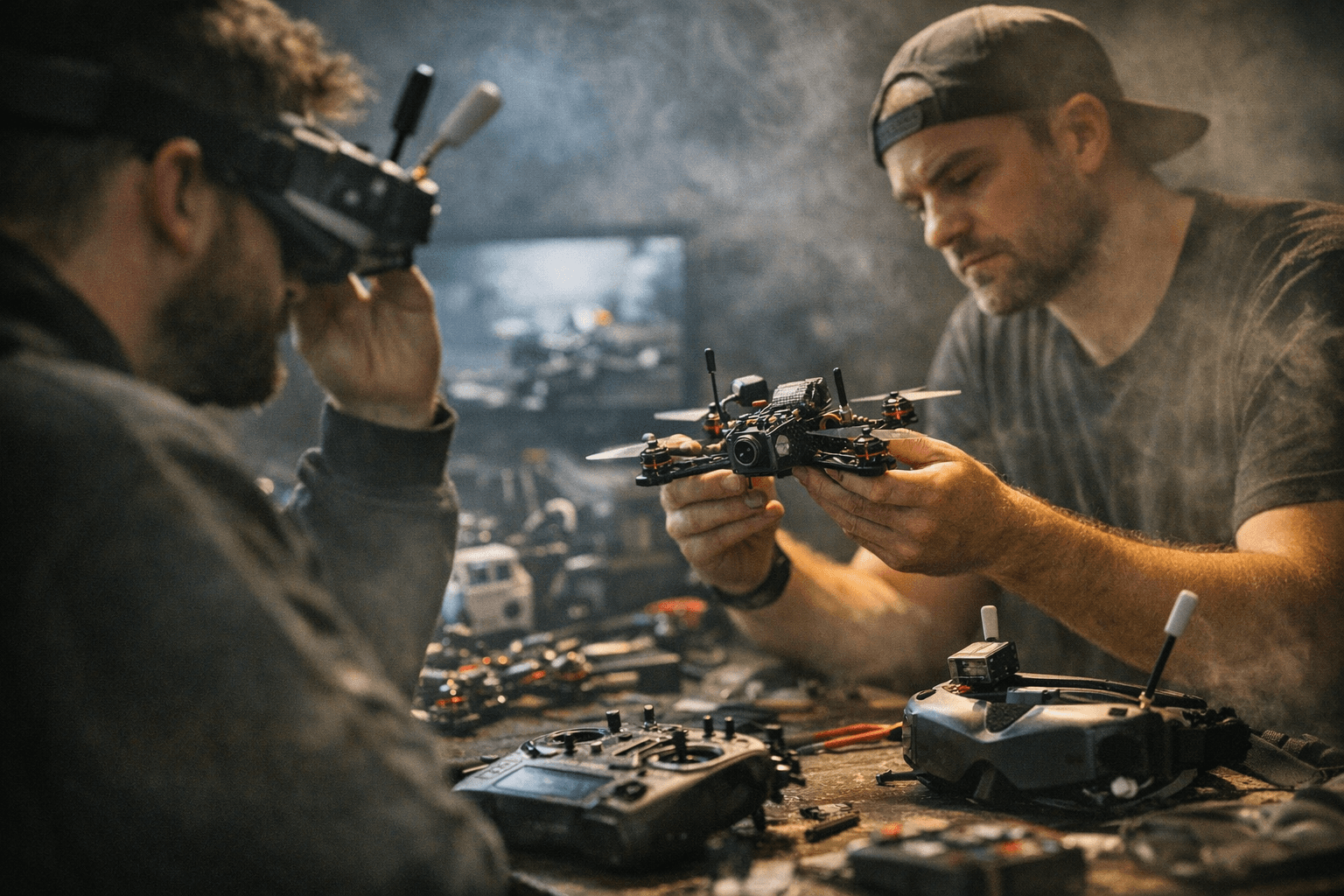
The moment you pull on FPV goggles and throttle up, every spec claim on the vendor's box is either working for you or against you. You just won't know which until it's too late. With the 2026 season rollout underway and mixed-reality racing formats entering the calendar, teams are finalizing hardware configurations right now. The terminology gap between what marketing copy says and what actually performs at speed is precisely where costly compatibility mistakes live.
MacSources' recent explainer "EIS to UHD: 20 Drone Spec Terms Decoded" is technically aimed at general drone buyers, but every term on its list carries a direct competitive implication. Below, all 20 are unpacked with a race team's priorities in mind.
1. Brushless Motor
The propulsion standard for any serious racing build. Unlike brushed motors, brushless motors contain no internal brushes, reducing friction and heat and producing better power density, quieter operation, and a longer service life. For racing specifically, the payoff is superior throttle linearity and less performance decay as the motor heats through a race. The critical discipline: KV rating alone tells you nothing useful. KV, prop size, and battery chemistry have to be evaluated together as a matched system, not chased independently.
2. EIS (Electronic Image Stabilization)
A software method that slightly crops the video frame and processes it in real time to smooth out vibration and small movements. EIS is useful in windy conditions but meaningfully less effective than a physical gimbal. Competitive pilots have two specific concerns: the crop reduces usable field of view, which matters for spatial awareness at high speed, and the processing introduces micro-latency that degrades the sharpness of a live POV feed exactly when pilots need it most.
3. Extended Flight Time
A marketing label applied to drones capable of longer airborne sessions on a single charge. Entry-level platforms typically top out at 10 to 15 minutes; drones advertised with extended flight time often reach 25 to 40 minutes. In a racing context, flight time on a competitive charge is a configuration output, not a fixed number. It shifts with throttle profile, payload, and environmental conditions, so vendor claims need to be tested against your specific build weight and flying style.
4. Fixed-Wing Drones
Platforms that generate lift through forward airspeed across fixed wings rather than powered rotors, flying more like a conventional aircraft than a helicopter. Fixed-wing drones are generally faster and more power-efficient in sustained cruise than multi-rotors but require space for take-off and landing and cannot hover. They are largely absent from closed-course racing formats but understanding the category is essential for reading vendor catalogs without confusing platform types.
5. FPV (First-Person View) Perspective
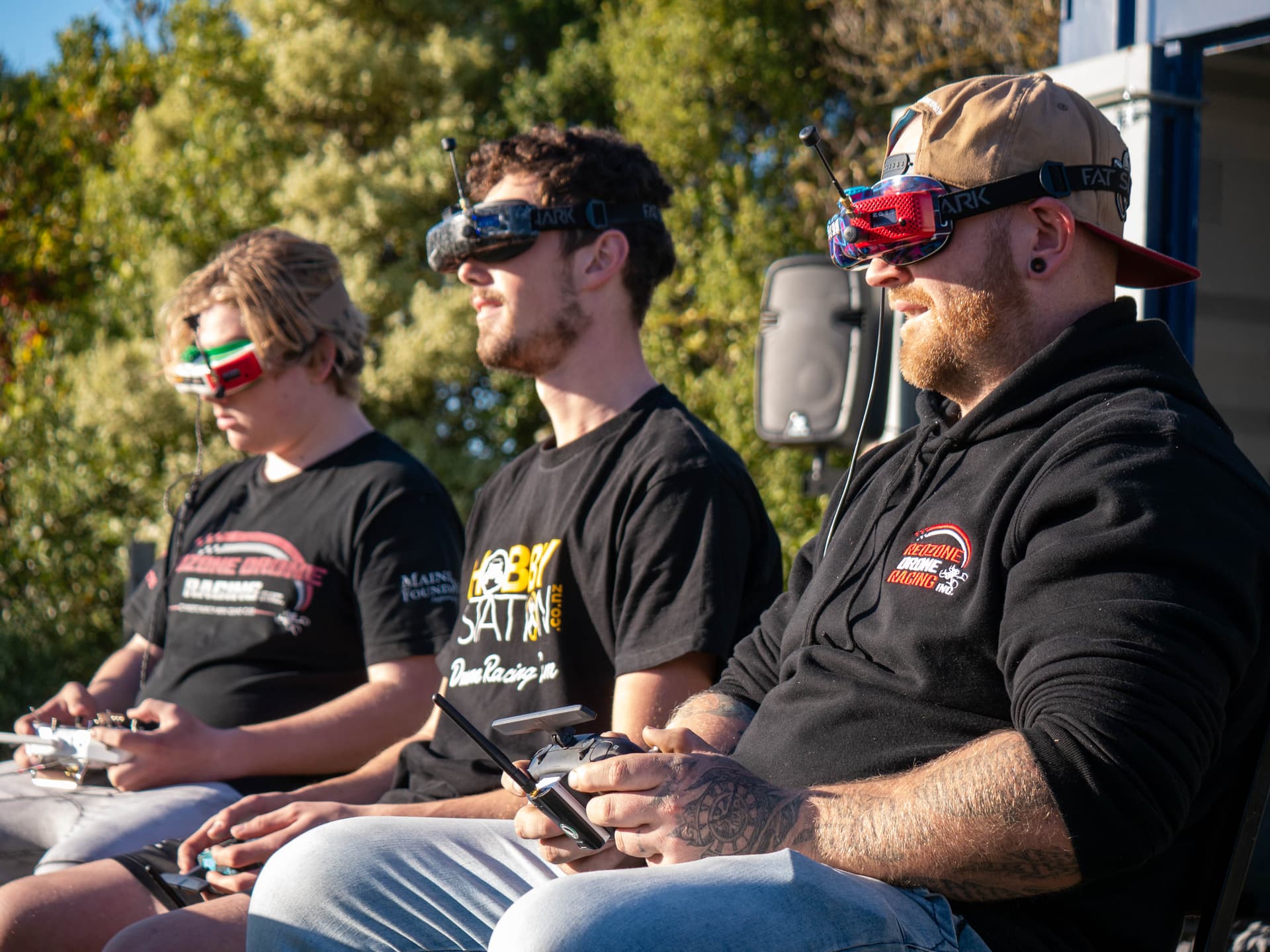
The live camera-to-goggles link that is, by definition, the operating mode of drone racing. Low latency is not a nice-to-have; it is the functional requirement that makes controls feel instant and responsive. Some systems can route FPV data to VR headsets, but only when latency stays within thresholds pilots can tolerate. The key variable heading into 2026: digital HD systems from DJI, HDZero, and Walksnail differ meaningfully in latency figures, implementation architecture, and cross-compatibility, which affects pilot performance, pit-crew setup, and whether a particular system clears league rules.
6. Gimbal
A motorized camera mount that stabilizes footage across two or three axes, typically tilt, roll, and sometimes pan. Unlike EIS, a gimbal physically counters movement rather than cropping around it, preserving the full field of view and generally producing cleaner results. The weight tradeoff is real: gimbals add mechanical complexity and grams to the airframe. For race builds where mass directly affects speed and handling, the choice between gimbal and EIS is a weight-versus-capture-quality calculation that changes with each specific build and use case.
7. HDR (High Dynamic Range)
A video processing technology that expands the camera's contrast range to produce deeper blacks and brighter highlights within the same frame. HDR is most visible in challenging lighting: the low-sun contrast of dusk events, the hard shadow-to-sky transitions common on outdoor courses. For broadcast and event production teams covering competitive FPV, the decision to enable HDR affects not only visual quality but post-production workflow and how fast-moving race elements register in the final cut.
8. Headless Mode
A flight control feature that decouples the drone's stick inputs from its physical heading, so that pushing forward always moves the drone away from the pilot regardless of which way the nose is pointing. This is a beginner orientation aid, not a racing tool. Competitive pilots navigate by the drone's nose reference, and headless mode is typically disabled or absent on any race-spec build.
9. Hybrid VTOL (Vertical Take-Off and Landing)
A platform type that combines multi-rotor and fixed-wing capabilities in a single airframe. A hybrid VTOL takes off and lands vertically like a quadcopter, then transitions to fixed-wing cruise for greater speed and range efficiency. These platforms are most relevant to long-range and mapping applications rather than closed-course racing, but they are increasingly prominent in vendor catalogs and worth recognizing to avoid confusing them with racing-class hardware.
10. LiDAR (Light Detection and Ranging)
A sensor technology that uses pulsed light to map the environment around a drone, detecting obstacles and generating detailed 3D terrain models. LiDAR-equipped platforms, including the DJI Avata 360, use this data for collision avoidance and precision surveying. In competitive contexts, understanding whether a drone's obstacle sensing is LiDAR-based or camera-based matters for accurately interpreting safety system performance specifications.
11. Multi-Rotor Drones
The dominant platform architecture in drone racing, using multiple powered rotors, most commonly four, six, or eight, to generate lift and directional control. Speed, hover, and rotation are managed by adjusting each rotor's individual spin rate. The overwhelming majority of commercially available drones and virtually all competitive racing platforms are multi-rotor designs.
12. Omnidirectional Obstacle Sensing
A safety architecture in which sensors covering all directions around the drone detect approaching objects and trigger an automatic stop or reroute. The system relies on LiDAR, cameras, or a combination of both depending on the platform. For racing, this feature is typically deactivated because it would interrupt high-speed intentional maneuvering; even so, pilots evaluating training or dual-purpose platforms should know that even advanced omnidirectional systems can miss small or thin obstacles.
13. Palm Takeoff
A launch method that allows the drone to take off from an operator's open hand rather than a flat surface. This is practically useful at race venues with uneven staging areas, tall grass, or confined pit zones. Some palm-takeoff platforms incorporate gesture controls as a secondary function, though careful hand positioning around spinning propellers is required regardless.
14. Propeller Guards
Protective rings or frames surrounding the propellers to prevent contact with walls, obstacles, or people. Guards are a common feature recommendation for beginner platforms but carry a direct performance cost: added weight and reduced control precision. Racing builds operate without propeller guards; the term is most relevant when evaluating training drones or equipment used in indoor demonstrations and mixed-use event environments.
15. Quadcopter
The most widely deployed sub-type of multi-rotor drone, defined by four propellers on four arms in a symmetric layout. The quadcopter configuration delivers a reliable balance of stability, agility, and mechanical simplicity that has made it the default airframe for FPV racing. When a vendor or league rulebook references a "quad," this is the architecture under discussion.
16. RTH / RTL (Return to Home / Return to Launch)
An automated safety function that commands the drone to navigate back to its launch coordinates when triggered. RTH can activate manually or automatically in response to critical events, most commonly low battery or signal loss. For race operations, understanding the conditions under which RTH engages matters for course marshals and safety officers; unexpected autonomous behavior in a competition environment creates collision risk and can affect results.
17. RTK (Real Time Kinematic)
A high-precision GPS mode that delivers centimeter-level positioning accuracy rather than the meter-level accuracy of standard GPS. RTK is the standard for commercial mapping, surveying, and precision agricultural drone work. Its racing relevance is concentrated in precision drone sports formats and autonomous racing development, where exact positional data is required for timing verification and course compliance rather than pilot judgment.
18. Single Rotor Drones
Platforms that use one large main rotor for lift and a smaller tail rotor for directional stability, essentially a miniaturized helicopter. Single rotor drones can carry heavier payloads than comparable multi-rotors and sustain longer flight times because lift generation is distributed between two rotors rather than four or more. They are considerably harder to pilot and are not a standard platform in competitive racing formats.
19. Smart GPS
A GPS implementation that layers additional automated functions on top of basic positioning: follow-me mode, RTH activation, RTK integration, and headless mode coordination all qualify as smart GPS features. Drones with smart GPS are more configurable and safety-capable than basic-positioning alternatives, but competition pilots and event operators need to know which automated behaviors are active by default and whether they can be overridden cleanly during racing conditions.
20. UHD (Ultra High Definition)
A camera resolution designation indicating 4K output or higher, producing sharper image detail than standard HD. UHD matters most for broadcast and content teams capturing race footage for post-production, streaming, or sponsor deliverables. For pilots selecting onboard cameras, resolution specifications need to be weighed against file size demands, processing overhead, and the overall weight budget of the platform, since a UHD sensor that adds too much mass changes how the drone flies, not just how it records.
The 2026 race season is compressing simultaneous product launches, new broadcast standards, and emerging mixed-reality formats into a single procurement window. A goggles-VTX incompatibility, a motor KV mismatch, or a misread of EIS versus gimbal tradeoffs is not an abstract spec error; it is a result that shows up on the timing sheet and in the event producer's review of the broadcast footage. Fluency in this vocabulary is the baseline for evaluating every vendor claim that lands in the team inbox between now and the start gate.
Know something we missed? Have a correction or additional information?
Submit a Tip