2026 FPV Latency Test Reveals Analog Still Leads HD Systems
Walksnail Avatar Pro V2 spiked to 35ms under RF interference, nearly 4x analog's 8ms baseline, in UAVMODEL's hardware-level glass-to-glass FPV latency test.
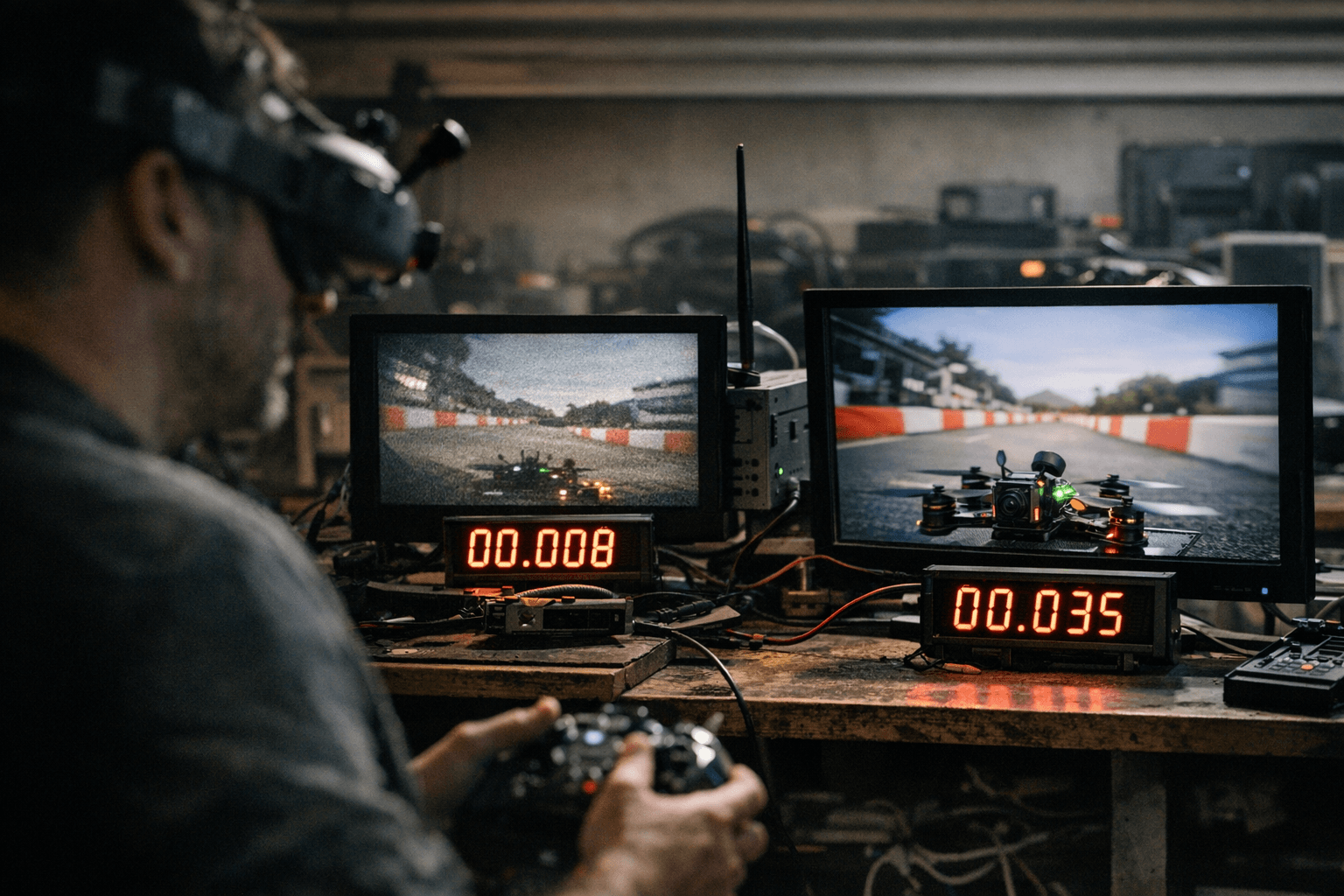
When a Walksnail Avatar Pro V2 spiked to 35 milliseconds of glass-to-glass latency under simulated bando interference, it was registering 27 milliseconds slower than the analog system sitting on the same test bench. At a competition 5" quad's peak velocity of roughly 160 kilometers per hour, that 27ms gap represents approximately 1.2 meters of closing distance before the pilot's visual system receives updated positional information: enough to blow past a gate center, clip a proximity line, or miss the entry window for a split-S entirely.
That figure, drawn from UAVMODEL's hardware-level latency test published March 30, 2026, is the benchmark the FPV racing community has lacked since HD systems began competing with analog on podiums and in spec classes. The test measured three widely used video systems: a high-end analog stack representative of Foxeer and TBS hardware, the HDZero Race V3, and the Walksnail Avatar in both Pro V2 (1080p/120fps) and Race Mode (720p/120fps) configurations.
The methodology is the first thing worth scrutinizing, because latency claims in this hobby have historically ranged from manufacturer marketing to forum speculation. UAVMODEL placed an LED-based millisecond timer directly in front of each FPV camera lens and captured both that timer and the goggle display simultaneously with a 1000fps slow-motion camera. Every reported figure is a physical photon-to-photon measurement from camera sensor to rendered screen pixel, not a software timestamp or a theoretical pipeline calculation. Tests were run outdoors with a calibrated 5.8GHz RF noise floor introduced by a spectrum analyzer to approximate the interference density of a typical urban bando session. Multiple runs captured both typical base latency and worst-case packet-loss spikes, giving the data the statistical shape race engineers actually need.
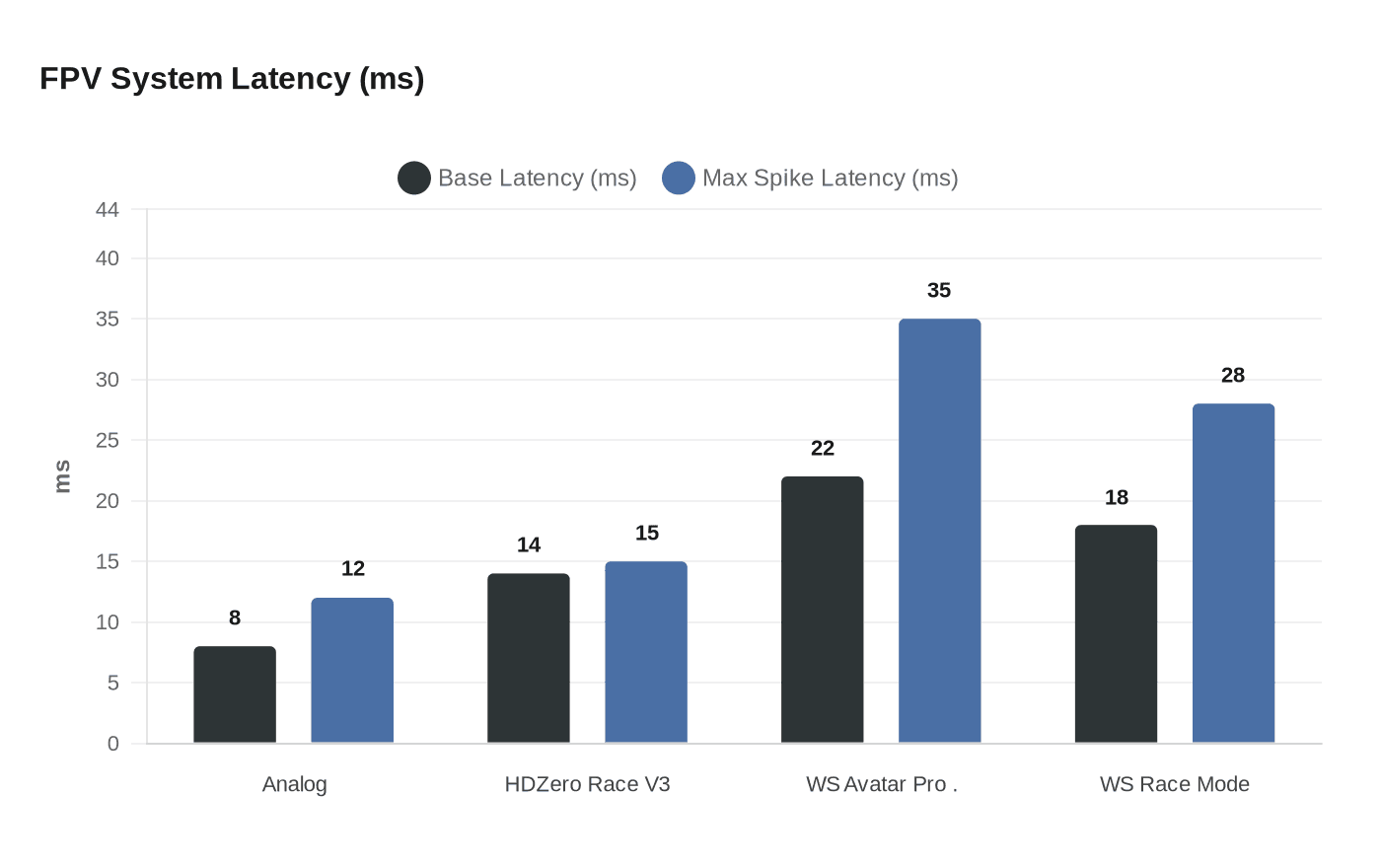
The headline numbers: analog base latency measured approximately 8ms with a maximum spike of 12ms. HDZero Race V3 at 720p/100fps clocked a base of approximately 14ms and a maximum of 15ms. Walksnail Avatar Pro V2 at 1080p/120fps registered a base of roughly 22ms with spikes reaching 35ms. Walksnail Race Mode at 720p/120fps measured a base around 18ms, spiking to 28ms under heavy signal blockage.
The most surprising number in that table is not analog's 8ms baseline, which experienced pilots have long taken for granted. It is HDZero's near-flat variance: a spread of just 1ms between base and maximum, 14ms to 15ms. For an HD digital system, that is a remarkable stability profile, and it flows directly from HDZero's uncompressed, fixed-latency architecture. H.265 encoding, the compression backbone of Walksnail's Avatar Pro V2, trades that stability for dramatically higher image resolution: the codec introduces a pipeline that can absorb extra frames during packet reconstruction, producing the 13ms internal variance (22ms to 35ms) observed under interference.
Translating those numbers into lap-time consequences requires common race speeds as a reference frame. At 160 km/h, or roughly 44 meters per second, every 10 milliseconds of added latency equals approximately 44 centimeters of closing distance. The 6ms gap between analog (8ms) and HDZero (14ms) costs roughly 27 centimeters per perception moment: negligible on a banked sweeper, significant when threading a 1.2-meter gate at full throttle. The 14ms gap between analog and Walksnail Race Mode baseline translates to 62 centimeters of unperceived travel. When Walksnail Pro V2 spikes to 35ms under interference, that figure grows to nearly 1.2 meters per moment, essentially a full gate width of blind flight. On a proximity course with painted lines and foam-brick walls, that spike is not a statistic; it is the difference between a clean pass and carbon fiber on concrete.
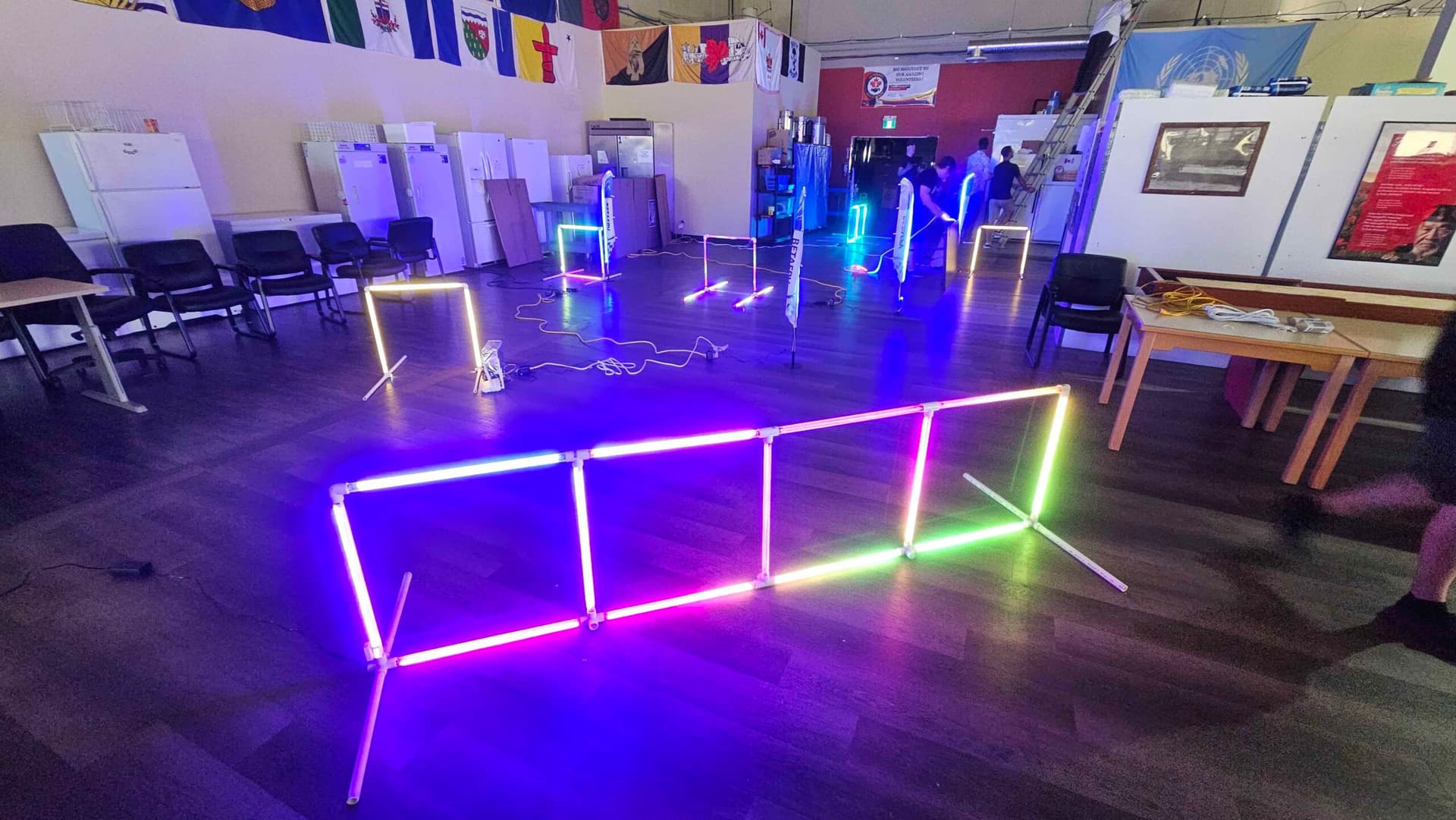
Those consequences are not uniform across race classes. Tinywhoop pilots flying a gymnasium at 40-50 km/h see the latency math shrink dramatically. At approximately 14 meters per second, the worst-case 27ms delta between analog and Walksnail Pro V2 accounts for roughly 38 centimeters of travel, a margin most indoor obstacles will forgive. Given the tight corridors and foam obstacles where Walksnail's RF robustness and image clarity become genuine navigational advantages, the latency penalty in tinywhoop formats is largely academic. Resolution wins that argument.
For 5" arena racing, with dense spectator RF traffic, tight proximity courses, and high-interference backgrounds, the calculus reverses hard. HDZero's flat 14-15ms profile becomes a serious competitive asset precisely because it is predictable. A pilot who knows their system delivers 14ms consistently, lap after lap, can build spatial memory around that fixed sensory delay. A pilot whose system spikes from 18ms to 28ms mid-lap is flying with a moving reference point. Open-field and endurance formats shift the equation back toward Walksnail: at distance and with complex terrain, the H.265 encoding provides RF penetration and image fidelity that analog cannot match, and the latency penalty at cruising speeds below 100 km/h is less acute.
Seven-inch long-range builds occupy a different world entirely. At the reduced velocities and expanded safety margins of 7" platforms, the latency delta between any of these three systems is operationally minor. Walksnail Pro V2's 1080p feed serves 7" pilots better than analog's noise floor, and the spike behavior under interference is an acceptable trade-off when the flying envelope is measured in hundreds of meters rather than gate apertures.
For competition teams making hardware decisions before the 2026 championship season opens, the UAVMODEL data supports a fairly clean framework: pilots flying 5" analog-only spec classes have no pressure to change. Pilots targeting HDZero events or looking to leave analog without accepting variable latency should treat the Race V3's 14-15ms profile as a genuine analog alternative with the added benefit of HD image quality. Pilots competing in HD-permitted classes should default to Walksnail Race Mode at 720p/120fps (18ms base) and reserve Pro V2's 1080p mode for mixed-use or non-competitive flying where image clarity outweighs lap precision.
The data also lands on race directors' desks at a useful moment. Event organizers weighing whether to permit HD systems, and under what configurations, now have measured glass-to-glass latency figures rather than vendor claims to anchor their spec rules. Whether that produces a maximum allowable latency threshold, a mandatory Race Mode requirement, or a formalized analog-vs-HD split class structure depends on how much competitive equity individual organizations want to enforce. The UAVMODEL test does not make that decision, but it removes the excuse that it cannot be made with data.
Know something we missed? Have a correction or additional information?
Submit a Tip