DJI Avata 360 Debuts 8K FPV Capture With Long-Range Transmission
DJI's Avata 360 shoots 8K/60 HDR in full 360 degrees with O4+ at 20km range, forcing race organizers to reckon with a new forensics, replay, and HD transmission benchmark.
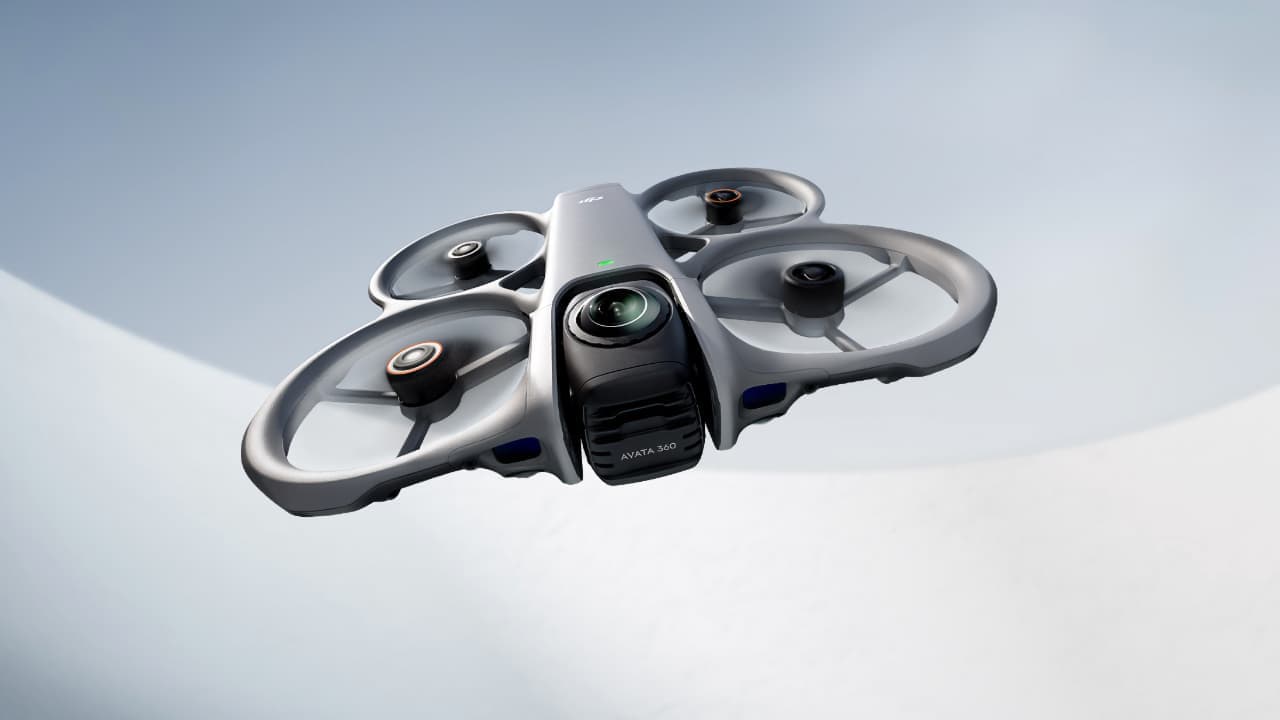
When a protest lands on a race director's table after two pilots clip the same gate at 130 kilometres per hour, the ruling has always depended on which fixed camera happened to face the right direction. The DJI Avata 360, launched March 26, does not run that race. But it may end the argument.
A single Avata 360 unit mounted trackside or flown as a production chase drone captures every gate approach, every exit vector, and every mid-air from all directions simultaneously at 8K/60fps in 10-bit HDR. In post, the GyroFrame tool in the DJI Fly app lets officials or broadcast editors reframe that omnidirectional footage to any perspective with a single tap, and the Virtual Gimbal feature enables infinite programmatic rotation and tilt to isolate the decisive contact point. At 8K resolution, cropping down to broadcast-standard 4K still leaves meaningful zoom headroom. At 60 frames per second, a 24fps slow-motion sequence runs at 2.5x, enough to determine definitively whether a pilot held their line or drifted three inches into the adjacent gate on a double. That is a forensic capability that currently requires a multi-camera crew, synchronised rigs, and a post-production budget. The Avata 360 collapses it into a single airframe.
The three race-specific applications that follow directly from the hardware are crash forensics, post-race line analysis, and spectator replay. The pair of 1/1.1-inch sensors, each with 2.4-micrometre pixels, delivers enough resolution to isolate a wingtip's position relative to a gate frame at speed. For line analysis, the value compounds. A pilot reviewing a race from the Avata 360's omnidirectional footage can examine their own gate exit from angles unavailable during the run: looking back at the gate from the apex of the next turn, or viewing the entry to a split-S from directly above. The Virtual Gimbal enables infinite rotation and tilt for dynamic camera moves, even while flying in a single direction, meaning post-race analysis is not limited by where the camera happened to face during competition. The 42 gigabytes of onboard storage covers approximately 30 minutes of 8K 360 footage without a microSD card, and Wi-Fi 6 High-Speed Transfer moves one gigabyte of footage in roughly ten seconds. A complete event day's heat finals could be ingested and reviewed before the final round.
DJI's O4+ transmission system delivers 1080p/60fps live feeds with a range of up to 20 kilometres. Inside a typical race venue, that ceiling is academic, but the underlying architecture matters for a different reason: frequency coordination in a crowded RF environment. A race event running eight to sixteen pilots simultaneously already manages 5.8GHz analogue video, 2.4GHz control links, and spectator WiFi. O4+ operates on its own RF characteristics, and event technical directors who have spent years hand-assigning channels and polarisations to prevent video bleed will need to understand how a broadcasting or chase unit running O4+ interacts with that spectrum. DJI has not published interference test data for multi-transmitter race environments, which leaves event operators with a practical homework assignment before deploying the platform at a sanctioned venue.
Obstacle sensing introduces a harder constraint. The drone features full propeller guards, user-replaceable lenses, omnidirectional obstacle sensing, and LiDAR on the front, which in a filmmaking context is a genuine safety asset over crowds. In a race venue, those same sensors read gate frames, safety netting, timing transponders, and competing aircraft as hazards and intervene accordingly. A chase drone that pulls autonomously away from a gate cluster at the precise moment it would have captured a passing move is operationally useless in that role. Whether obstacle sensing can be disabled cleanly in a controlled course environment, and whether doing so triggers regulatory reclassification under applicable national airspace rules, remains a question DJI's filmmaking spec sheet does not address.
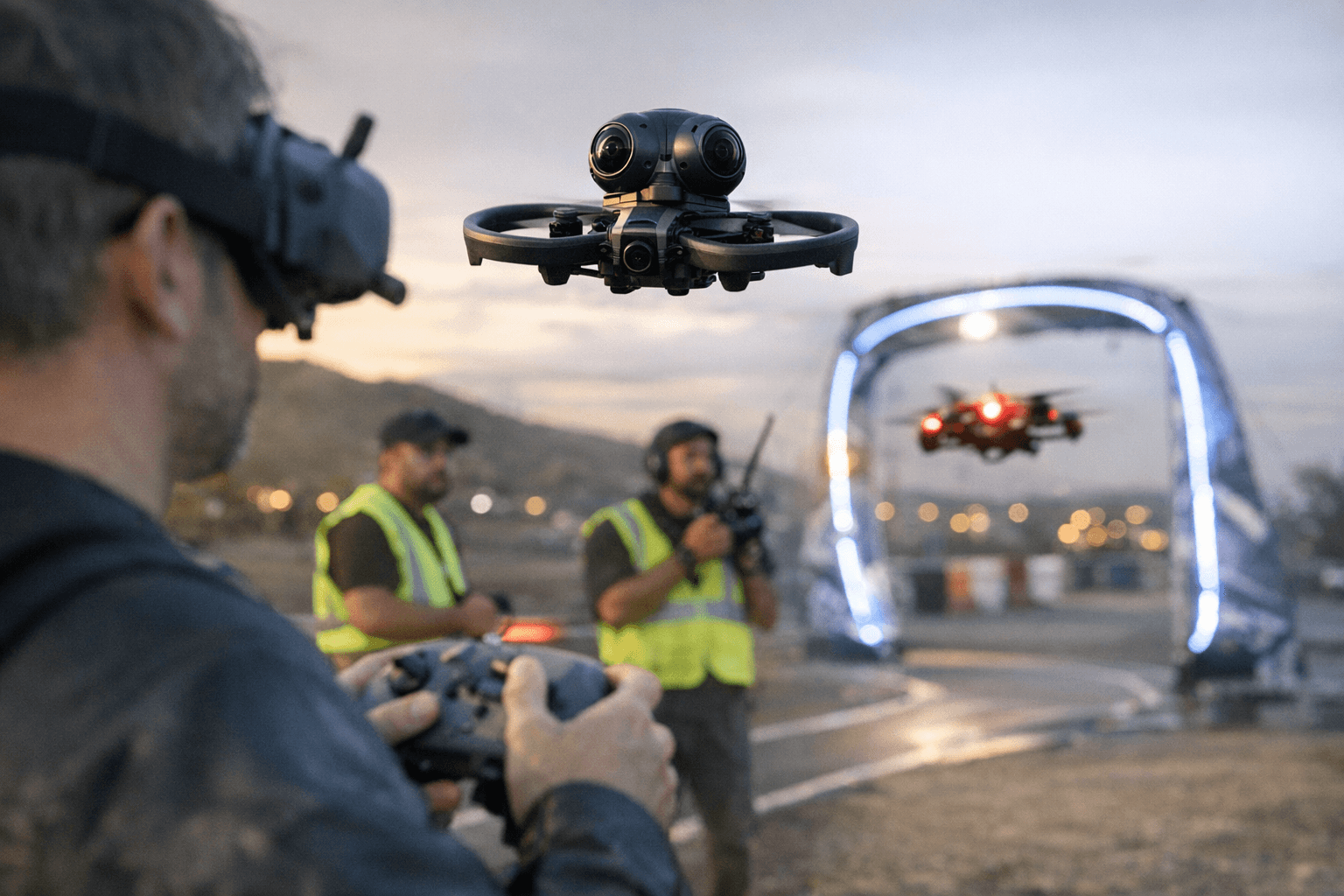
The thermal question is equally unanswered. Sustained 8K/60fps HDR capture on two 1/1.1-inch sensors and the image processors required to stitch and encode spherical footage generates heat at a rate that a studio production workflow does not stress-test the same way a summer outdoor race event does. Real-world flight time testing put expectations at 18 to 20 minutes once variable throttle and ambient conditions are factored in, well short of the published 23-minute ceiling. At maximum resolution in high ambient temperatures, thermal throttling on the imaging pipeline is a scenario without a published data point. A replaceable front lens element allows field repairs without sending the drone in for service, a meaningful concession to field serviceability, but one that addresses impact damage rather than processor thermals.
The Avata 360 launched with immediate sale availability in China and on pre-sale in most other regions. American buyers faced a separate situation: DJI's official website did not offer the Avata 360 in the United States at launch, with Amazon's DJI storefront pointing to March 30 as the go-live date for U.S. pre-orders through third-party retailers. American event directors and production crews evaluating the platform for the current season are starting a week behind their international counterparts.
None of this positions the Avata 360 as a competition platform. It does not run any current MultiGP class and was not designed to. What it does is move the transmission, resolution, and sensing baseline in a direction that the competitive HD-digital FPV segment cannot ignore. Event directors and manufacturers building HD racing systems now have a consumer-priced data point: O4+, 1080p/60fps at 20 kilometres, in a drone that also captures spherical 8K and arrests itself when it detects an obstacle. The implicit question that raises for sanctioned-event infrastructure is not whether the Avata 360 belongs on the start grid. It is whether the transmission and sensing capabilities race organizers currently accept as adequate still clear the bar when the filmmaking division is already operating above it.
Know something we missed? Have a correction or additional information?
Submit a Tip