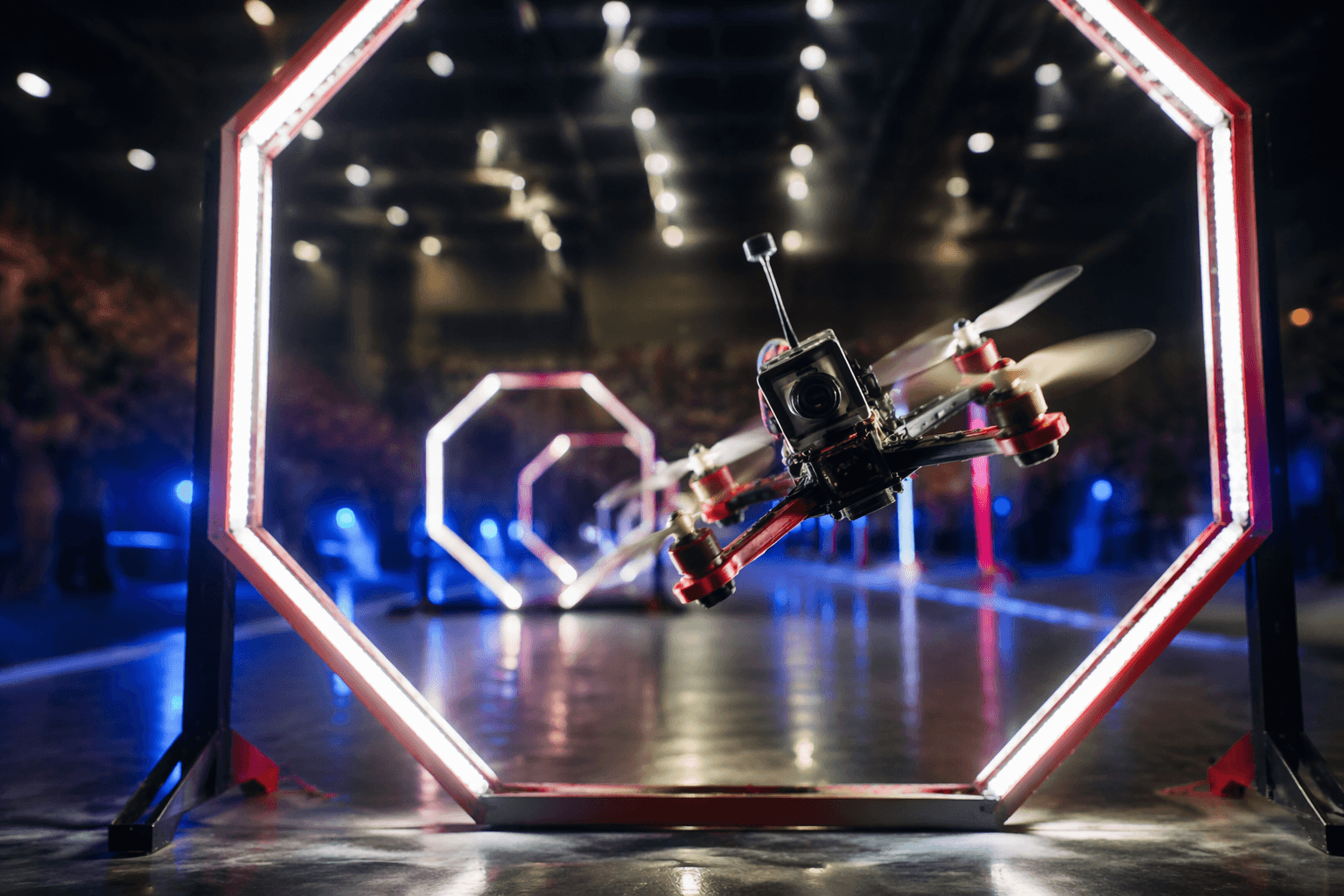
Drone Champions League roster shows global teams and young pilots
New flags from Kazakhstan and Argentina are widening DCL’s elite field, but Raiden and Vexcel still set the standard in a season built around three cups.

Drone Champions League’s roster page is doing more than listing names. It is showing how far elite drone racing has spread, and how much of the old hierarchy is still intact. Kazakhstan and Argentina are now on the board through Aspan and Squadron78, but the same page still puts Japan’s Raiden Racing and Spain’s Vexcel Spain Drone Team at the center of the sport’s power structure.
A roster page that reads like a world map
The strongest signal on the teams page is geographic. Aspan is marked as Kazakhstan-based and a DCL member since 2026, while Squadron78 brings Argentina into the league as another 2026 entrant. That matters because these are not decorative additions at the fringe. They sit on the same page as Raiden Racing, based in Japan with three championship titles and a DCL membership going back to 2016, and Cyclone Drone Racing, the USA-based outfit with one championship title.
Vexcel Spain Drone Team tells the other half of the story. Spain is not a new dot on the map, but a long-running competitive base, with DCL listing the team as a member since 2016. Put those names together and the page stops looking like a directory and starts looking like a pressure test for the sport’s international depth. The league now has recognizable anchors from Europe, Asia, North America and South America all in one competitive frame.
The lineups themselves reinforce that point. Aspan mixes younger talent such as Naykabro Nauryzbek Yessetov, Daniyal Kazymov and Alikhan Nsanbaeyv with leadership under Andrei Tishin, while Cyclone’s group includes Swan Versmissen, ZionFPV, Cryson and NeonFPV under manager Breton Woodford. Raiden’s roster carries a deeper championship memory, with names like Yasuyuki Harima and other seasoned Japanese pilots giving the team the feel of a program that expects to contend, not just participate.
The age spread is the real story underneath the flags
The page’s age range is almost as striking as the country list. DCL shows pilots as young as 8 and 10 inside team structures that also include racers in their 30s and 40s. That is not normal in most top-tier sports, and it is one reason the league’s talent pipeline feels unusually open. In one frame, you see the next generation being built in real time, not just recruited later.
That breadth makes the roster page feel more alive than a static team directory. Morten Siimar, Swan Versmissen, Shaigne Colin Chaigne, Gabriel Barrasso and Miron Cheremnykh all appear as part of the same competitive ecosystem, which tells you DCL is not only expanding by geography. It is also spanning generations in a way that keeps the sport’s elite tier from turning into a closed club.
For fans, the practical takeaway is simple: this is not a league waiting for one breakout country to carry it. It already has pilots and teams from multiple regions, and the age spread suggests the next wave is already in the pipeline. That is why the roster page carries more weight than a standard team list. It is a live snapshot of where drone racing is getting broader, younger and more global at the same time.
The 2026 format is designed to separate contenders from passengers
DCL’s broader season structure makes the roster depth more meaningful. The league describes itself as the world’s leading mixed-reality drone racing league, built around virtual and physical racing with Digital Twin technology, and its 2026 season is structured around three Cups, the Falcon Cup, Eagle Cup and Hawk Cup, followed by a Super Final. That format rewards teams that can keep pace across multiple competitive environments instead of peaking once and fading out.
The season already began with a real-world statement. DCL says the live race opener took place in Riyadh on 29 January 2026 during the Drones Hub Opening, hosted by Tuwaiq Academy. That was not just a ceremonial launch. It put the league’s mixed-reality identity on display in a city that is increasingly part of the sport’s global footprint, and it gave local FPV and drone racing fans a direct look at how DCL’s race format translates from simulator to real air.
The AI Grand Prix pushes that logic even further. DCL says the project, operated with Anduril, will use remote qualification in spring 2026 before a live final in November 2026 in Ohio, USA. That adds another layer to the competitive calendar and another route for pilots and teams to matter on the world stage. For a league that wants to look future-facing, the combination of mixed reality, seeding races and autonomous competition is a serious attempt to widen the sport without flattening its identity.
Raiden still sets the standard, and the draft is feeding the machine
If the new teams show expansion, Raiden Racing shows continuity at the top. DCL says Raiden won the 2025 DCL Championship, and the season’s climax came at LOTTO Eiskanal Königssee in Germany, a real bobsleigh track that underscores how physical and technical this sport can be when the pressure is highest. That championship pedigree still matters because it gives the 2026 field a benchmark. The newcomers may be real, but the standard remains high.
The April 22, 2026 draft-selection post adds another layer to the picture. DCL says four pilots were selected into teams for the 2026 season: Pēteris Ozoliņš, Alexander Prokhorov, Tristan Twine and Nauryzbek Yessetov. Those moves show the league is not only importing new flags. It is also feeding new talent into established structures, which is exactly how a top tier grows without losing its competitive edge.
That is why the current roster page feels more like evidence than promotion. Kazakhstan and Argentina are not token additions. The age spread is not a gimmick. The draft is not window dressing. But the old guard is still very much in charge, with Raiden’s three titles and Vexcel’s long-term presence reminding everyone that expansion is only half the battle.
The clean read on DCL’s 2026 landscape is this: the sport is getting wider faster than it is getting less predictable. That is real growth, not just a reshuffled field.
This article was produced by Prism’s automated news system from verified source data, official records, and press releases, then run through automated quality and moderation checks before publishing. The system is built and supervised by the people who set the standards it runs under. Read our full AI policy.
Know something we missed? Have a correction or additional information?
Submit a Tip