Evergreen: Where Competitive FPV Drone Racing Stands in 2026 — Leagues, Format Trends, and Where Tech Is Taking the Sport
Spec formats, HD video links, and diversified sponsorship are reshaping competitive FPV in 2026; here's what that means for your next race season.
Three forces are pulling competitive FPV drone racing in directions that would have seemed improbable just a few years ago: a hardening split between professional spec formats and grassroots open racing, a video-link technology war that is quietly settling in favor of low-latency HD, and a commercial ecosystem that has stopped treating hardware stickers as the ceiling of sponsorship ambition. Understanding how those forces interact is the difference between showing up to 2026 ready and showing up a season behind.
Forecast 1: The Pro/Grassroots Split Becomes Permanent
The bifurcation between entertainment-oriented pro leagues and grassroots chapter racing is not a phase the sport is passing through; it is the sport's structure now. Professional properties have converged on closed spec classes, where identical hardware eliminates equipment arms races and makes races legible to TV audiences and casual viewers. At the grassroots level, chapter models emphasize frequent races, training nights, and low-barrier whoop and sub-250 classes specifically designed to cultivate participation and build pilot pipelines. MultiGP, the largest drone racing league and FPV community in the world, organizes hundreds of chapters across the United States and internationally, with active locations in Australia, Asia, South Africa, Europe, and South America.
The practical consequence for pilots: if you want a pathway to a pro event, you almost certainly need to be active in a chapter system first. The grassroots tier is not a consolation bracket; it is the feeder structure that professional formats depend on.
Forecast 2: VelociDrone and Simulator Qualifiers Are Now Talent Infrastructure
Simulator leaderboards and remote qualification formats remain important for identifying talent and making events globally accessible. Virtual qualifiers let teams from regions without a strong live event calendar compete under equal course geometry before traveling to finals. MultiGP partners with VelociDrone as its official drone racing simulator, positioning it as the primary tool for pilot development and practice between live events.
The simulator is no longer a beginner's crutch. For pilots in regions with thin local calendars, a strong VelociDrone leaderboard rank is the credential that gets them on a flight to a championship. Simulators also provide a low-cost way to maintain pilot readiness between events, which matters in a discipline where muscle memory on a specific track geometry decays fast. Teams that build structured sim training into their weekly schedules carry a measurable consistency advantage when live qualifying opens.
Forecast 3: HDZero Wins the Racing Video Link War
The video link debate consumed enormous community bandwidth over the past two years. It is largely resolved. HDZero is the clear recommendation for racers and pilots who prioritize low latency, especially those who compete. For racing specifically, HDZero or analog are the recommended choices; Walksnail and DJI carry latency penalties that are measurable on-track.
The competitive calculus for 2026 often centers on marginal gains in battery optimization, motor KV selection, and prop and frame efficiency rather than radical airframe changes in pro-spec classes. That makes video link selection one of the few remaining hardware decisions with a direct impact on lap time in spec-class racing. Budget analog remains the backup every serious racer keeps in the bag; HDZero is increasingly the primary stack for anyone racing competitively. For open-class events, teams still exploit high-thrust propulsion packages for outright speed, and leagues are increasingly adopting rules that limit extreme weight reduction or battery modifications to preserve parity.
Forecast 4: Broadcast Infrastructure Separates Fundable Events from Boutique Ones
Technology investment in competitive FPV is concentrated on real-time timing and scoring, immersive spectator feeds combining FPV and external cameras with live telemetry overlays, and shorter race windows designed to maintain audience attention. Race directors who invest in reliable lap-timing hardware and integrated scoring platforms substantially improve broadcast readiness and sponsor appeal.
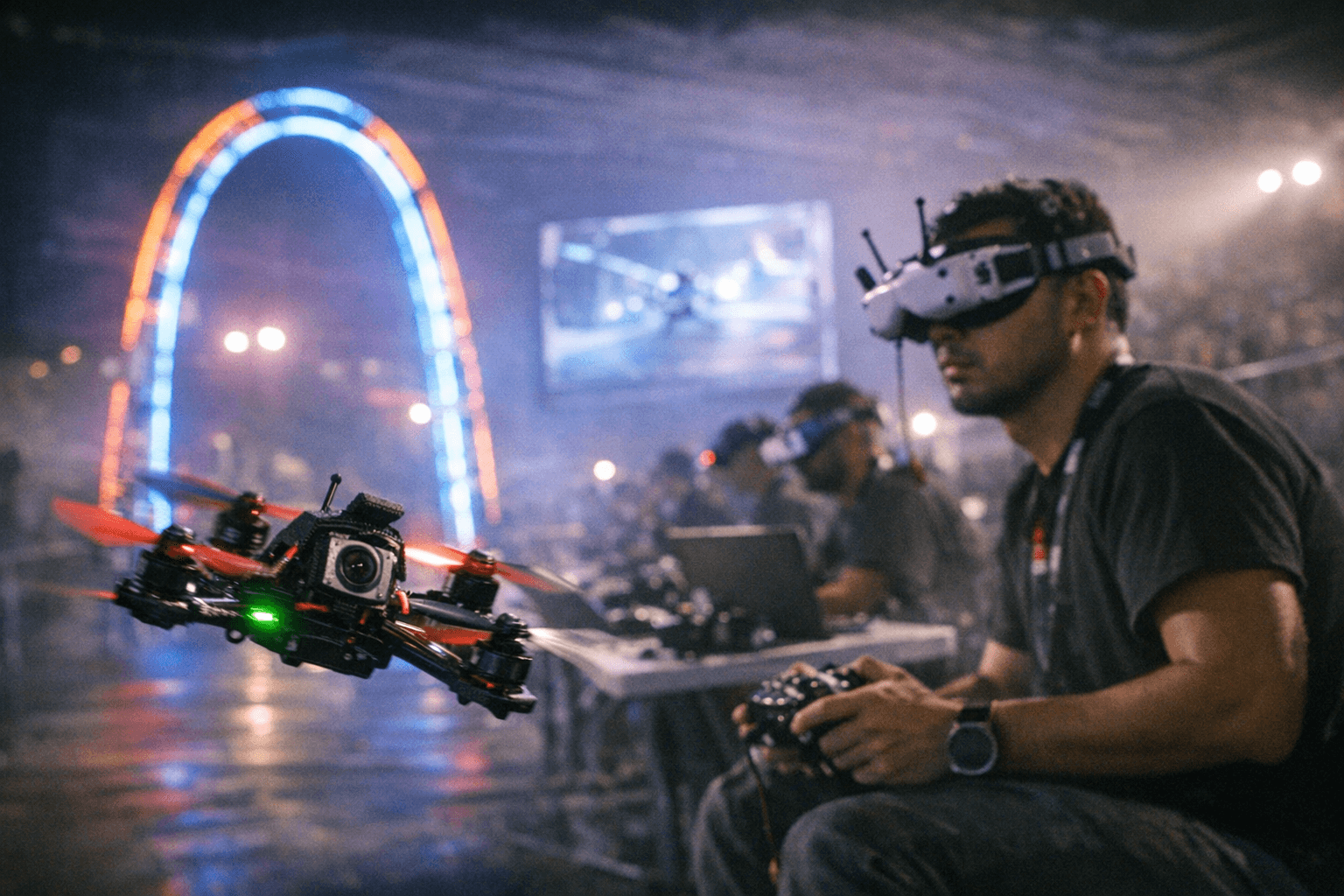
DRL pilots race in first-person view with identical custom-built drones at speeds above 80 mph through three-dimensional courses, with broadcasts that have aired on NBC, NBC Sports, Sky Sports, and ProSiebenSat.1. That broadcast footprint is the commercial proof of concept. Events that cannot demonstrate reliable timing data, clean production feeds, and repeatable heat formats are increasingly invisible to mainstream sponsors, regardless of the quality of racing on track.
Forecast 5: Airspace Compliance Is Now a Venue Prerequisite, Not an Afterthought
Regulatory frameworks continue to tighten: in the United States, the FAA requires registration for drones over 250 grams, mandates Remote ID broadcasting, and caps uncontrolled airspace operations at 400 feet above ground level. UTM coordination is accelerating on both sides of the Atlantic, with NASA and the FAA's UTM Pilot Program in operational testing across major cities, and EASA's U-Space Services now mandatory for certain urban drone flights in Europe.
Leagues, venues, and local authorities now routinely require documented operation plans, safety marshals, redundant kill switches, and rapid incident reporting. For larger public events, integrated airspace management and coordination with local ATC or UTM providers is increasingly necessary. Professional events invest in on-site counter-UAS standard operating procedures and emergency response plans to satisfy insurers and local regulators. Race directors who treat compliance as a box to check after the venue is booked are the ones who lose permits two weeks before gates open.
Forecast 6: Sponsorship Diversification Is Rewriting Team Economics
Sponsorship models that once centered on hardware branding have diversified into streaming rights, talent sponsorship, and integrated B2B deals with software and logistics providers. Leagues that offer predictable broadcast schedules, consistent spec classes, and reliable timing and broadcast infrastructure attract more stable sponsor commitments. DRL has secured deals worth a reported $100 million, including a five-year partnership with crypto platform Algorand that introduced blockchain-enabled ticketing. That figure is the sport's current commercial ceiling, but it signals the category of partner now paying attention.
For teams operating below that level, the most actionable takeaway is the B2B angle. Software companies, logistics platforms, and sports-tech startups are actively looking for properties with measurable, tech-literate audiences. A mid-tier team with solid broadcast integration and a defined pilot persona is a more credible pitch than a team with a faster quad and no data story.
Forecast 7: MultiGP's Championship Structure Is the Clearest Pro Pathway in the Ecosystem
MultiGP organizes its chapters into tiers, with each tier rewarding a chapter's growth in ways designed to grow the sport organically. The top 64 Pro and 52 Sport pilots from Global Qualifier standings earn the first opportunity to compete at the MultiGP Championship. For pilots outside the DRL's closed invitation system, that GQ leaderboard is the most transparent and accessible route to a championship start. The 11th MultiGP Championship represents the most established recurring title in grassroots-to-pro racing, and Global Qualifier season is the structured ladder that feeds it.
The Roadmap: Where to Invest in the Next 12 Months
The three vectors that determine competitive and commercial outcomes in 2026 are operational reliability, spectator clarity, and talent pipeline health. Here is what that means in practice:
- Pilots: Prioritize sim hours on VelociDrone using the current MultiGP qualifier track geometry. Build your GQ ranking early in the season. On hardware, resolve your video link stack now: HDZero for competition primacy, analog as backup. Marginal motor and prop tuning will move lap times more than airframe changes in any spec-class event.
- Teams and race directors: The broadcast investment case is clear. Integrated lap-timing hardware and a clean scoring feed are the first infrastructure spend that pays off in sponsor conversations. Run short, repeatable heat formats. Prioritize UTM and Remote ID compliance documentation before venue confirmation, not after.
- Sponsors: The B2B deal structure is where stable ROI lives right now. Leagues with consistent spec formats and broadcast schedules offer the predictable audience exposure that hardware-only deals never could. Identify properties with documented timing infrastructure and a defined pilot development program; those are the organizations building durable commercial value, not just producing spectacle.
The sport's hybrid ecosystem, grassroots vibrancy feeding professional formats with the operational tooling and commercial ambition to sustain them, is not a transitional state. It is the mature model. The pilots, directors, and sponsors who internalize that architecture in 2026 are the ones who will still be competing, running events, and writing partnership checks when the next technology cycle arrives.
Know something we missed? Have a correction or additional information?
Submit a Tip