FAA Potomac Vertical-Lift Restrictions Reshape Drone Racing and AAM Operations
The FAA on January 23 issued permanent vertical-lift flight restrictions over the Potomac near DCA, tightening urban airspace and forcing drone-racing and AAM planners to rethink access and safety.
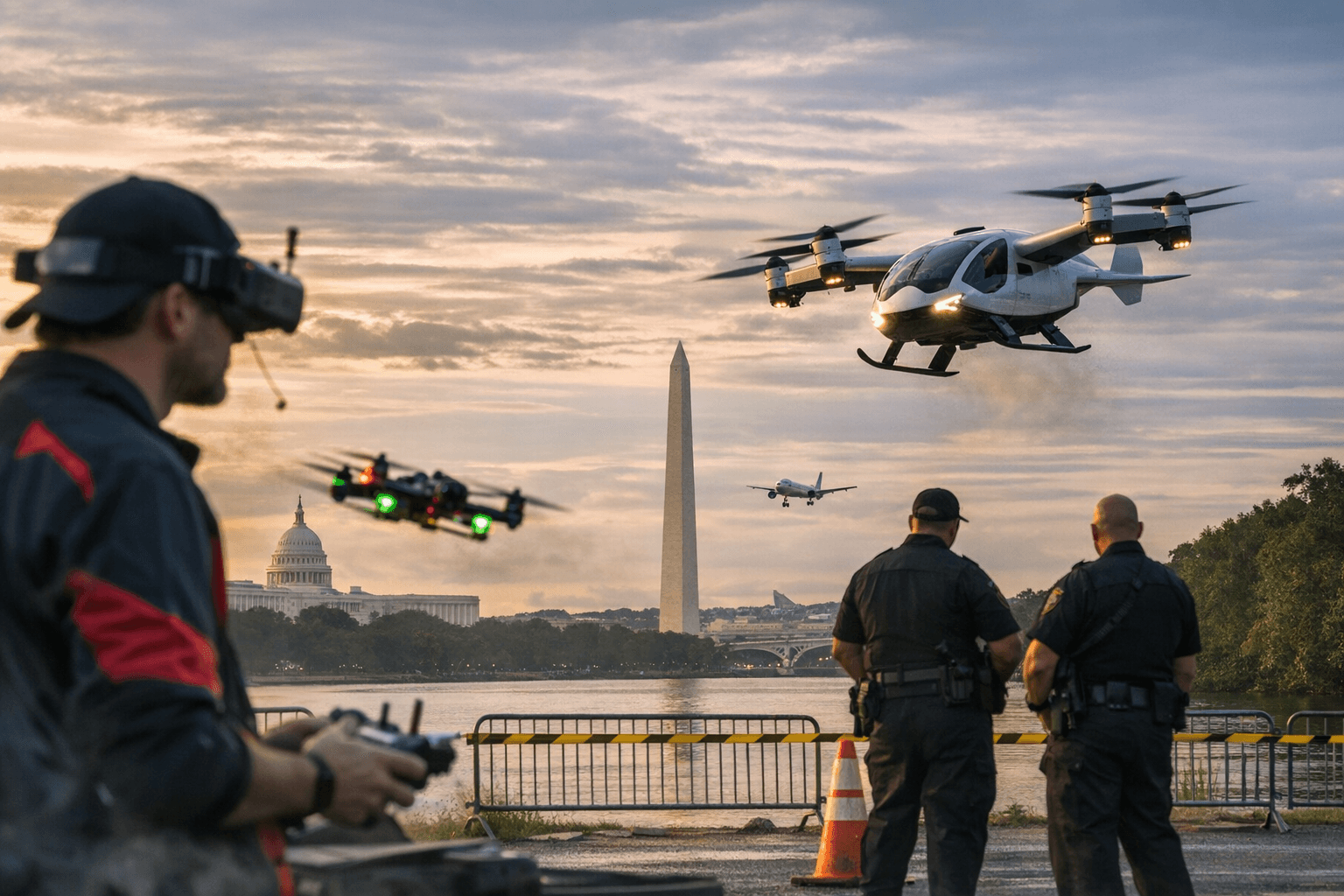
A new FAA interim final rule establishing permanent vertical-lift restrictions in the Potomac River corridor has immediate implications for drone racing, demonstration flights, and advanced air mobility operations around Ronald Reagan Washington National Airport. The rule, announced on January 23, 2026, bars helicopters and powered-lift aircraft from a defined area over the Potomac except for essential missions such as lifesaving medical flights, active law enforcement, national security, continuity-of-government, and presidential transport.
The restricted airspace extends from the surface up to roughly 1,500 feet above mean sea level in FAA diagrams and materials. The move was framed as a safety-driven response to a January 2025 fatal midair collision and follows a National Transportation Safety Board recommendation aimed at reducing conflicts between vertical-lift operations and fixed-wing traffic in the congested DCA airspace. For drone racers and race promoters who count on scenic metropolitan corridors and waterfront sightlines, this formalizes a tighter no-fly envelope in one of the country’s most sensitive airspaces.
Operationally, the rule does not single out small unmanned aircraft systems, but it signals a regulatory posture that favors strict deconfliction and prioritized access for essential missions. For event planners, that translates into harder lines around where demo flights and exhibition heats can run, and more scrutiny from air traffic managers when proposing urban courses. FPV pilots who previously mapped courses along the Potomac waterfront or hoped to stage eVTOL showcases will need to reconfigure course design, spectator placements, and contingency plans well outside the newly restricted footprint.
From a performance perspective, racers must adapt to altered course opportunities and potential supply-chain effects. Restrictions that limit vertical-lift demonstrations constrain the exposure of advanced air mobility prototypes to mainstream audiences, slowing the experiential feedback loop that pushes pilot craft improvements, battery and motor tuning, and spectator-driven sponsorships. The likelihood of relocated events to industrial airfields or closed-course arenas increases lap-count reliability, but removes the visual hook of skyline runs that attract casual fans and corporate partners.
Industry trends point toward a bifurcation between constrained urban testing and out-of-city performance venues. Manufacturers and race organizers will invest more in authorized airspace coordination and simulation platforms that recreate urban turbulence and wake interactions without landing teams in restricted corridors. Insurers, sponsors, and broadcasters will recalibrate risk models and audience strategies around venues that are certifiable under a more conservative FAA stance.
Culturally, the ruling underlines a tension in the drone-racing community: the drive for spectacle and urban relevance versus the public demand for safety and prioritized government missions. The rule elevates the policy debate to one where sporting ambitions must routinely demonstrate mitigation of airspace risk to earn runway time.
For pilots, promoters, and AAM developers, the practical next step is tighter planning. Expect more formal airspace requests, earlier coordination with FAA officials, and an acceleration of alternative venue development. The rule reshapes not just where drones can fly, but how the sport stages its most compelling moments in a world where safety and national priorities define the skyline.
Know something we missed? Have a correction or additional information?
Submit a Tip