FlyWing's X-Wing Fighter Puts Pilots Inside a Virtual Cockpit
FlyWing's X-Wing Fighter streams a live cockpit view straight to your FPV goggles, with head-tracking and built-in radar that turns every group flight into a shared-airspace encounter.
Most hobby aircraft treat the camera as a spectator tool, something to capture sweeping scenery for playback later. FlyWing's X-Wing Fighter represents a deliberate shift in RC design philosophy, one that prioritizes immersion over imagery and piloting over passive viewing. When Flywing Aero Technology took the wraps off the craft at CES 2026, the product on the table wasn't just another drone with a wide-angle lens. It was a rethink of what the word "first-person" should actually mean.
Cockpit-First: A Different Design Starting Point
The philosophy behind the X-Wing Fighter begins with a single premise: the pilot's goggles are the primary design consideration, not the footage they produce. At CES 2026, Flywing Aero Technology showcased an RC aircraft that rethinks RC flight with cockpit immersion, FPV goggles, radar tracking, and multiplayer air-battle simulations. That framing matters because it reverses the usual consumer drone priority stack. Where most platforms are built around camera stabilization and cinematic output, the X-Wing Fighter is built around what the pilot sees and feels in real time.
Flywing Aero Technology designed a VTOL craft not for cinematic aerial footage but to place pilots inside a virtual cockpit and into multiplayer encounters. Flywing representative Troye Qu, speaking to Interesting Engineering at CES, explained that the company "intentionally shifted focus away from cameras as passive recording tools." The goal, as Qu put it, was for pilots to "feel as if they were flying the aircraft themselves, not watching it from afar."
Inside the Virtual Cockpit
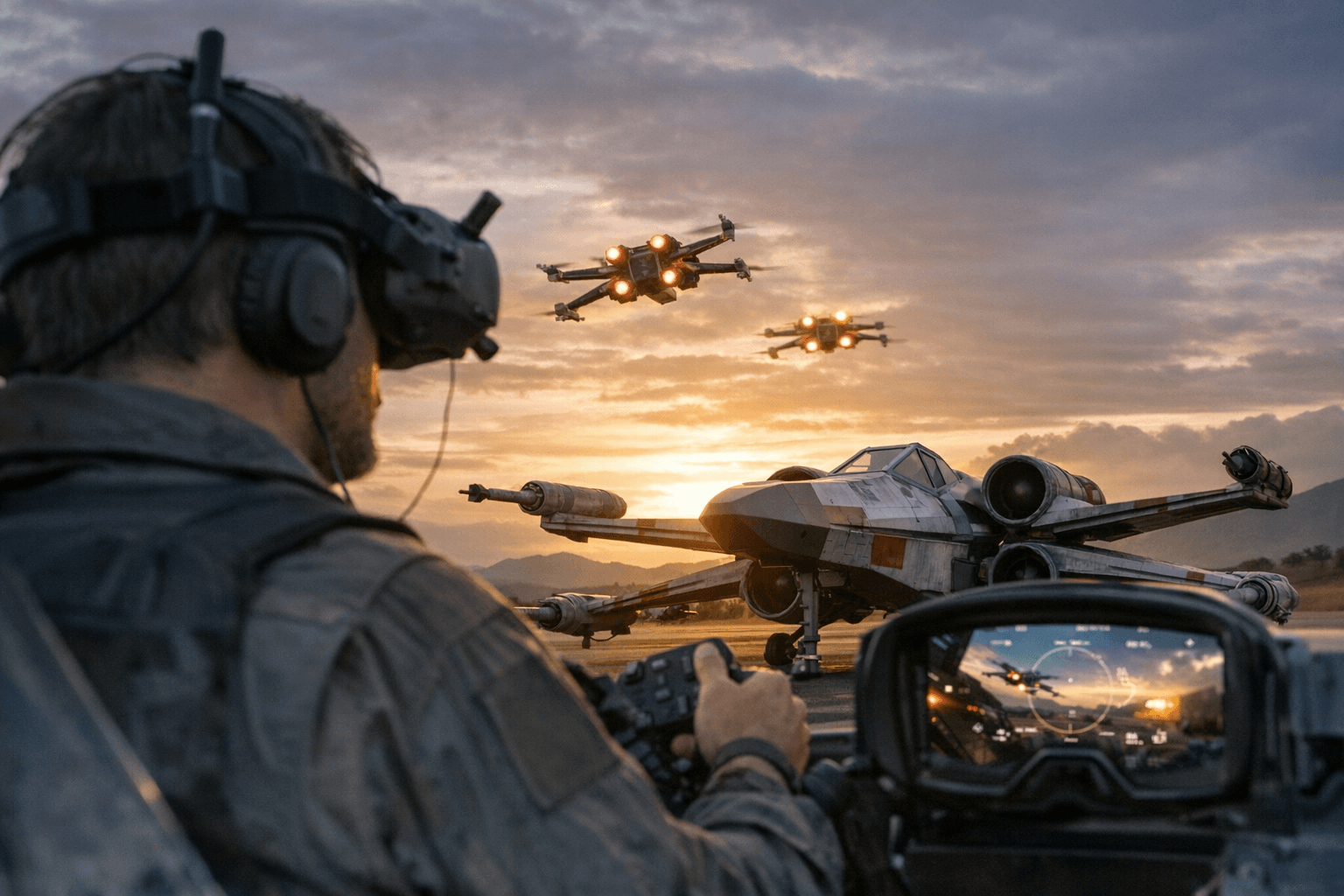
The mechanism that delivers this immersion is straightforward but effective. A forward-facing camera streams live video directly to FPV goggles, giving pilots a continuous cockpit view during flight, while the goggles act as both a viewing interface and a recording device, letting pilots capture footage directly from the cockpit perspective without relying on external cameras.
That live feed is only part of the picture. The system also tracks head movement, allowing pilots to look around naturally while airborne, replicating the situational scan a real pilot would perform mid-flight. As Troye Qu described it: "There's a camera onboard connected to goggles, so you can see from inside the cockpit." The result is a continuous, reactive cockpit perspective rather than a locked forward view, which changes how pilots read their environment and respond to other aircraft in the air around them.
VTOL Capability and Familiar Controls
The X-Wing Fighter pairs with FPV goggles and head-tracking, and the craft folds for transport using foam construction for lightweight durability. VTOL capability means vertical takeoffs and landings without needing a runway or open strip, keeping launches and recoveries compact for field use.
Despite the sophisticated cockpit interface, the control scheme stays on familiar ground. Flywing kept the control scheme familiar to experienced RC users: pilots fly the X-Wing Fighter using a standard RC transmitter, relying on traditional stick inputs rather than custom controllers, and "the aircraft is controlled with a standard RC transmitter." That decision is deliberate. Rather than inventing a new input paradigm that would require relearning muscle memory, Flywing preserved the tactile language that experienced RC pilots already know, which means the learning curve applies to the immersive cockpit layer, not to the act of flying itself.
Radar, Shared Airspace, and Multiplayer
What separates the X-Wing Fighter from a standard FPV fixed-wing is what happens when more than one aircraft is in the air. A functional radar system helps pilots detect and track other aircraft during group flights, reinforcing the sense of shared airspace. This isn't a cosmetic feature. The radar feeds real-time positional awareness directly into the pilot's cockpit view, turning a group flight from a loosely coordinated swarm into something closer to an actual formation exercise with tactical context.
The X-Wing Fighter carries an integrated short-range radar system to enable cooperative and competitive flights. FlyWing built multiplayer interaction into the system to allow formation flying or simulated combat scenarios, and operators will be piloting a single-seat virtual cockpit with HUD-style overlays, on-screen scoring, and the possibility of hit points and team formation mechanics. For organized groups, on-screen scoring and hit-point mechanics would let organizers run matches without third-party scoring hardware, turning local meets into arcade-style dogfights or precision-formation contests.
Hobby-Grade Positioning
Flywing avoids positioning the X-Wing Fighter as a casual toy; Qu said the company sees it as a hobby-grade product aimed at users who want a closer approximation of real piloting. That positioning shapes everything from the control scheme to the radar integration. The platform is not trying to compete with camera drones on footage quality or with toy-grade VTOLs on simplicity. The X-Wing Fighter isn't positioned as a gate-to-gate racer so much as a portable, immersive flying platform that could sit between toy-grade VTOLs and full-on FPV race builds.
Development has stretched over several years, with repeated refinements based on testing and user feedback, and the company says a full kit will be offered on Kickstarter, with a claimed flight time of up to 60 minutes in its current configuration.
What It Means for FPV Flying
The X-Wing Fighter's cockpit-first architecture raises a legitimate question about the direction of hobby FPV. For years, the dominant narrative has been about footage quality, stabilization algorithms, and camera specs. FlyWing's approach argues that the pilot's live sensory experience, not the video archived afterward, is the more compelling design target. For pilots and clubs, this matters in concrete ways: event formats, safety briefings, and rulesets will need updating to cover contact, simulated hits, and shared-state features.
The radar, the head-tracking, and the multiplayer scoring architecture all point toward a flight experience that is socially and tactically layered in ways that no single-pilot cinematic drone can replicate. Whether that translates into a durable category or remains a compelling niche product will depend on the details, price, latency measurements, goggle compatibility, and serviceability chief among them. But as a statement of intent from Flywing Aero Technology, the X-Wing Fighter makes its priorities unmistakably clear: get the pilot inside the aircraft first, and build everything else from there.
This article was produced by Prism’s automated news system from verified source data, official records, and press releases, then run through automated quality and moderation checks before publishing. The system is built and supervised by the people who set the standards it runs under. Read our full AI policy.
Did this article answer your question?