FPV Racing VTX Guide Weighs Power, Heat, and Signal Stability
Max VTX power is not a badge of honor. In FPV racing, the right setting is the one that keeps video clean, heat down, and everyone else on frequency.
The old FPV mistake is still the most expensive one: more power is not always more speed. A transmitter pushed to the top end can add heat, chew through battery, and spray interference across a crowded race, while the wrong low setting can turn a clean lap into a frozen screen at the worst possible moment. The smart move is not “max it out,” it is matching the VTX to the venue, the format, and the rules.
That is why VTX settings matter as much as tune, props, or camera angle. In the largest drone racing league in the world, with hundreds of chapters and more than 30,000 registered pilots, 25mW is still the benchmark for many race environments. That is not nostalgia. It is race management.
What VTX power really changes
VTX power controls how hard the video transmitter pushes signal back to the goggles. More power can help punch through distance and obstacles, but it also raises thermal load and drains the battery faster. In a race, that tradeoff is brutal: too little power and the picture can breakup in a technical gate sequence; too much and the transmitter becomes a little heater strapped to the frame.
The key point is that signal quality is not just about brute force. Video systems fail from heat stress and power strain as often as they fail from weak transmission. That is why a pilot who understands power levels can make better calls under pressure, especially in repeated heats where a quad is sitting on the line, idling hot, and then asked to go full throttle again.
Pit mode, low power, and why cooling matters
Betaflight’s current VTX setup makes the engineering point plain. In Betaflight 4.1 and newer, pilots must configure a VTX Table to control power settings, which means the transmitter is no longer a one-size-fits-all switch. You define the bands, channels, and power levels, and those settings should be tied to local regulations.
Pit mode is the bluntest example of why lower power has real value. Betaflight says pit mode can make the VTX transmit at very low power, or even stop transmitting entirely. That matters in a packed race environment because it reduces heat and cuts the chance of blasting nearby pilots while a quad sits armed on the bench.
Cooling is not a side issue. It is part of the setup. A VTX that runs too hot can become unstable even if the RF link is strong on paper. A race pilot who treats thermal management as part of strategy, not just hardware trivia, is already thinking like a winner.
Match the setting to the venue, not your ego
The right power setting depends on where you fly.
Whoop tracks and tight indoor layouts
On micro-whoop tracks, the job is not to reach the horizon. It is to preserve a clean picture in a tight, reflective, crowded space where several pilots may be transmitting at once. That is exactly where 25mW makes sense. It gives enough signal for the indoor course while helping avoid video chaos when multiple quads are moving through the same airspace.
In a dense club environment, low-latency reliability matters more than raw output. A pilot who cranks power just because the transmitter allows it is often making the field worse for everyone, including themselves. Clean video, not maximum wattage, is the real edge in a small indoor race.
Indoor leagues and multi-pilot events
Indoor leagues live and die on coexistence. When the room is full of transmitters, the issue is not simply range, it is whether everyone can keep a stable picture without stepping on each other. MultiGP’s class specifications explicitly limit VTX power to 25mW because the goal is to increase the success rate of multiple pilots having perfectly clear video transmission and to reduce frequency issues when pilots transmit at higher power.
That benchmark carries over into major competition rules. MultiGP’s 2023 Mayhem team rules used 25mW on Raceband, and championship-oriented racing specs continue to require 25mW for certain events. The message is clear: in organized racing, low power is not a compromise. It is the standard that protects the race.
Outdoor race courses and longer lines
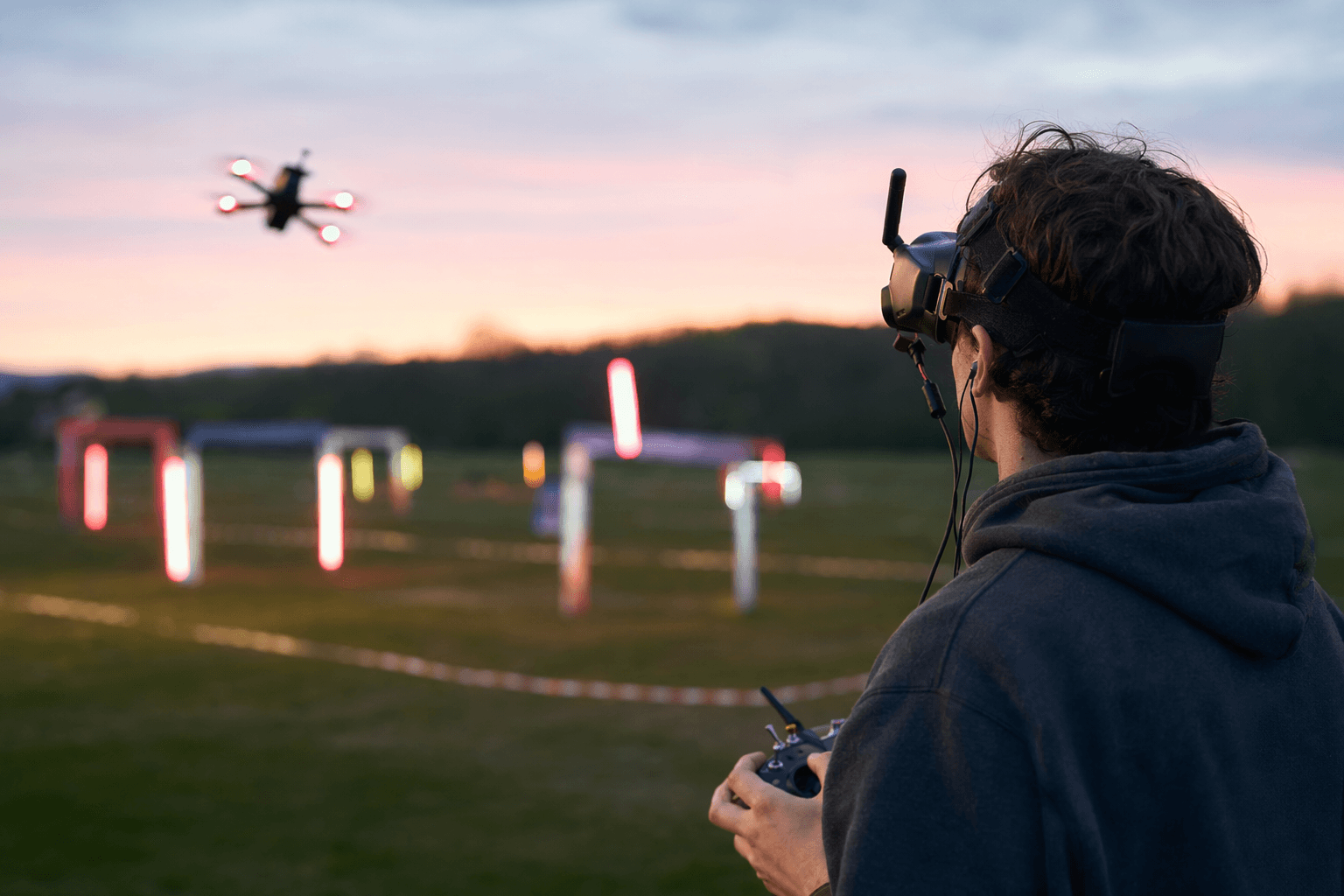
Outdoor tracks change the equation. Open air gives you more room to breathe, and the video link may need more help to stay stable through distance, terrain, or course features. That is where pilots start weighing higher output, but the same rule still applies: use only as much power as the course demands.
For outdoor racing, the best setting is the one that keeps the picture solid through the hardest part of the lap without turning the VTX into a battery drain or heat source. If the quad blacks out in a bend, the race is already slipping away. If the transmitter survives the first lap but cooks itself by the third, the result is the same.
The legal line is part of the setup
VTX power is not just a tuning decision, it is a compliance decision. The Federal Communications Commission says RF devices are regulated equipment and points pilots to the rules in Title 47 of the Code of Federal Regulations. Betaflight’s documentation also tells pilots to define power settings based on local regulations.
That means the smartest setup is not the most aggressive one, it is the one that is legal where you fly. A race-day VTX profile should be built with the venue, event rules, and local regulations in mind. If the class specification says 25mW, that is not a suggestion. It is the line.
A practical decision framework
The easiest way to think about VTX power is to start with the event and work backward.
1. Check the rulebook first. If the event requires 25mW, or specifically calls for Raceband or HDZero in championship settings, lock that in before anything else.
2. Match power to the course size. Small indoor tracks and whoop layouts usually benefit from low-power stability. Larger outdoor courses may justify more output.
3. Watch the heat. If the transmitter runs hot in the pits or after repeated heats, power may be too high for the build.
4. Protect battery life. More output means more drain, and a dying pack can ruin video quality before the lap ends.
5. Use pit mode when it fits the moment. Low-power or no-transmit states reduce interference and help manage bench heat.
6. Keep local regulations in view. The best race setup is useless if it is not legal.
That framework is the point of the whole debate. VTX tuning is not a side quest. It affects video clarity, interference with other pilots, and whether the quad stays legal in organized competition.
The real competitive edge is restraint
The smartest pilots do not treat the transmitter like a volume knob they keep pinned. They treat it like race strategy. On a small whoop track, 25mW can be the winning setting because it keeps the air clean. In a multi-pilot indoor league, it can be the difference between a usable image and a frequency mess. On a long outdoor course, higher power may help, but only if the added heat and battery draw do not create a new problem.
That is the contrarian truth inside the VTX guide: the strongest setup is not the loudest one. The right power is the one that lets the pilot see the next gate, stay within the rules, and finish the race with a picture that never flinches.
This article was produced by Prism’s automated news system from verified source data, official records, and press releases, then run through automated quality and moderation checks before publishing. The system is built and supervised by the people who set the standards it runs under. Read our full AI policy.
Did this article answer your question?