From Tiny Whoop to 3-5-Inch FPV: Complete Pilot Progression Guide
This progression guide maps the move from Tiny Whoop micro classes to 3-5 inch outdoor FPV, detailing skills, gear, training, and race-ready safety that matter for competitive pilots.
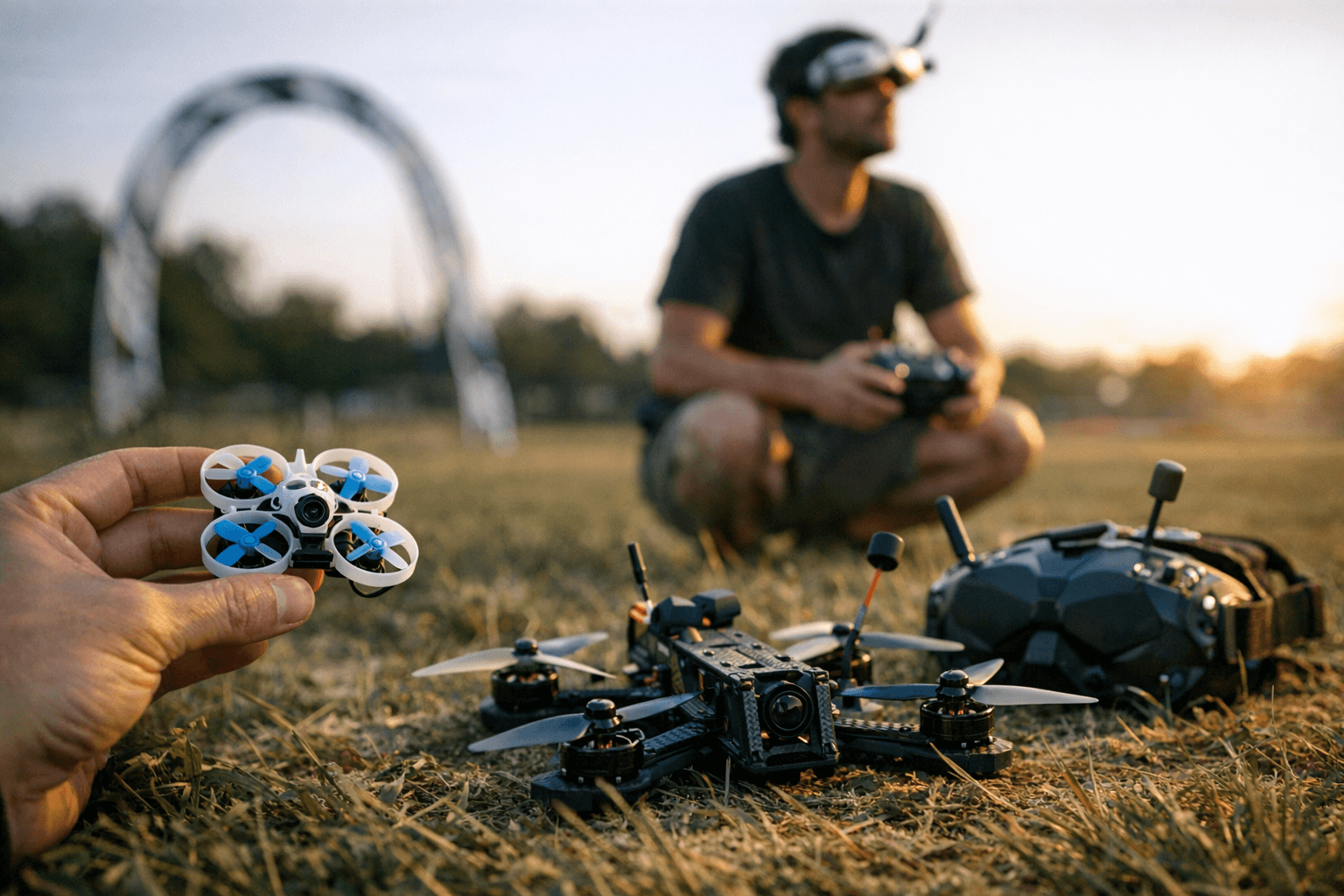
Moving from Tiny Whoop indoor flying to full‑speed 3-5 inch FPV racing is less about bigger motors than about a new mindset: smooth throttle control, gate-to-gate planning, and learning to carry forward momentum instead of stalling into a turn. Pilots advancing to outdoor 5 inch competition need a compact curriculum that pairs simulator hours with field time, concrete hardware targets, and a checklist mentality that translates practice into race results.
Start with skills. Spend the first week in a simulator such as VelociDrone for three to five hours focusing on throttle drills, straight-line speed, and line anticipation. Week two should shift to a low-traffic open field to practice long straights and gentle corners on a 3-4S 5 inch test frame. Week three adds gate work and lap consistency, while week four runs race-format practice: standing starts, overtakes, and clean mains. Measurable goals are lap-to-lap consistency, reduced throttle oscillation, and stable mid-corner lines.
Hardware choices drive handling. Recommended motors sit in the 1900-2600KV range on 4S for a balance of top speed and control. ESC choices favor BLHeli or modern 4-in-1 units rated 40-60A depending on prop and motor selection. Flight controllers pre-configured for Betaflight or alternative modern firmwares reduce setup friction. For FPV, low-latency HD headsets or analog setups paired with reliable controller radios are essential; prioritize clear, low-latency video links for confident passing and high-speed gate entries.
Tuning and setup checklist: begin with conservative PID and filter starting points, then tune P and damping if you see mid-corner oscillations. Address throttle oscillation by adjusting filters and expo rather than aggressive P increases. Prop selection matters, higher pitch and heavier props yield more top speed but increase stress on ESCs and motors; lighter props smooth acceleration and improve lap consistency. Weight reduction should target non-structural items first. For video, test antennas and VTX placement to minimize dropout and glare in transitional light.
Safety, legal compliance, and race prep are non-negotiable. Carry batteries, a quality charger, spare props, motor screws, tools, zip ties, a transmitter, goggles and antennas, a spare VTX or camera, a multimeter, and a basic first-aid kit. Observe battery care, run a preflight checklist, verify local airspace and Remote ID compliance, and practice race etiquette such as marshalling and prop-safety protocols.
Common mistakes and fixes are predictable: throttle wobble needs filter and expo work, mid-corner oscillations require PID damping adjustments, and repeated flips point to flight-mode awareness and line-of-sight fallback. This progression guide is aimed at club racers and pilots preparing for regional 5 inch circuits; it translates simulator metrics and hardware specs into on-track performance. For pilots moving up, the next steps are disciplined simulator hours, incremental field tests, and a race-ready kit that keeps you flying clean and fast.
This article was produced by Prism’s automated news system from verified source data, official records, and press releases, then run through automated quality and moderation checks before publishing. The system is built and supervised by the people who set the standards it runs under. Read our full AI policy.
Did this article answer your question?