HDZero Goggle 2 Brings 1080p OLED, 3ms Latency, and Open-Source Racing Display
HDZero's Goggle 2 pairs a 1080p OLED display with 3ms fixed glass-to-glass latency, a gap wide enough to separate a clean gate from a DNF at 120km/h race speeds.
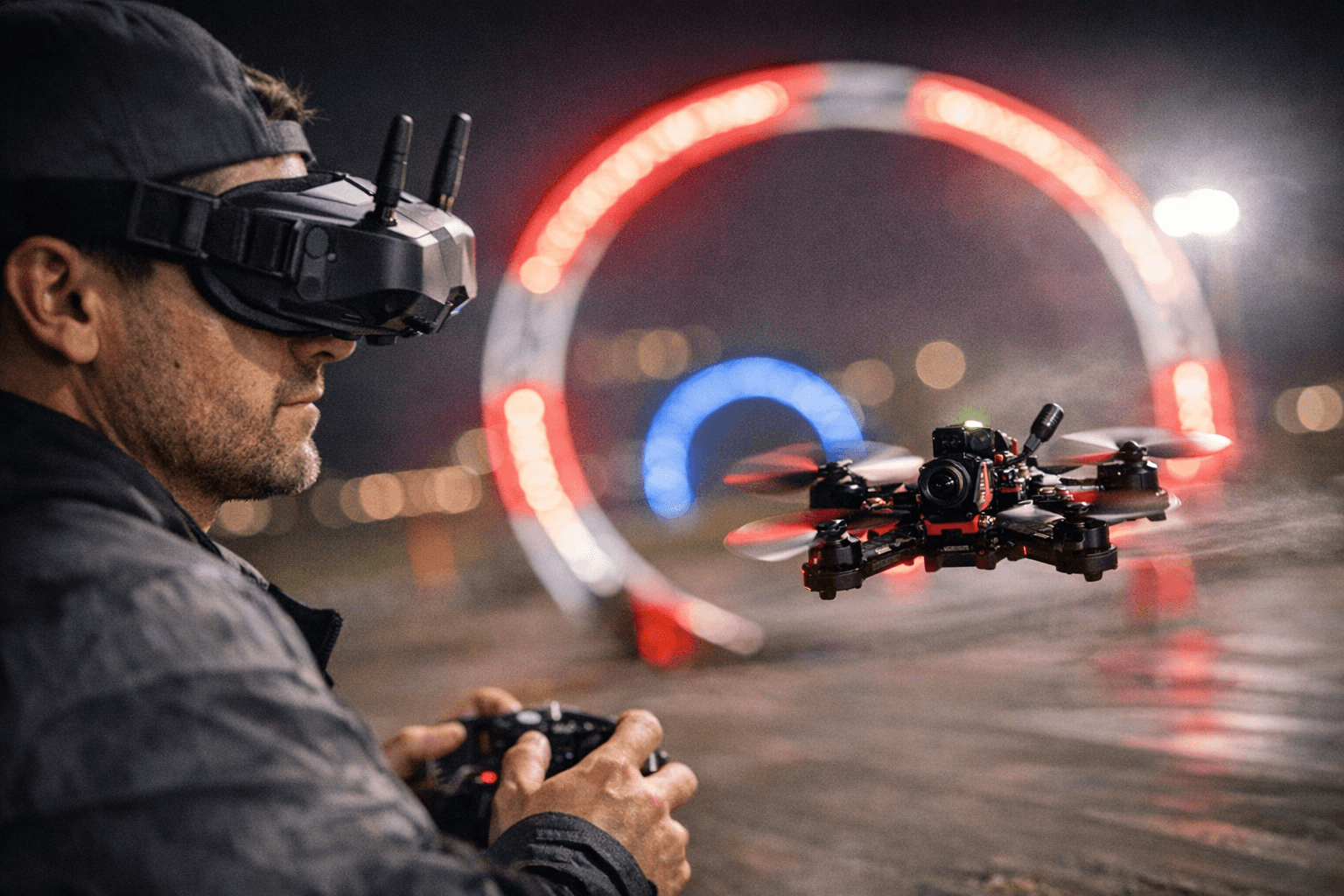
Threading a gate at 120 kilometers per hour, a competitive drone pilot works inside a correction window tight enough that trained pilots can register the difference between a 3-millisecond and an 8-millisecond display feed. That sensitivity is not theoretical: at race speed, analyses of pilot experience have documented perception of 2-to-5ms latency shifts during gate passes. Every frame the image lingers in the pipeline is distance the quad has already traveled without input. HDZero's Goggle 2, listed on the company's official product page in late March 2026, is engineered around precisely that arithmetic.
The number that defines the Goggle 2 for competitive racing is not the resolution. It is the consistency of the latency. HDZero claims a 3-millisecond glass-to-glass figure delivered through a sub-frame, fixed-latency pipeline that produces zero jitter and no dropped frames when paired with its low-latency transmission. The fixed nature of that number carries as much weight as the number itself. DJI's O3 system and Walksnail's Avatar lineup both produce high-quality HD feeds, but their latency is variable: signal congestion, multi-pilot spectral interference, and environmental degradation push both systems beyond 20 milliseconds in dense race conditions, with 28 milliseconds recognized as the threshold where pilots accustomed to HDZero or analog speeds begin to feel the lag as a physical disconnect. In an RF-dense race pack, where multiple quads broadcast simultaneously, the advantage of HDZero's fixed-latency, one-way broadcast architecture compounds with every pilot added to the field.
The display carrying that pipeline is a 1080p 90Hz OLED micro-display, a meaningful shift from the LCD panels that have defined the prior generation of racing goggle hardware. OLED's pixel-level illumination delivers deeper blacks and sharper contrast ratios in the harsh outdoor light where circuit racing takes place, giving pilots a cleaner read of gate depth and spatial position without the washout that affects LCD panels in direct sunlight. At 90 frames per second the display updates faster than the transmission pipeline itself, which means the goggle is never the constraint. HDZero has also built in four adaptive refresh modes, 1080p at 30Hz, 720p at 60Hz, 540p at 90Hz and 60Hz, allowing pilots to match display output to transmission mode and spectrum environment without any hardware swap between rounds.
The race-day hardware engineering runs several layers deep. Three independently addressable fans handle internal cooling and anti-fog management, and each is soft-mounted to decouple vibration from the display stack, a small but consequential design decision: a vibrating OLED in a high-G maneuver introduces image noise that breaks a pilot's spatial read at exactly the moment precision matters most. The optical modules are redesigned for greater image clarity and are now dust-resistant, and they are user-replaceable, meaning a scratched or damaged module does not retire a pilot from an event. Antenna management gets a practical fix through recessed front SMA jacks: antennas stay attached during transport, eliminating a connection-point failure mode that has cost pilots qualifying positions at multi-round events.
For organizers running mixed-format race days, the Goggle 2's integrated analog receiver alongside full HDZero digital support reduces the hardware burden of multi-class fields. A race where some pilots run analog and others run digital no longer requires two separate goggle ecosystems at the marshal or spotter station. HDMI input and output extend that flexibility further for timing integration and external monitoring setups.
H.265 DVR support means onboard race recording uses more efficient compression than H.264, storing longer footage at comparable quality on the same media, a practical advantage at all-day events where pilots archive qualifying runs and finals without swapping storage between sessions. Built-in ELRS backpack support handles control-link integration for race timing and telemetry workflows, and the head-tracking IMU extends the Goggle 2 into simulator and VR training use cases, allowing a pilot to train on the same hardware they race on rather than maintaining a separate simulator setup.
The sharpest differentiation the Goggle 2 makes against DJI and Walksnail is not in any single spec but in its software architecture. Both DJI and Walksnail operate on closed firmware with manufacturer-controlled update cycles. HDZero has released open-source software and CAD files alongside the Goggle 2, running on a Linux-based UI that the community can modify, tune, and build on. In FPV racing, where development iteration is fast and pilot feedback is the most direct form of product testing available, open architecture historically produces performance gains that closed ecosystems cannot match on the same timeline. The original HDZero goggle benefited from community-driven tuning; the Goggle 2 is structured to accelerate that cycle.
The switching calculus, framed by system, breaks down this way. Pilots on the original HDZero goggle gain the OLED display's outdoor brightness advantage, the 90Hz ceiling, the improved thermal management, and access to the open-source platform; the latency architecture was already competitive, and the hardware reliability upgrades make the Goggle 2 a direct racing replacement. Pilots on DJI O3 who race on timed circuits face a direct tradeoff: DJI's image quality margin in casual flight is real, but the fixed 3ms pipeline is not available in any DJI configuration, and in RF-dense race environments the predictability gap widens with each additional pilot on the frequency band. Pilots who race seriously and train in simulators will find the Goggle 2's open-source toolchain more responsive to their specific optimization needs than DJI's closed update cycle allows. Pilots on Walksnail's Avatar system, which shares the variable-latency characteristic with DJI and offers more ecosystem openness than DJI but less than HDZero, face a clearer upgrade path to the Goggle 2 if latency consistency is the primary metric: Walksnail has not closed the gap to HDZero's fixed-pipeline figures in competitive configurations, and the Goggle 2's open-source orientation separates it further on that axis.
HDZero notes that exact shipping dates, latency benchmarks under varied configurations, and final production weights are to be confirmed through authorized resellers. What the late-March 2026 product listing establishes is where HDZero's competitive ambitions are pointed: a display fast enough that the goggle is no longer the variable a pilot has to manage between the gate and the stick.
Know something we missed? Have a correction or additional information?
Submit a Tip