Michigan Capitol Adopts Airspace Link Platform to Manage Drone Traffic
Michigan's Capitol went live with Airspace Link's AirHub Portal in February 2026, giving Capitol Police, State Police, and Lansing PD a shared real-time view of every aircraft overhead.

The Michigan State Capitol in Lansing completed full deployment of Detroit-based Airspace Link's AirHub Portal Drone Operations Management System in February 2026, bringing Michigan Capitol Police, Michigan State Police, and the Lansing Police Department onto a single shared airspace picture for the first time.
The system, built around a vendor-agnostic common operating picture, integrates Remote ID and ADS-B detection sensors to track all aircraft activity surrounding the Capitol complex in real time. Rather than giving each agency its own fragmented data feed, AirHub consolidates that information into one operational view, allowing all three law enforcement organizations to identify whether a given flight is authorized or a potential threat and coordinate a response without burning time on inter-agency communication delays.
The deployment did not happen overnight. Airspace Link ran a proof of concept at the Capitol in late 2025 before the state committed to a full rollout. That transition to full deployment came in February 2026, with Airspace Link's public announcement following on March 9. The system gives Capitol security personnel real-time visibility into both drone and conventional aircraft operations, with automated UAS alert capabilities and friend-or-foe identification built into the platform.
Multi-agency coordination was a specific design requirement for the Capitol, not an afterthought. Airspace incidents over a state capitol can involve overlapping jurisdictions quickly, and having Michigan Capitol Police, Michigan State Police, and Lansing PD accessing the same data simultaneously collapses the response timeline. According to Airspace Link CEO Michael Healander, that kind of collaboration is becoming increasingly important as drone activity grows nationwide.
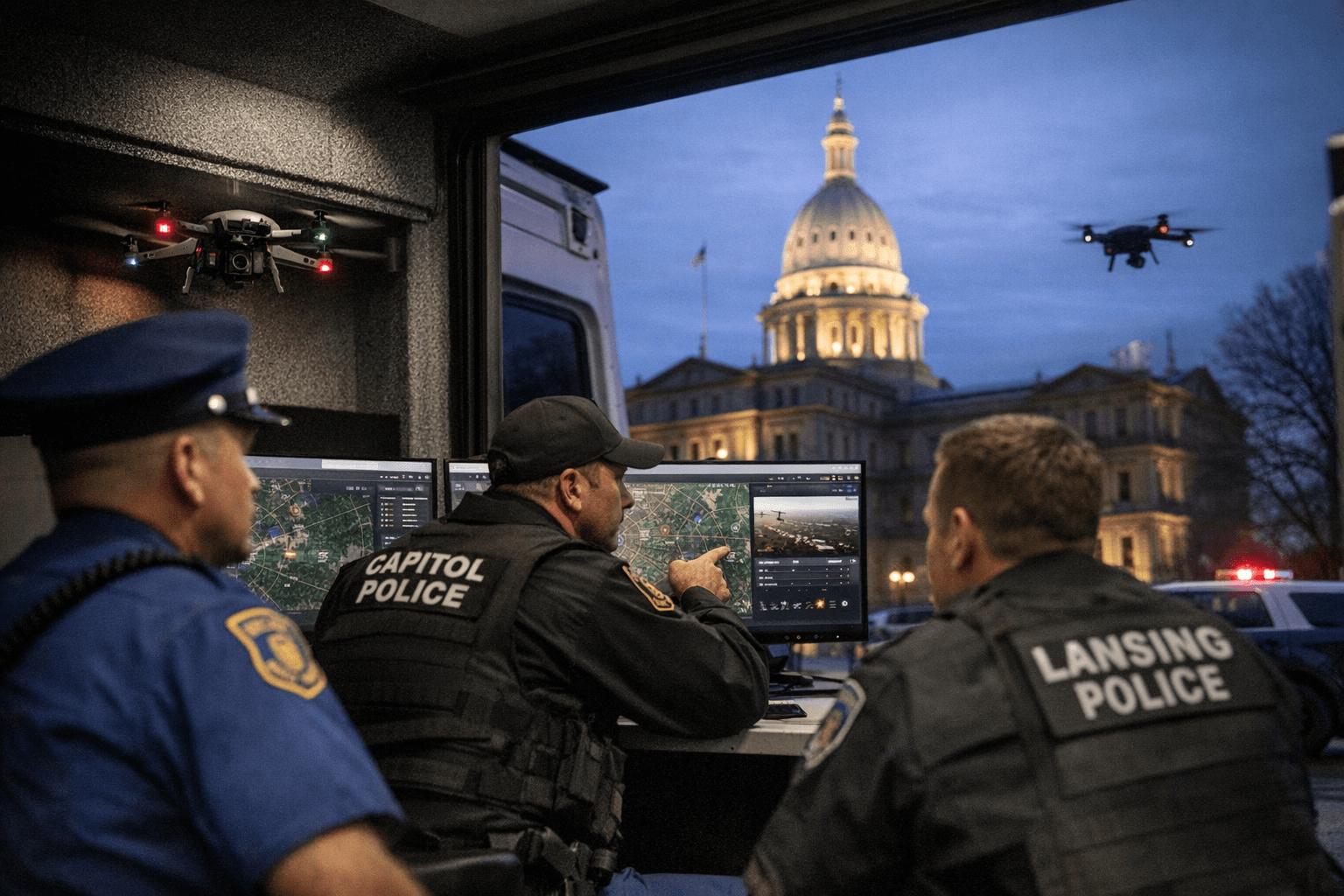
The Capitol is also deploying drones of its own. As part of the AirHub rollout, the Michigan State Capitol is expanding an internal drone team to conduct infrastructure inspections of the complex, with those flights managed through the same AirHub platform. That dual function, both monitoring outside aircraft and managing authorized internal operations, reflects the system's classification as a Drone Operations Management System rather than purely a counter-UAS detection tool.
The timing is not incidental. The 2026 FIFA World Cup is set to span 11 U.S. host cities, and federal agencies including the Department of Homeland Security have flagged integrated airspace security as a national priority. State legislatures across the country are advancing drone-related legislation, and the Michigan Capitol deployment fits squarely within that acceleration of counter-UAS investment at critical infrastructure sites.
Airspace Link, which holds FAA-approved Unmanned Traffic Management provider status, is headquartered in Detroit. The AirHub Portal is designed to be vendor-agnostic, meaning it can pull in sensor data from multiple manufacturers rather than locking an agency into a single hardware ecosystem. That flexibility matters for a deployment covering multiple law enforcement agencies that may already have different equipment in the field.
Know something we missed? Have a correction or additional information?
Submit a Tip