MIDRT USA 2026 blends drone racing with tactical capability testing
Lewis, New York, will host open-class racing, red-force intercept drills and vendor demos in a format built to test more than speed.

MIDRT USA 2026 is setting up in Lewis, New York, as something closer to a proving ground than a standard race meet. From June 1 to 5 at ADK Battlelab, the Military International Drone Racing Tournament will blend open-class FPV racing with tactical mission execution, vendor participation and real-world capability demonstration, a structure built to test whether drone racing can double as an operational sandbox.
The format is what separates this from a normal weekend on the circuit. Registered pilots will get access during designated practice windows on a purpose-built FPV course, while Monday is reserved for equipment check-in, testing, open practice and vendor booth assignments. Tuesday is set aside for open qualifying and tactical event time slots. Wednesday carries morning warmups, practice, evening finals, the championship race and final tactical windows, before teardown and wrap-up on Thursday and Friday.
MIDRT is also broadening the field beyond pure racers. The event is open to military drone pilots and leadership, industry partners, drone and counter-drone manufacturers, first responders, law enforcement and approved non-military participants. That mix turns the weekend into a cross-section of the UAS and C-UAS world, with frequency coordination mandatory and requests for non-standard VTX or control-link setups due by May 1, 2026.
The tactical scenarios underline how far the event has moved beyond lap times. One exercise has teams defending a fixed point against an inbound red-force aircraft approaching from 3 kilometers out, with success measured by cutting the streamer before the intruder crosses a 500-meter perimeter. Another requires teams to identify and intercept a moving military convoy target before it leaves the operational area. A third simulates a precision strike on a fixed infrastructure target from about 2 kilometers away, with battle-damage assessment encouraged. Team size is flexible, though three to five people is suggested.
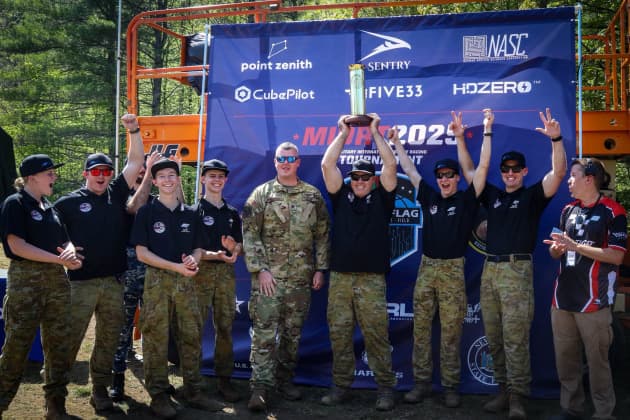
The 2026 stop follows a 2025 MIDRT in upper New York State that drew 37 pilots from the Australian Defence Force, the United Kingdom, Singapore and the United States to a refurbished Atlas-F missile silo site in the Adirondack Mountains. The Australian Defence Force Drone Racing Team won that event, U.S. pilots finished second in the team competition, and an American pilot posted the fastest individual time. The course itself, ringed by decommissioned tanks, trucks and a helicopter, showed how MIDRT has made realism part of the racing product.
That evolution has been years in the making. MIDRT says its inaugural event ran in Sydney in 2018 with teams from Australia, Malaysia, New Zealand, Thailand, the United Arab Emirates, the United Kingdom and the United States. Since then, it has used drone racing to push speed, precision, teamwork and engineering under pressure, while building a pathway into defence, aviation and engineering. Lewis now becomes the latest test of whether open-class racing can live inside a larger tactical ecosystem without losing the competitive edge that made it matter in the first place.
This article was produced by Prism’s automated news system from verified source data, official records, and press releases, then run through automated quality and moderation checks before publishing. The system is built and supervised by the people who set the standards it runs under. Read our full AI policy.
Did this article answer your question?