Monocular-only A2RL Drone Championship Debuts AI vs AI, Human Challenges at UMEX
A monocular-only A2RL Drone Championship debuted AI vs AI and Human vs AI races at UMEX, advancing vision-based autonomy and testing drones in race-like multi-agent and human-competition scenarios.
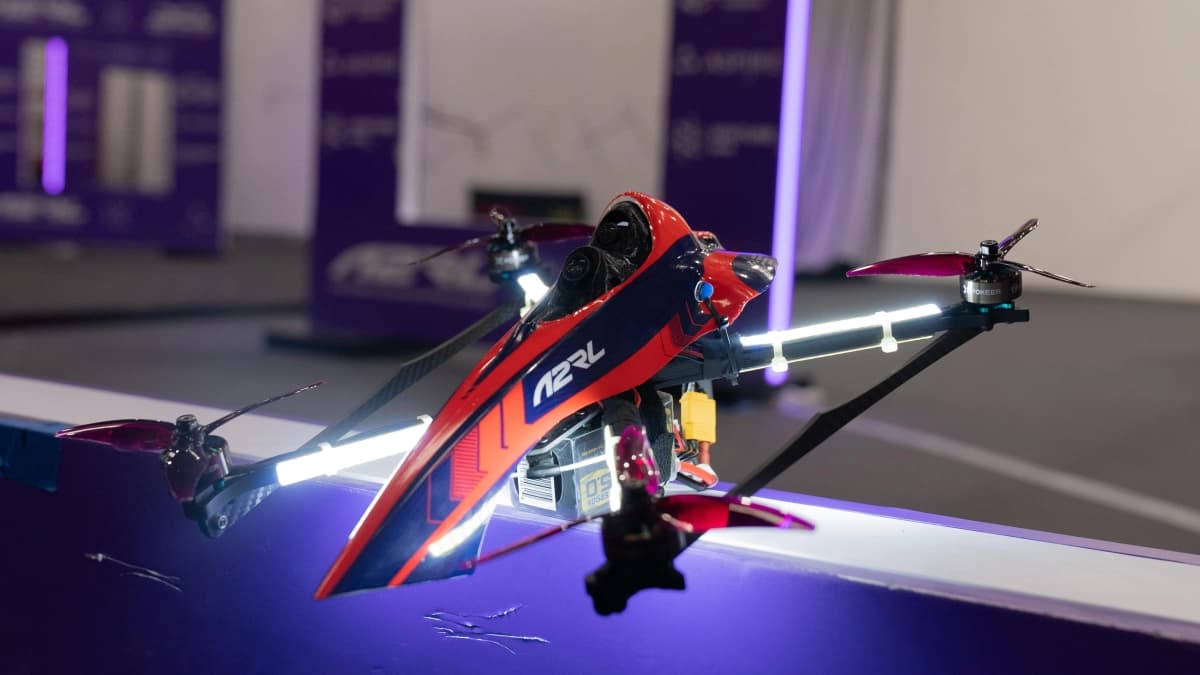
The A2RL Drone Championship staged a high-stakes showcase of vision-only autonomy during UMEX and SimTEX, with Season 2 pushing faster drones, tighter courses and head-to-head formats that tested perception, decision-making and multi-agent behavior under pressure. ADNEC Group announced ASPIRE as Strategic Technology Partner ahead of the event, which ran as part of the region's exhibition for unmanned and autonomous systems.
Organizers ran the championship on 21-22 January after A2RL Summit 3.0 on 20 January, presenting three competition formats. The AI Speed Challenge measured fastest combined time across two consecutive laps in single-drone time trials. The AI vs AI Multi-Drone Race put three autonomous craft in the same airspace to force real-time collision avoidance and strategic pacing. The Human vs AI Challenge matched the fastest autonomous teams directly against elite FPV pilots under identical course conditions. All drones operated fully autonomously using only a single forward-facing monocular RGB camera plus an IMU; no LiDAR, no stereo vision and no external positioning systems were permitted, and all perception, planning and control ran onboard in real time.
Season 2 raised technical ambition from the inaugural year. Competition frames were reinforced for higher speeds and heavier impacts, and the course layout was tightened to amplify technical demand. The Ladder obstacle brought vertical complexity into the gate sequence to probe depth estimation, spatial awareness and high-speed planning where single-camera systems must infer altitude and range without stereo cues.
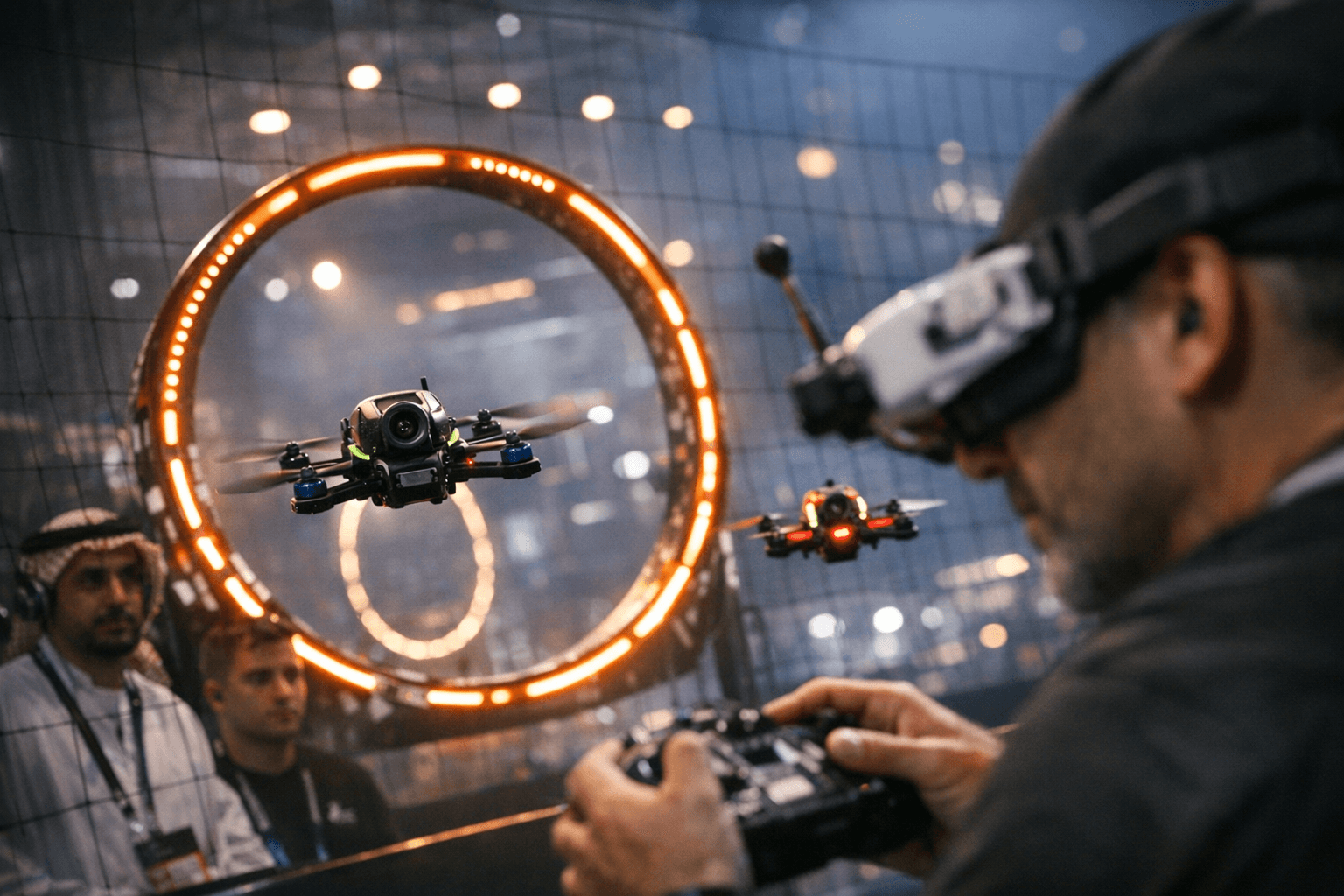
The A2RL Summit 3.0 convened regulators, researchers and industry voices including ATRC, GCAA, Sony AI, AWS and the Technology Innovation Institute to discuss autonomous racing as a testbed for real-world systems, regulatory frameworks and simulation fidelity. ADNEC emphasized A2RL's role as a public science testbed with direct application potential in logistics, inspection, emergency response and future air mobility, underlining how race-sourced advances translate into operational capability.
Event reporting released prior to and during the show focused on format, technical rules and ecosystem participation. Individual race results, pilot names and lap times were not included in the available announcement, so detailed podium statistics are pending formal results distribution through UMEX channels. That omission did not obscure the championship's signal: monocular vision stacks are maturing to the point where real-world multi-agent interactions and pilot-level speed can be meaningfully probed.
For fans and developers, the takeaway is clear. A2RL's insistence on minimal sensors forces software and perception excellence, accelerating techniques that matter beyond sport. Expect teams to iterate rapidly on neural perception, state estimation and trajectory optimization, and for regulators and industry partners to track which autonomy breakthroughs migrate from the racetrack to inspection fleets, delivery drones and emergency response craft.
This article was produced by Prism’s automated news system from verified source data, official records, and press releases, then run through automated quality and moderation checks before publishing. The system is built and supervised by the people who set the standards it runs under. Read our full AI policy.
Did this article answer your question?