Monocular Vision Estimator Cuts Orientation RMSE 70%, Powers A2RL Medal Finish
A monocular vision estimator cut orientation RMSE by about 70% and helped its developers finish among the final four at A2RL, a leap for high-speed, GNSS-denied drone racing.
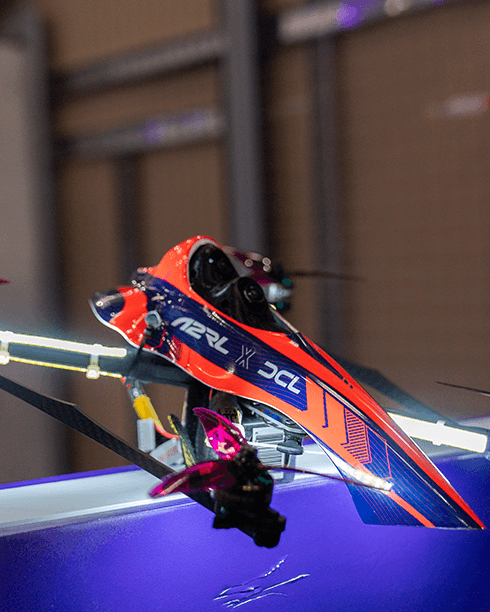
A new vision-centered onboard state estimator is reshaping expectations for high-speed drone racing and industrial autonomy. The arXiv preprint (submitted 2026-02-02) reports a pipeline that reduces orientation Root Mean Square Error (RMSE) by roughly 70%, trims linear velocity RMSE by about 16%, and improves angular velocity estimates by a factor of eight. Those gains powered the authors’ live deployment at the A2RL Drone Racing Challenge, where their team advanced to the final four out of 210 entrants and earned a medal.
At the heart of the paper is a compact claim of sensor simplicity paired with aggressive performance. The manuscript states, "Sensor set: monocular," and also notes, "Additionally, directly incorporating IMU data into the final estimate ensures fast response and high precision even during highly aggressive maneuvers." The juxtaposition implies a vision-centric architecture that nonetheless uses high-rate inertial information to maintain responsiveness under rapid attitude changes - a common and practical design for on-board flight stacks in GNSS-denied, cluttered arenas.
The authors stress that their estimator "corrects all VIO states (position, orientation, linear and angular velocity)," and validate the approach at scale: "Our approach was thoroughly validated through 1600 simulations and numerous real-world experiments." According to the paper, the pipeline consistently outperformed current state-of-the-art methods in those tests, although the supplied excerpts omit the explicit names of the baseline algorithms used for comparison. The manuscript frames the work as a decomposed, classical solution - separating planning, state estimation, and control - and argues that this modularity makes it preferable to end-to-end solutions for industrial and safety-critical applications. As the authors put it, "Unlike end-to-end solutions, our method is well-suited for industrial and safety-critical applications, as it decomposes the problem into planning, state estimation, and control, where theoretical guarantees exist."

For the racing community, the technical gains translate directly into sharper, more reliable flight during aggressive lines and split-second maneuvers. Better orientation and angular-velocity estimates reduce oscillation, improve gate entry angles, and shrink safety margins without endangering craft or bystanders. For team operators and sponsors, that balance of performance and explainability is commercially attractive: systems that can offer theoretical guarantees and decomposed diagnostics are easier to certify, integrate, and maintain than black-box neural controllers.
Beyond sport, the social and industry implications are significant. Faster, explainable estimators expand the use cases for autonomous UAVs in inspection, delivery, and search-and-rescue where GNSS may be unavailable. The paper’s competition result - final four out of 210 and a medal - is a public demonstration that such approaches can survive the real-world chaos of live racing. The manuscript does show a typographical anomaly, listing the competition as "A2RL Drone Racing Challenge 20251" in some passages while elsewhere referring to 2025, which readers should note when cross-checking records.

What comes next is verification and adoption: publication of the full preprint with an arXiv identifier, disclosure of baseline comparisons and absolute RMSE values, hardware details, and release of code or parameters would let teams reproduce lap-time improvements and organizers consider rule and safety updates. For fans and operators, the immediate takeaway is clear: tighter state estimation is making daredevil flight both faster and more defensible, and the next A2RL season may be decided as much by software sophistication as by prop wash and pilot reflexes.
This article was produced by Prism’s automated news system from verified source data, official records, and press releases, then run through automated quality and moderation checks before publishing. The system is built and supervised by the people who set the standards it runs under. Read our full AI policy.
Did this article answer your question?