NASA Airspace Priority Tests Put First-Responder Drones Ahead of Commercial Traffic
NASA tested airspace systems to guarantee first-responder drones instant priority over commercial traffic, with ANRA Technologies and DroneSense supporting the Williamsburg demonstrations.
When a search-and-rescue drone needs to launch, waiting in a digital queue behind a delivery fleet is not an option. That operational reality drove NASA researchers to Williamsburg, Virginia, where they presented new airspace prioritization tests at the DRONERESPONDERS National Public Safety UAS Conference on March 10, 2026, laying out a framework designed to ensure emergency drones cut through commercial traffic instantly.
The tests, conducted by NASA alongside the Federal Aviation Administration and several industry partners, focused on priority airspace features built into a UAS Service Supplier, known in the industry as a USS. The core question was whether those features could reliably resolve conflicts between public-safety missions and the growing volume of commercial drone operations, including delivery services, without requiring human intervention or causing dangerous delays.
ANRA Technologies served as the USS during the demonstrations, managing the airspace coordination layer at the center of the tests. DroneSense provided software support throughout the process. Together, the two companies helped NASA and the FAA run through multiple scenarios engineered to mirror real-world conditions, though specific scenario details and quantitative outcomes from the tests have not yet been released publicly.
"If public safety needs to conduct a life-saving mission, the system must ensure they can operate immediately and safely," said Borade, who was quoted in coverage of the conference. Full attribution for Borade, including a first name and organizational role, was not available at the time of publication.
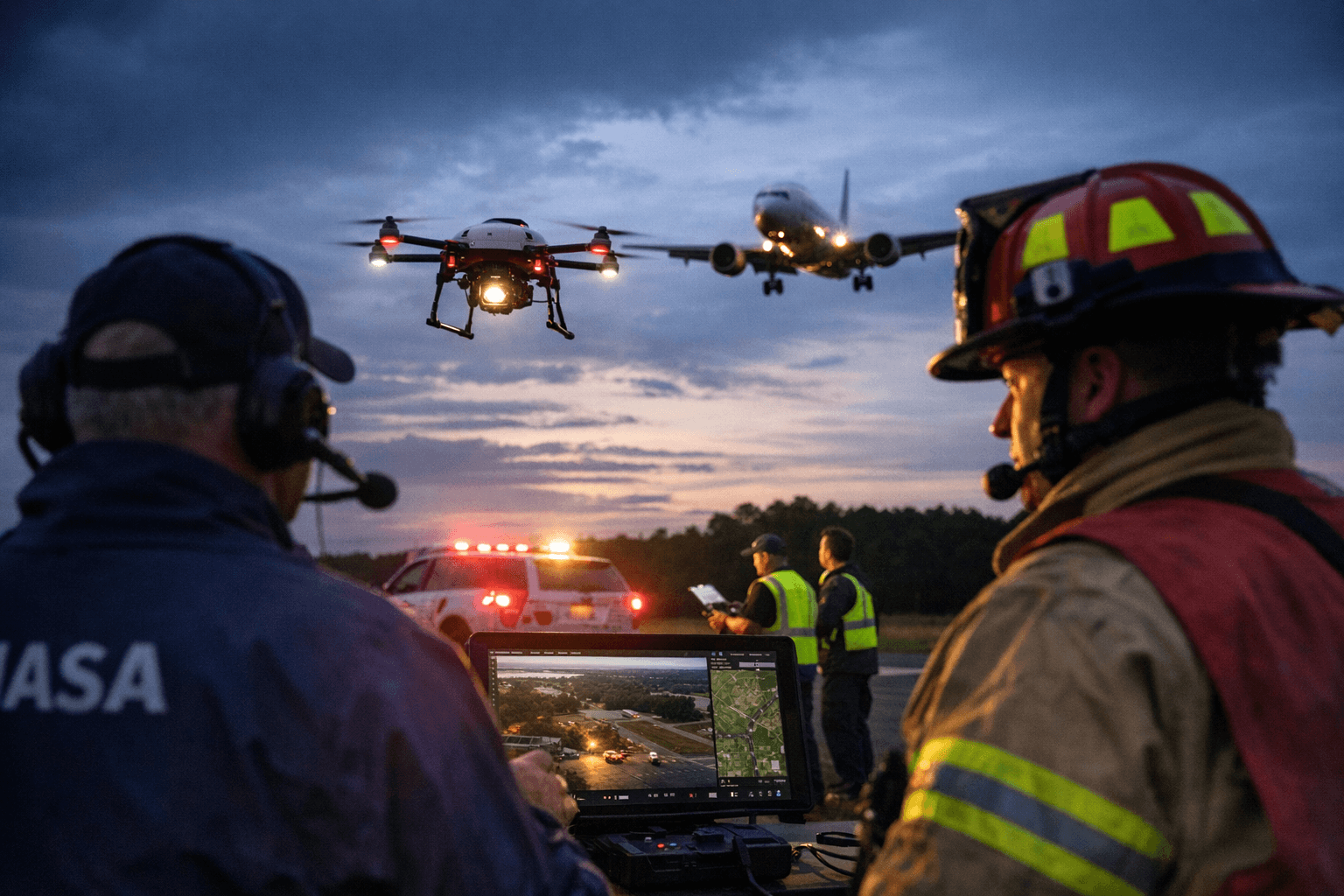
The urgency behind the research tracks directly with how quickly the U.S. drone landscape is changing. Commercial operators, particularly drone delivery providers, are filing for increasing volumes of airspace access across urban and suburban corridors. As that traffic density rises, the risk that a first-responder drone could face routing conflicts or clearance delays during a critical mission becomes a legitimate operational concern rather than a theoretical one.
NASA's approach frames the USS, the digital infrastructure layer that manages drone flight coordination, as the place where priority logic must live. By embedding emergency access rules directly into the USS, researchers hope to create automated systems that recognize a public-safety flight's urgency and clear a path without manual override. The March demonstrations were designed to stress-test whether that architecture holds under simulated pressure.
The work presented in Williamsburg is part of a longer research arc. NASA's stated goal is to build a technical foundation that allows commercial drone growth and emergency drone access to coexist, with clear precedence rules in place before the skies become significantly more congested. Whether the FAA will translate the findings into formal regulatory requirements or operational guidance for USS providers remains an open question, and no policy timeline has been announced.
Know something we missed? Have a correction or additional information?
Submit a Tip