NIT Delhi Drone Racing Challenge 2026 demands speed, precision, and control
One clean run decides everything at NIT Delhi, where drone speed only matters if it survives gates, turns, and a precision landing.
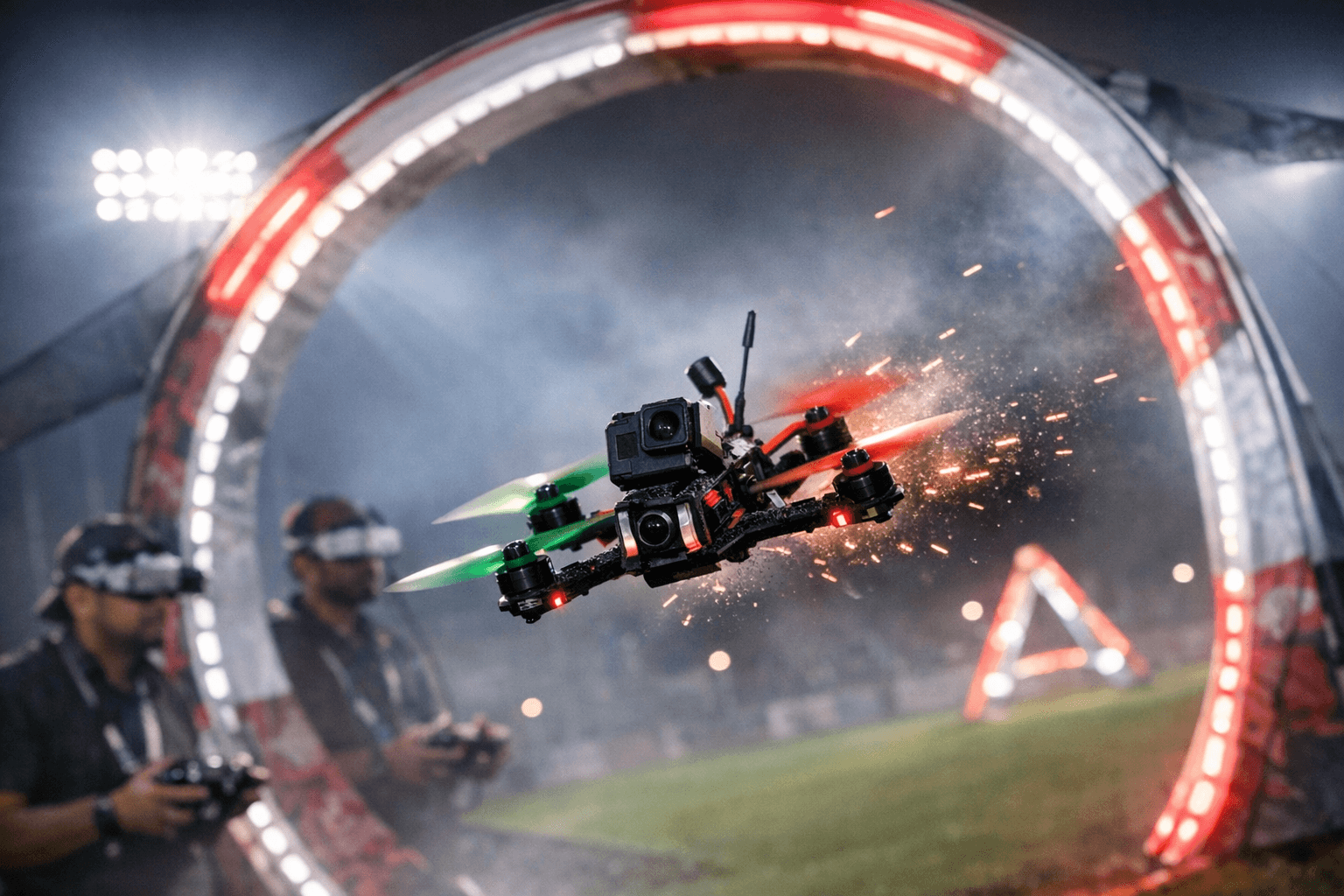
A one-shot format turns the race into a pressure test
The NIT Delhi Drone Racing Challenge 2026 is built to expose the difference between raw speed and real control. In a single round, with no second chance to recover from a bad turn or a sloppy landing, the race becomes less about flash and more about execution under pressure. That is the story here: one run, one clock, and a course designed to punish hesitation, drift, and overcorrection.
This is what makes the event stand out from standard campus drone competitions. In many university races across India, pilots get qualifiers, heats, or a final bracket that gives them time to adapt. NIT Delhi’s format compresses the entire contest into one decisive attempt, which changes everything about how pilots prepare, how they tune their quads, and how they manage risk. The challenge is not simply to be fast. It is to be fast without losing the precision that keeps a lap alive.
What the course demands from the first gate to the final landing
Unstop lists the event as a combined racing and precision-course challenge inside a fixed time window, and that wording matters. The course is built around straight-line speed segments, gate navigation through hoops or frames, sharp turns, directional control, and a precision landing zone. Each element asks for a different kind of discipline, and the strongest runs will be the ones that connect all of them without visible strain.
That structure tells you what the organizers want to reward. A pilot who guns the throttle on the straightaways but clips a gate, drifts wide in a turn, or lands outside the target zone is likely to lose ground quickly. The course is not a spectacle track built only for speed highlights. It is a technical test that values clean lines, stable flight, and the kind of control that holds up when the margin for error is thin.
How scoring changes the race
Evaluation is based on total time, accuracy in passing checkpoints, stability during flight, and penalties. That combination creates the central tension of the event: speed helps, but only if it does not come with mistakes. A messy run can easily give way to a cleaner one, especially if penalties stack up or the pilot spends too much time correcting small errors.
That scoring system makes the format-shift especially important. In a multi-heat event, a pilot can sometimes survive one imperfect run and recover later. Here, there is no such cushion. The one-round setup puts engineering reliability on the same level as pilot reflexes, because a well-built quad that stays stable through turns and checkpoints can be the difference between a good time and a wasted attempt. In practical terms, this is a race where a steady airframe and a disciplined line matter as much as raw throttle response.
Who can enter, and why the field matters
The event allows teams of 1 to 5 members, which opens the door to solo pilots and small engineering groups alike. That range is part of what gives the competition its reach. A single student can enter with a sharp set of flying skills, while a small team can divide responsibility across build, tuning, and race-day execution.

Eligibility is also broad for a campus competition. It includes engineering students as well as undergraduate and postgraduate participants from other disciplines, which suggests NIT Delhi wants more than a narrow technical showcase. The format can welcome students who already follow FPV racing closely, but it also works as an entry point for newcomers who are learning how racecraft, tuning, and pressure management fit together. That mix makes the field more varied and the competition more revealing.
Why NIT Delhi is a natural host
The venue is National Institute of Technology Delhi in Alipur, Delhi, India, and the setting fits the event’s technical identity. NIT Delhi describes itself as one of the 31 NITs, established in 2010 by an Act of Parliament, and its current site identifies it as a premier public technical university and an Institute of National Importance in Delhi. This is not just a backdrop. It is the kind of institution where a drone race can sit naturally alongside engineering and applied problem-solving.
The institute’s clubs ecosystem reinforces that point. Its clubs page lists Aeromodelling, known as Vyomkriti, and Robotics among its technical clubs, which places the challenge inside a broader culture of building and testing machines. Kinetic Robotics Club, the organizer, presents itself as NIT Delhi’s premier robotics club. The club’s profile says it has 10-plus projects, 24 members, and 2 awards, which signals that this is an active student group with a real engineering footprint rather than a one-off event committee.
The educational layer behind the competition
NIT Delhi leadership has framed Kinetic as a bridge between learning and real-world application, with an emphasis on creativity, teamwork, innovation, and problem-solving. That matters because the race mirrors those values almost perfectly. Pilots need creative line choices, teams need coordination, and the course itself rewards the kind of problem-solving that happens under race pressure, not in a lecture hall.
The structure also says something larger about where student drone racing in India is heading. These events are no longer just demonstrations of speed or crowd-pleasing agility. They are becoming controlled tests of accuracy, stability, and decision-making. By building a one-round format around gates, turns, and landing precision, NIT Delhi is training pilots for the kind of flying that reveals discipline, not just spectacle.
Why the single-round format changes the stakes
The sharpest insight from this challenge is how much a single run can reveal. In a multi-heat environment, a pilot can treat early runs as reconnaissance, adjusting lines and fixing errors. In a single-round course, every choice is final the moment the drone clears the gate or misses it. That creates a more severe test of preparation and a clearer measure of composure.
For Indian student drone racing, that shift is important. It pushes the sport toward a standard where accuracy is not secondary to speed, but part of speed itself. The NIT Delhi Drone Racing Challenge 2026, last updated on 22 Apr 26 at 02:21 AM PDT, captures that evolution cleanly: one round, one course, one chance to prove that the fastest pilot is the one who can stay precise when the pressure is highest.
This article was produced by Prism’s automated news system from verified source data, official records, and press releases, then run through automated quality and moderation checks before publishing. The system is built and supervised by the people who set the standards it runs under. Read our full AI policy.
Did this article answer your question?