Parallel Flight's Firefly Drone Earns FAA Clearance for Commercial Operations
Parallel Flight's Firefly cleared the FAA's 55-lb weight threshold with a Section 44807 exemption, backed by a $3.74M Navy shipboard contract and first customer units shipping this summer.
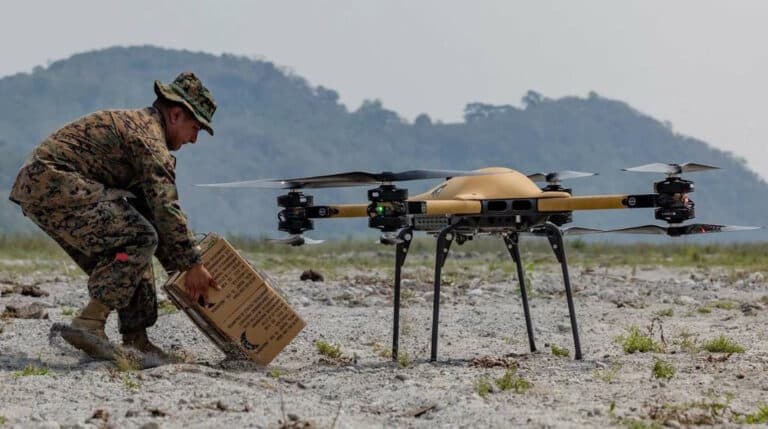
When a drone weighs more than 55 pounds at takeoff, the standard Part 107 rulebook doesn't apply. Getting into the air commercially requires a 49 U.S.C. §44807 exemption, and the FAA doesn't hand those out easily. Parallel Flight Technologies, based in La Selva Beach, California, just earned one for its Firefly heavy-lift hybrid UAS, clearing the path for commercial operations across U.S. airspace.
The exemption, announced February 24, required Parallel Flight to demonstrate rigorous safety architecture, documented operational procedures, and genuine platform maturity to FAA reviewers. That process matters because it separates concept hardware from cleared, deployable systems. CEO Craig Stevens framed it plainly: "This is an important step for our team and our customers. The 44807 exemption validates the safety architecture, system design, and maturity of our platform. We are ready to support customers as demand for heavy-lift, long-endurance UAS continues to grow."
The Firefly is a Group 3 quadcopter built around a propulsion architecture Parallel Flight calls PHEM, short for Parallel Hybrid Electric Multirotor. The engineering distinction is meaningful. Serial hybrids use a generator to charge a battery; parallel hybrids run the gas engine and the electric motor simultaneously on each rotor, which delivers both efficiency gains and true per-rotor redundancy. Five patents protect that architecture. The company claims the system enables payloads up to 100 pounds (45 kg), supplies 2 kW of continuous in-flight power to payload systems, and produces endurance up to 10 times greater than all-electric UAS of comparable size.
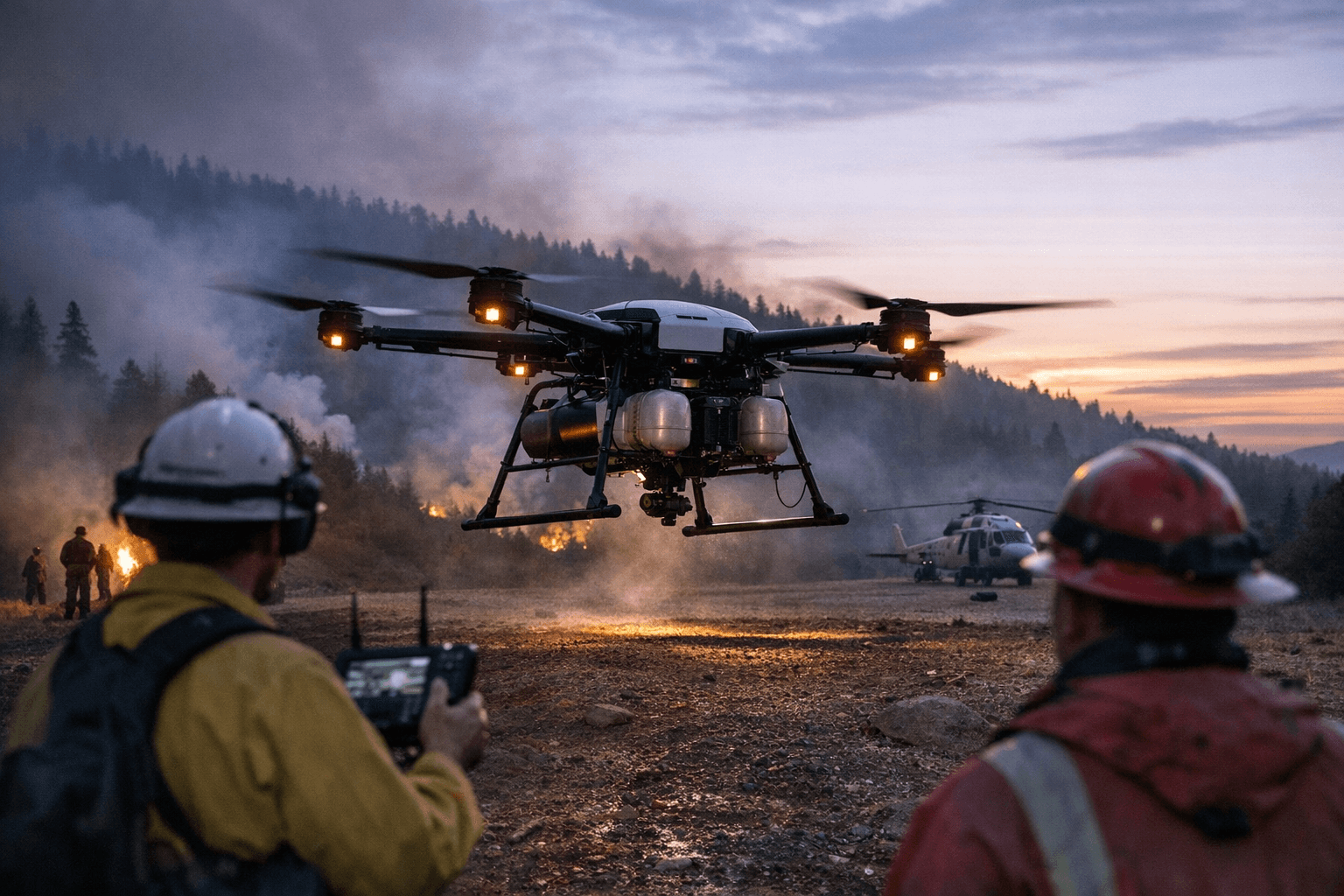
That endurance claim, combined with the portability profile, is what makes the Firefly unusual in its class. Two people can carry it, transport it in the bed of a pickup truck, and deploy it with no ground infrastructure. That combination puts it squarely in the frame for wildland firefighting support, heavy sensor packages for industrial inspections, and cargo runs to remote locations where conventional aircraft can't operate cost-effectively.
The platform has drawn serious institutional attention. The Defense Innovation Unit, USDA, NASA, NSF, and the Office of Naval Research have all supported its development. The Navy's investment is the most concrete signal of where this technology is headed: the service is paying $3.74 million to adapt the PHEM system for shipboard use, according to DroneXL.
Parallel Flight says initial customer units will ship this summer, enabling what the company describes as a transition of contracted programs and a qualified pipeline into active commercial operations. The Firefly is NDAA-compliant and manufactured in the United States, a specification that matters increasingly for government and defense-adjacent procurement.
The exemption doesn't resolve every question. The specific operational conditions the FAA attached to the clearance haven't been publicly disclosed, and the company hasn't named its first commercial customers. But the regulatory barrier that kept the Firefly grounded commercially no longer exists, and the hardware behind it has already convinced the Navy to write a check.
Know something we missed? Have a correction or additional information?
Submit a Tip