Russia Tests Geran-2 as FPV Drone Carrier for Deep-Strike Attacks
Ukraine intercepted a Geran-2 fitted with two FPV drones on its wing, revealing a Russian two-stage strike concept pairing long-range autonomy with operator-guided terminal precision.
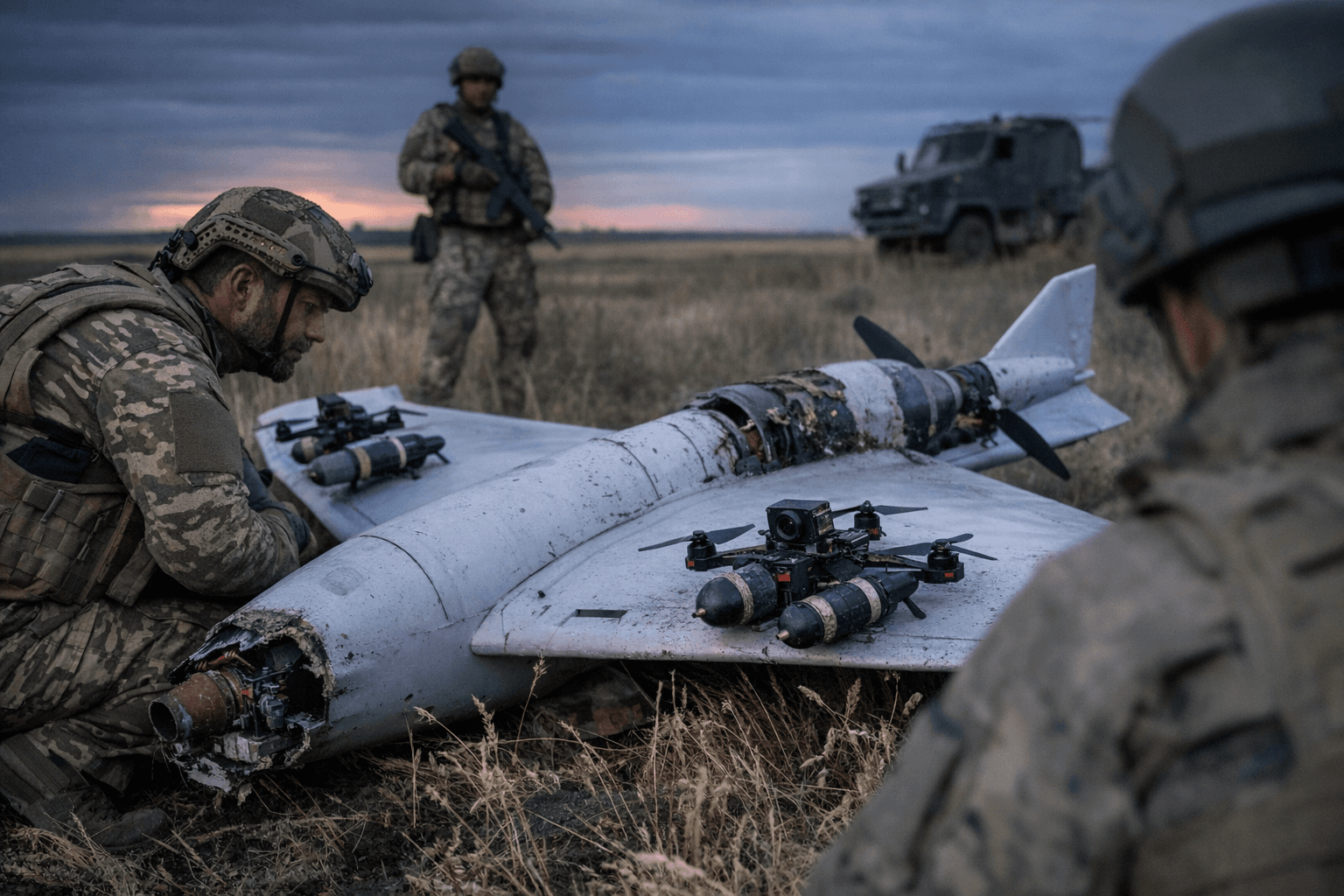
Ukrainian air defense units intercepted and destroyed a Geran-2 loitering munition with two FPV attack quadcopters mounted directly on its wing, confirming that Russia is actively experimenting with converting its most prolific strike drone into a mothership for short-range rotary payloads.
The Geran-2 is Russia's derivative of Iran's Shahed-136, a delta-wing autonomous munition carrying an estimated 50-kilogram warhead across a 2.5-meter wingspan. Depending on variant and payload configuration, the platform is capable of autonomous flight across hundreds to more than a thousand kilometers of contested airspace using GNSS and inertial navigation. The modification documented by Ukrainian Darknode units retains that strategic transit range while grafting on a terminal precision layer that a fixed warhead cannot provide: two operator-guided quadcopters released in the final approach to target.
The vehicle was neutralized before any payload separation occurred, which left its specific mission profile, reconnaissance, terminal strike, or both, unresolved. What the physical airframe confirmed is that the concept has moved beyond theory and into active fielding. Ukrainian open-source reporters and Darknode units documented the configuration before its destruction.
The tactical logic of the two-stage architecture is difficult to counter efficiently. A Geran-2 flying a conventional autonomous profile delivers its quadcopter operators to within short-range engagement distance, where the payloads separate and close under direct human control with on-board cameras and jam-resistant telemetry completing the guidance chain. That last-mile manual control addresses the core limitation of fixed loitering munitions against fleeting or protected targets, precisely the hardened positions and mobile equipment that have driven demand for FPV precision on both sides of the conflict.
For air defense planners, the configuration compounds an already layered interception problem. Sensor and engagement systems calibrated to the Geran-2's radar cross-section, altitude band, and flight profile do not automatically address the small rotary payloads it carries. Defenders face two simultaneous threat classes: a large carrier that is detectable at range, and compact quadcopters that separate and descend at close quarters with a very different kinematic profile. Analysts cited in coverage of the development stressed the need for layered counter-UAS capabilities spanning multiple altitudes and speeds, incorporating both electronic warfare and hard-kill systems able to service both platforms in the same engagement window.
The concept is not unprecedented globally, but the choice of an expendable, mass-produced loitering airframe as the carrier platform is a distinctly Russian adaptation: cheap enough to absorb attrition, standardized enough to modify at scale, and already present in Ukrainian airspace in sufficient numbers to field experimental configurations without disrupting baseline strike operations. The intercepted airframe signals that the operational envelope of FPV effects has extended well beyond the front line.
This article was produced by Prism’s automated news system from verified source data, official records, and press releases, then run through automated quality and moderation checks before publishing. The system is built and supervised by the people who set the standards it runs under. Read our full AI policy.
Did this article answer your question?