Russia's New KVS FPV Drone Uses Fiber-Optic Control for Jamming Resistance
Russia unveiled the KVS, a fiber-optic FPV attack drone with a ring wing that claims 5x the range of its predecessor while staying immune to jamming.
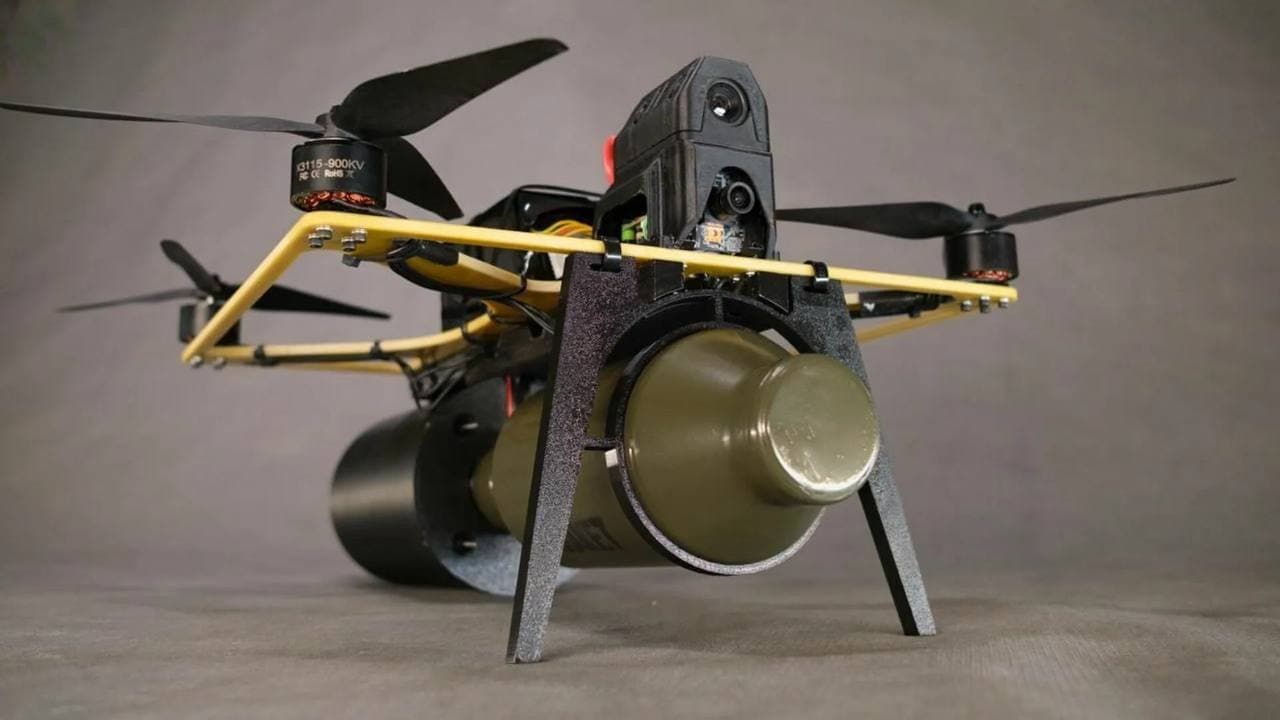
The most disruptive thing about Russia's KVS attack drone is not the shape of its wing, though that is hard to miss. It is the absence of a radio link. The KVS, short for Prince Vladimir Svyatoslavych, transmits control signals down a physical fiber-optic tether, eliminating the RF attack surface that electronic warfare teams on both sides of the Ukraine conflict have spent the past year systematically dismantling.
Alexey Chadaev, CEO of Ushkuynyk, the Veliky Novgorod production company that built it, released images of the drone on Telegram late last month. The airframe sits on a 10-inch configuration and carries a warhead reportedly comparable to the Knyaz Vandal Novgorodsky, up to three kilograms. Its defining structural feature is the annular, or closed-loop, wing, which joins the wingtips in a ring that channels airflow downward, reduces vortex drag, and generates additional lift. Ushkuynyk claims the result is roughly five times the range of its earlier KVN model, with the same payload.
The context for that design decision is a battlefield geometry problem. Samuel Bendett, adjunct senior fellow at the Center for a New American Security, framed Russia's prior position directly: "Russia was the first mover when it comes to fiber optic drones, using them in the Kursk region." That edge collapsed. Ukraine countered with its own fiber systems, then pushed standard FPVs to 50 to 60 kilometers using Starlink data links, airborne relay drones, and mothership launch platforms. Russia's Starlink access ended in February 2026, leaving it without the long-range relay architecture Ukraine has built. The KVS is the structural answer: extend reach through aerodynamics rather than relay, and keep the control link unjammable by keeping it physical.
Fiber-optic control stays reliable out to roughly 10 kilometers and is specifically effective in the terrain that defeats conventional 2.4 GHz and 900 MHz radio: dense forest, urban corridors, trenches, and tunnels where signal scatter and multipath losses accumulate. The failure mode is not jamming but physics. Beyond 20 kilometers, the tether becomes the liability as cables snap under stress, particularly with larger airframes or heavier payloads. Ukraine has already addressed the same problem in its own fiber fleet by testing dual-channel drones that pair fiber and radio so the aircraft keeps flying if the cable severs. Whether the KVS carries similar redundancy is not confirmed from available open-source imagery.
For the FPV community, this is recognizable engineering. The same latency, bandwidth, and interference tradeoffs that govern link selection in racing are being pressure-tested at scale, with the stakes considerably higher than gate placement. The comparison is direct.

Racing Link Stack vs. Fiber-Optic Stack
| Category | Racing Stack | Fiber-Optic Stack |
|---|---|---|
| Video | 5.8 GHz analog or digital broadcast | Direct feed over tether, no RF broadcast |
| Control link | 2.4 GHz or 900 MHz RC | Fiber-optic cable |
| Latency | Sub-1ms (analog); 8-22ms (digital) | Near-zero electrical latency |
| Range ceiling | RF envelope, terrain dependent | Hard cap at cable length (~10 km reliable, degrades past 20 km) |
| Interference | Susceptible to band congestion | Immune to RF jamming |
| Snag and fail risk | Minimal in open courses | Catastrophic in open terrain; cable snap ends the flight |
| Weight penalty | Negligible | Spool and tether add significant mass and drag |
The KVS does not resolve these tradeoffs so much as wager that, inside constrained terrain at medium range, the immunity column is worth every other cost. Given the iteration pace on both sides of this conflict, the next adaptation is almost certainly already in testing.
Know something we missed? Have a correction or additional information?
Submit a Tip