Skyworx Closes CES 2026 With 1,200 Drones, Four Shows in Three Hours
Learn how Skyworx and DAMODA ran four 1,200-drone shows in a three-hour window at CES and what that rapid, repeatable operation means for sports events and large-scale activations.

1. First performance
The opening run was one of four full-scale performances in a compressed three‑hour window, showcasing a fleet of 1,200 drones flying tightly choreographed patterns above the Las Vegas Strip. The sequence underscored the show's defining attributes: speed, repeatability and high-density flight, phrases described in reports as “tightly choreographed” and “repeatable, high‑speed sequences in dense urban airspace.” Operationally, the display was notable not just for scale but for how the hardware and choreography behaved like athletes executing a practiced routine: the same complex formations could be re-run with consistency across multiple shows, an important capability for sports halftime slots and stadium activations where timing matters.
2. Second performance
The second show reinforced the program’s operational thesis: large fleets can be run quickly and reliably with a compact crew. Skyworx staged the four performances with a “six-person core operations team,” while Skyworx operated and owned the fleet and DAMODA provided “automation-heavy swarm control systems and precision positioning technology,” according to reporting. The initiative was described as setting “a new bar for how efficiently large drone performances can be pulled off in the US,” and Skyworx’s CEO put the point bluntly: “This project demonstrates what’s now possible when advanced automation, streamlined workflows, and experienced operators come together,”, Taylor Woodall, Skyworx Drone Shows CEO. For sports managers, that combination of automation and a lean human crew signals a future where stadium spectacles can scale without proportionally ballooning labor costs.

3. Third performance
Technically, every run relied on the precise interplay of swarm control and positioning, the systems that turn a thousand-plus drones into coordinated pixels in the sky. DroneDJ and other outlets emphasize DAMODA’s role in supplying the automation backbone, “automation-heavy swarm control systems” and “precision positioning technology”, while Skyworx supplied fleet operations and airspace experience. Skyworx’s own materials explain the baseline tech approach: “Drone shows use hundreds of light-equipped quadcopter drones, synchronized through GPS and our proprietary software.” The partnership framing also appeared on DAMODA’s social post fragment: “DAMODA, with our partners @skyworxdroneshows , is making its appearance at CES 2026, presenting a large-scale 1,200-drone light show over”, that truncated caption highlights the joint marketing and technical stake both companies hold in pushing drone shows into mainstream event schedules.
4. Fourth performance
The final run closed the three‑hour cycle and crystallized why the deployment matters beyond a dazzler over Las Vegas: it maps directly onto what sports promoters and brands want, repeatable spectacle that can be delivered reliably across multiple show windows. Skyworx’s broader messaging frames this as a new operating benchmark; the company’s own headlines claim it “Sets New U.S. Benchmark With Hourly 1,200-Drone Performances at CES 2026,” while reporting noted four full performances in a three-hour span and called the operation one of the most efficient large-scale deployments seen in U.S. event airspace. Culturally, these shows are moving from novelty to toolkit, Skyworx’s site even lists use cases from branded pop‑ups to NCAA football halftimes, signaling that drone light shows are becoming a repeatable form of mass entertainment rather than one-off stunts. Practically, if you’re planning an event, factor in proven operational constraints: Skyworx’s FAQ recommends a lead time of “30 to 60 days” for creative and logistical planning and notes technical tolerances, drones that can operate in winds “up to 26 mph” and typical show lengths of “12 to 15 minutes”, so build scheduling, safety margins and contingency plans around those parameters.
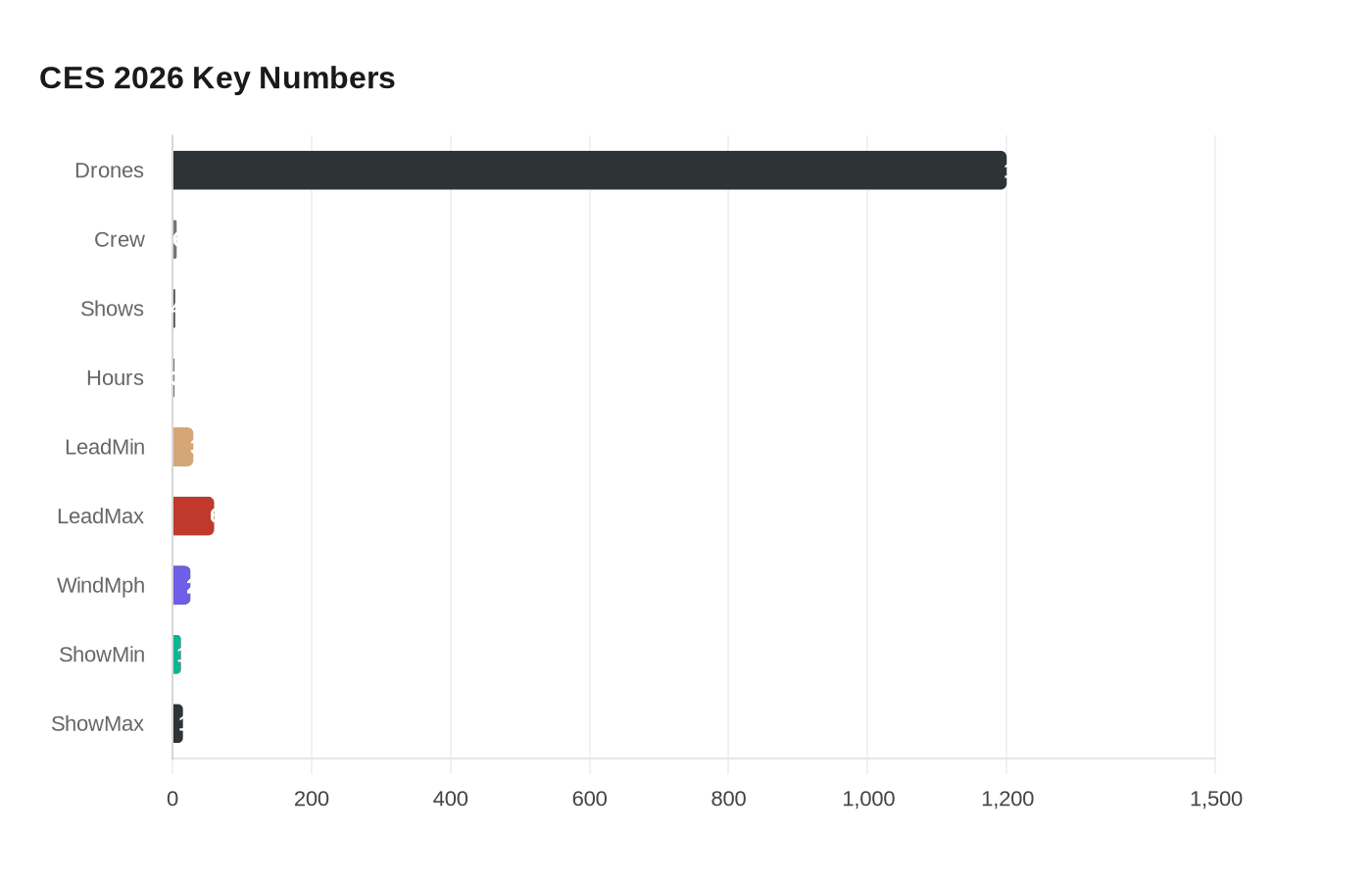
Practical takeaway: for sports organizers, the CES deployment demonstrates that high-volume drone spectacles are now a repeatable production option, plan lead time, collaborate with automation-capable partners, and design show windows that exploit the repeatability of modern swarm control while protecting crowd safety and airspace compliance.
This article was produced by Prism’s automated news system from verified source data, official records, and press releases, then run through automated quality and moderation checks before publishing. The system is built and supervised by the people who set the standards it runs under. Read our full AI policy.
Did this article answer your question?