Ukraine Tests Mothership Drones Carrying FPV Swarms Into Battle
Ukraine's Kazhan "Bat" drones are being tested as airborne motherships, launching FPV swarms deeper than any single drone can reach alone.
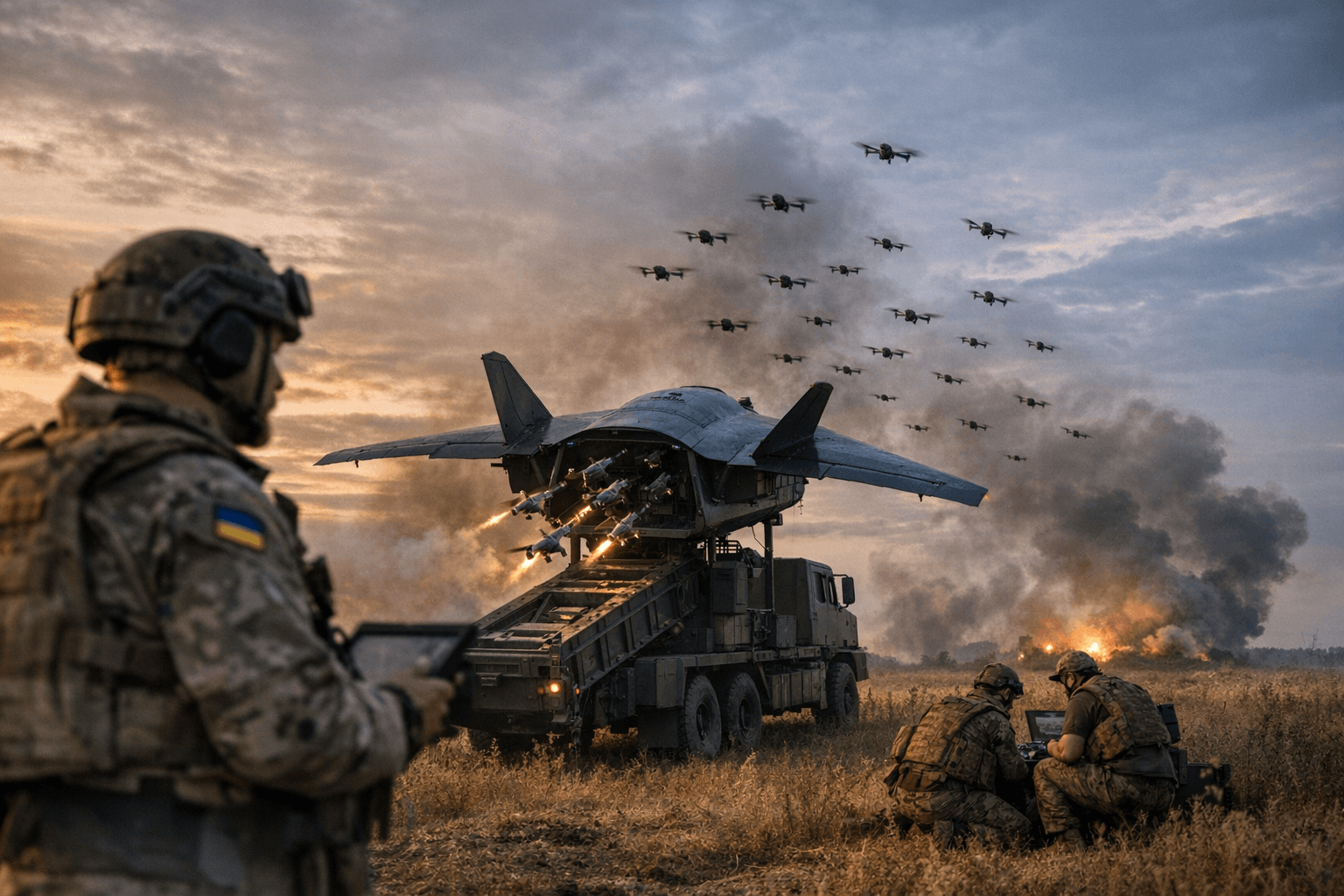
A heavy quadcopter lifts off somewhere near the front, carrying not a single warhead but two or three expendable FPV attack drones beneath its frame. It climbs to altitude, pushes beyond the range where a conventional FPV pilot could maintain a signal link, and releases its payload into contested airspace. The smaller drones ignite their motors, lock onto targets, and strike. The mothership, if it survives, turns back toward friendly lines.
This is the operational logic Ukrainian forces and their industrial partners are now pressure-testing at scale, and it represents one of the sharpest tactical innovations to emerge from a conflict that has already rewritten the rules of small-UAS warfare.
The Kazhan Platform: Ukraine's Airborne Carrier
At the center of this experiment is the Kazhan family of heavy multicopters, produced by Ukrainian manufacturer Reactive Drone. The name translates roughly as "Bat," and the series, sometimes labeled the Bat or Kazhan 620, is already a known quantity on the battlefield: the Ukrainian heavy bomber drone fleet includes several models such as the Vampire, R18, Nemesis, and Kazhan, with payload capacities of 9 to 18 kilograms and operational ranges extending to 19.3 kilometers. Each unit costs approximately $20,000 and is specifically designed for nighttime operations using advanced thermal imaging systems.
The Kazhan has been used by the National Guard of Ukraine, the country's gendarmerie, Special Operations Forces, the Ukrainian Navy, and the KRAKEN special unit operating under the Ministry of Defense. That breadth of adoption across disparate units reflects a platform that has earned operational trust. What the current experiments are testing is whether that same airframe can do something far more ambitious: serve as a flying launch rail for smaller, cheaper, more expendable FPV drones.
Reactive Drone's CTO, Artem Kolesnyk, frames the engineering challenge with deliberate understatement. "From a technical perspective, this is not extremely difficult to implement," he told Forbes. The harder problem is not the hardware integration; it is matching the mothership concept to a mission profile where its trade-offs actually pay off against real-world threats and countermeasures.
The Trade-Off Architecture
Every tactical advantage in drone warfare comes bundled with a corresponding liability, and the mothership concept is no exception. Larger platforms provide the lift capacity to carry multiple guided munitions or function as a launch node for smaller FPVs, enabling deeper strikes and longer loiter times than any individual expendable drone could achieve. A Kazhan-type quadrotor carrying two or three disposable FPVs effectively multiplies the reach of a ground-based FPV operator without requiring that operator to move closer to the front.
The cost, however, is visibility. Heavier platforms are slower, present a larger radar cross-section, and are easier to acquire visually. In contested airspace where Russian electronic warfare and air defense systems are dense, a $20,000 Kazhan flying a predictable approach vector is a target, not just a weapon. That tension between reach and survivability is what Kolesnyk's caution about "operational usefulness" actually means in practice.
Heavy bombers can serve as mothership carriers to extend the range of small FPVs, deliver supplies, lay mines, or perform standoff surveillance. The Forbes analysis adds a logistics configuration to that list: Kazhan-type platforms operating as resupply nodes, delivering sensors or small payloads at standoff distances rather than carrying munitions at all. In many scenarios, though, smaller and cheaper loitering munitions remain preferable precisely because their low cost and sheer numbers complicate enemy responses in ways a single large platform cannot.
A Wider Mothership Ecosystem
The Kazhan experiments are not happening in isolation. Ukraine's drone industrial base has generated several parallel mothership concepts across different platform architectures, each addressing the range-and-reach problem from a different angle.
Ukrainian firm Temerland has developed the Gnom-DC, a ground robotic platform that acts as a mobile base for FPV drones, featuring a hybrid chassis combining wheels and tracks to traverse uneven frontline terrain. That ground-based approach sidesteps the aerial signature problem entirely, at the cost of terrain dependency.
At the longer-range end of the spectrum, Strategy Force Solutions developed the GOGOL-M, a reusable mothership drone capable of delivering two strike FPV drones to operational distances of up to 300 kilometers, with those smaller drones capable of autonomously detecting and engaging precise targets ranging from parked aircraft to air defense systems.
A CSIS analysis described the fixed-wing mothership variant as a drone that can carry up to six FPVs, fly over a Russian position, release the attack drones to execute their mission, while the mothership itself plays the role of a relay drone. The relay function is particularly significant: by acting as an airborne communications node, the mothership solves the signal attenuation problem that has historically capped FPV operational range at just a few kilometers.
Russia Absorbs the Lesson
Ukraine's adversary has been watching and adapting. Russia adopted Ukraine's drone mothership technology after first encountering it in November 2023. Its Molniya carriers extend FPV range to 40 kilometers behind friendly lines. Reusable motherships add a particularly unsettling capability: if the FPVs miss their target on the first pass, the mothership can return to base, reload, and attack again.
The speed of that adaptation illustrates the core dynamic of this conflict's drone competition. Ukraine pioneers a concept, Russia reverse-engineers it within months, and both sides then race to develop countermeasures while simultaneously iterating on the original idea. The mothership doctrine is now a feature of both sides' playbooks, not a Ukrainian exclusive.
What This Means for the FPV Technology Curve
The implications extend well beyond the battlefield. The demands of contested-airspace operations are forcing rapid iteration on the underlying technology stack of multirotor systems, and those improvements do not stay classified. Better battery energy density, higher-efficiency motors, improved onboard autonomy and sensor fusion: each of these battlefield requirements maps directly onto capabilities that matter in civilian and competitive FPV contexts.
Frame efficiency, motor and ESC technology, telemetry robustness, and autonomous flight modes are all being stress-tested in conditions no racing circuit or commercial operator has ever faced. The feedback loop between wartime demand and engineering output is compressing development timelines that would ordinarily span years into months. Competition-level pilots and builders are likely to see faster iteration curves on propulsion, telemetry, and autonomy than the hobby ecosystem has experienced in any previous period.
That acceleration carries a regulatory shadow. The militarization of small UAS is ethically and politically charged in ways that invite legislative responses, and regulators in multiple jurisdictions are watching the Kazhan experiments and their international cousins with close attention. The dual-use nature of the underlying technology means that the same hardware improvements that make a racing quad faster and more responsive also make it more capable in applications that governments increasingly want to control.
The mothership concept, in other words, is both a battlefield tactic and a forcing function: it is pushing drone hardware toward a new performance ceiling, and the civilian FPV community will inherit both the gains and the scrutiny that follow.
This article was produced by Prism’s automated news system from verified source data, official records, and press releases, then run through automated quality and moderation checks before publishing. The system is built and supervised by the people who set the standards it runs under. Read our full AI policy.
Did this article answer your question?