U.S. Army Trains Snipers to Evade Thermal Drone Detection on Battlefield
Army snipers at Fort Benning now train to defeat thermal drone detection, a shift exposing how battlefield-grade sensors are compressing into the same commercial hardware that powers FPV sport.
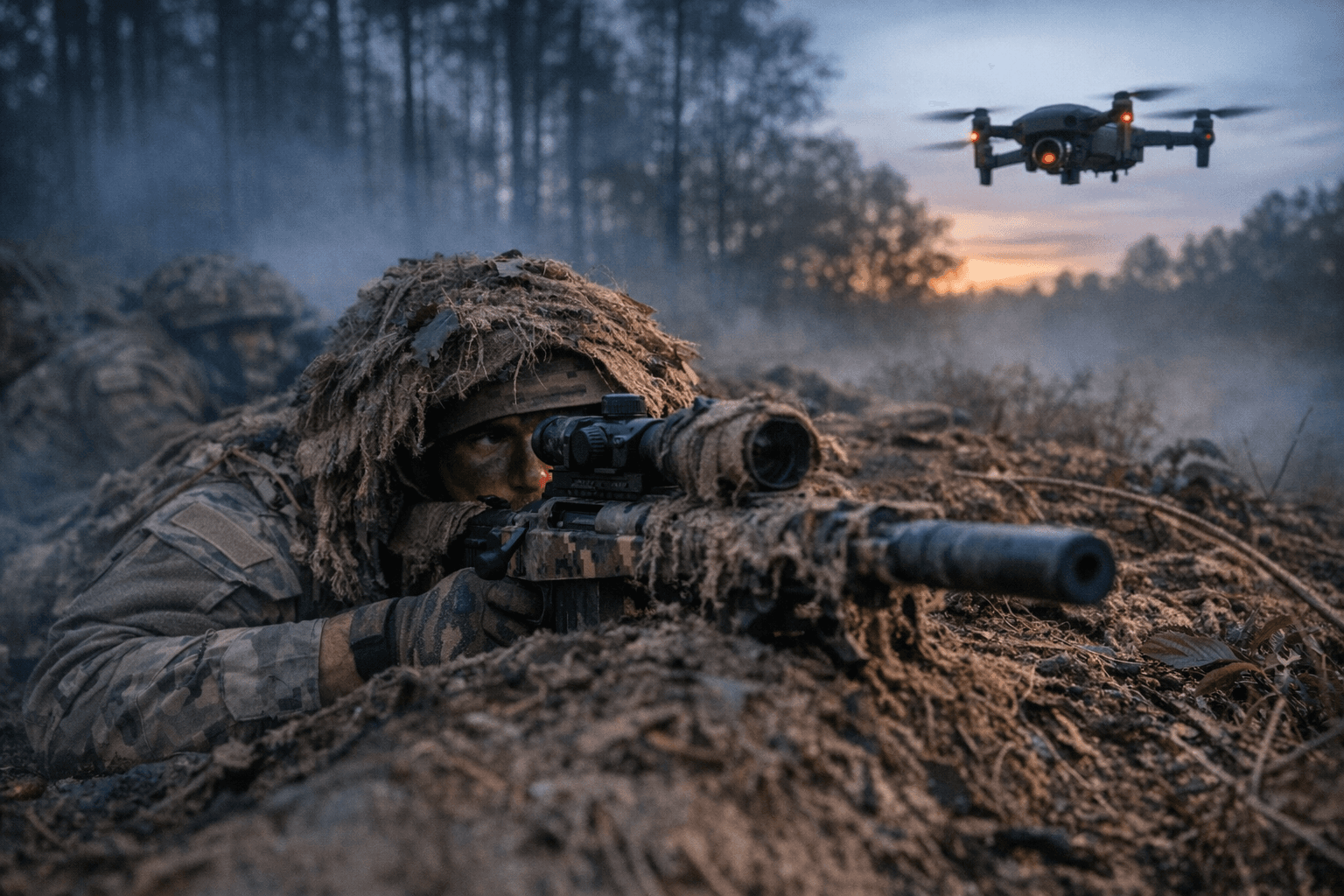
Thermal cameras mounted on small drones have broken the cover snipers relied on for a century. The U.S. Army formalized its response with a curriculum overhaul at Fort Benning, Georgia, where new training modules now teach snipers not only how to hide from human eyes but how to vanish from infrared sensors carried by unmanned aircraft systems that have become a persistent fixture of modern combat.
The new course is built around the reality that thermal- and multispectral-equipped drones are already widely fielded across multiple theaters. Snipers are being exposed to a range of drone imaging modalities, taught to recognize common flight profiles, and drilled in techniques to reduce both thermal and electromagnetic signatures. That means limiting heat-generating activities, practicing strict movement discipline, and rehearsing exfiltration routes specifically designed to stay outside the observation envelopes of drone-mounted sensors.
Staff Sgt. Brett Bollinger, an instructor at the center of the program, framed its practical aim directly: "We've been evaluating products with the objective of defeating thermal sensors, whether it be aerial or ground systems." The Army worked alongside private manufacturers to test camouflage nets and signature-masking materials against drone-mounted electro-optical and infrared sensors under field conditions, using data from those trials to shape what snipers are taught.
The implications run well past Fort Benning. The same sensor technologies being stress-tested against soldiers in Georgia have migrated into commercial airframes accessible to civilian operators, including the FPV racing and sport drone community. What was once confined to defense procurement budgets now ships in consumer camera modules. That compression of the technology cycle creates two pressure points for drone sport: regulators and event organizers face mounting questions about safe operational separation when low-cost thermal-capable platforms are broadly available, and racing teams now operate alongside sensor capabilities that were, until recently, well outside civilian reach.
Army training staff also signaled a specific intent to close knowledge gaps with the commercial drone industry, recognizing that civilian design iteration routinely outpaces military procurement timelines. Understanding how off-the-shelf airframes perform in real detection scenarios has become operationally relevant, not merely an academic exercise in acquisitions.
The broader signal from Fort Benning is about who controls the pace of the sensor arms race. Low-cost thermal airframes have extended aerial surveillance to actors far beyond organized militaries, and the Army's decision to formalize evasion tradecraft as a core sniper skill marks how thoroughly the threat environment has shifted. For a sport that has always pushed the performance ceiling of commercial drone hardware, the same technology cycle now cuts in both directions.
This article was produced by Prism’s automated news system from verified source data, official records, and press releases, then run through automated quality and moderation checks before publishing. The system is built and supervised by the people who set the standards it runs under. Read our full AI policy.
Did this article answer your question?