Ukrainian Bomber Drone Returns Pierced by Improvised Trident of Nails and Rods
A Ukrainian Backfire bomber flew home from Kharkiv with a two-foot trident of welded nails and steel rods buried in its fuselage, in what may be the first recorded drone-vs-drone trident intercept.
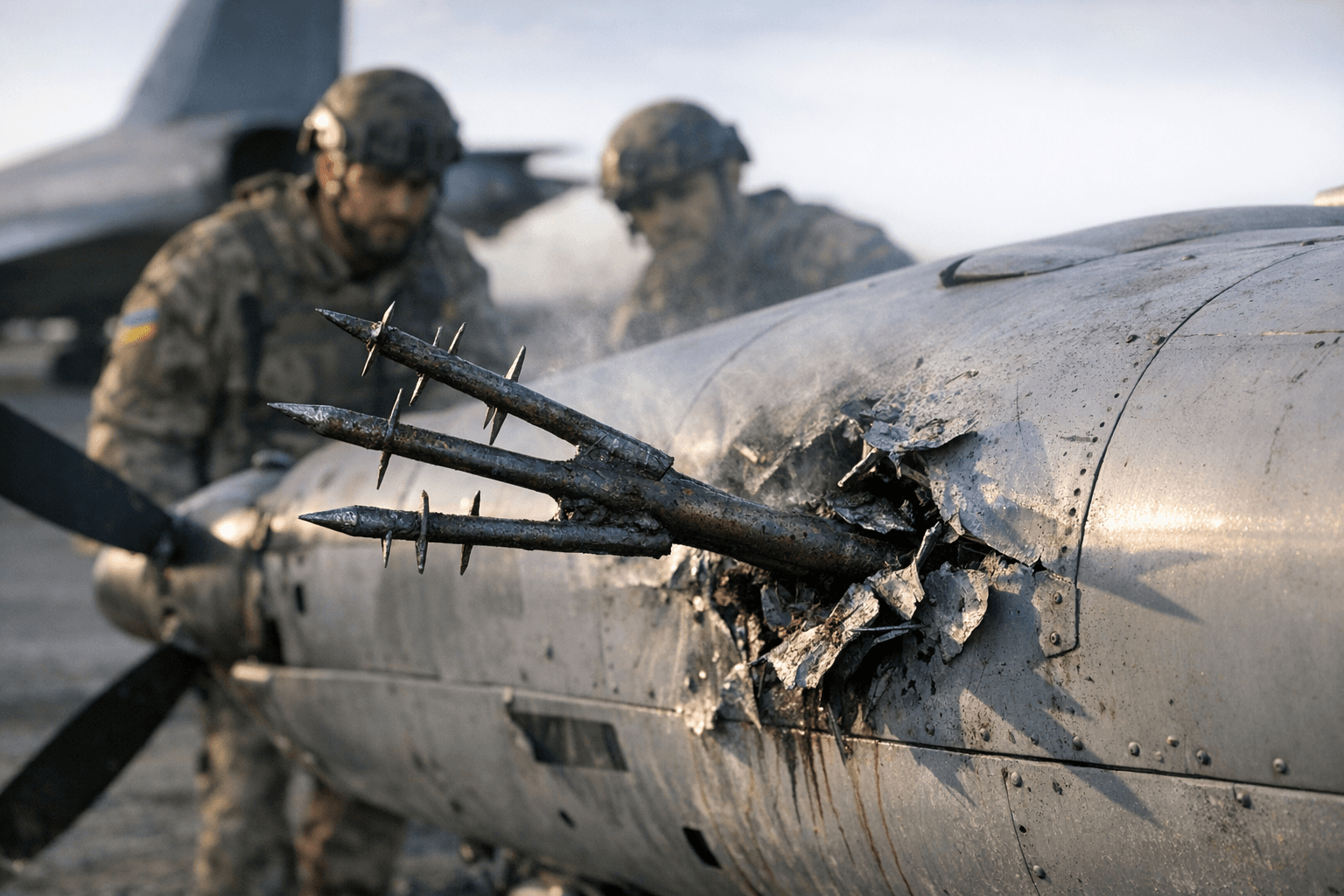
The first clue something was wrong came when soldiers noticed an unfamiliar protrusion jutting from the fuselage. They assumed it was part of an antenna. It was not.
A Ukrainian Backfire fixed-wing heavy bomber drone completed a strike mission over the northeastern Kharkiv region late last month and returned to base carrying a roughly two-foot object made of nails welded onto thin steel rods, assembled into a crude trident shape and buried upright in its airframe. The aircraft did not crash. It staggered home, scratched around the impact point but otherwise structurally intact, and the operators who retrieved it had no idea it had been hit during flight.
Alex Eine, a unit commander in Ukraine's northeastern Kharkiv region, told Business Insider the trident was "definitely" launched from another drone rather than thrown or fired from the ground. The Backfire was cruising above 800 meters, roughly 2,600 feet, when it was apparently struck from above in a blind spot that its cameras did not cover. Photos the unit shared with Business Insider show the trident embedded clearly in the fuselage.
Business Insider, which reported the story with photos the unit shared exclusively with the publication, described the incident as what appears to be the first reported case of a trident being used to try to intercept a drone, calling it "a rudimentary air defense approach in a war defined by both makeshift improvisations and technological innovation."
The weapon's tactical logic, as outlined in reporting by DroneXL on March 15, turns on a simple physics problem. Against the Backfire's robust fixed-wing airframe, the 60-centimeter trident punched into the fuselage and caused manageable damage; the aircraft flew home. Against a heavy quadcopter, the calculation is entirely different. Any object that contacts a spinning propeller at speed can instantly disable the aircraft, and a two-foot steel trident dropped into the rotor path of a quadcopter from above would not produce scratches. It would produce a crash. The device does not need to destroy a target through penetration alone; it needs to reach the propellers.
The Backfire's robust airframe absorbed what might have been a fatal strike for a lighter rotary-wing platform. Operators credited that structural resilience for the aircraft's survival, noting that the same impact could have shredded a smaller quadcopter instantly.
No identifying details about the attacking drone, its operator, or its affiliation were confirmed in the available reporting. Eine's statement attributes the launch to an airborne platform rather than a ground-based soldier, but the specific origin remains unconfirmed. Ukrainian forces have not released telemetry from the flight, and no video of the strike itself exists in the public record, consistent with the blind-spot attack vector Eine described.
The episode adds a medieval-looking artifact to the inventory of improvised weapons reshaping low-altitude airspace over eastern Ukraine, where both sides have been pushing the boundaries of what a consumer or military drone can carry, drop, and destroy.
Know something we missed? Have a correction or additional information?
Submit a Tip