U.S. Air Force Seeks Backpack-Portable FPV Strike Drones for Special Tactics Units
The Air Force admitted it lacks a purpose-built FPV strike drone, posting an RFI for a backpack system hitting targets 10+ km away with a 1.5 kg warhead.

Special Tactics teams in Air Force Special Operations Command currently carry no purpose-built FPV strike capability, and the Air Force put that gap in writing. "AFSOC and Special Tactics units currently lack a purpose-built First-Person View (FPV) unmanned capability," the service stated in a Request for Information posted March 18 on Sam.gov. "This deficit restricts the force's ability to employ FPV systems in specialized mission sets and limits the development of standardized Tactics, Techniques, and Procedures essential for modern, high-intensity conflict." Responses are due April 17.
The RFI, posted by the Air Force Life Cycle Management Center's Intelligence, Surveillance and Reconnaissance and Special Operations Forces Directorate, asks industry to describe a ground-launched VTOL drone that fits in a backpack, launches in under three minutes, and carries a combat payload 10 kilometers at minimum, with an objective reach of 20 kilometers. Armed endurance must fall between 15 and 30 minutes.
Payload requirements are equally specific. The RFI sets a 1.5-kilogram kinetic payload threshold with a 3-kilogram objective, using a fragmentation warhead as the baseline and a penetrator as the desired growth option. An electronic safe-and-arm device is required in the munition architecture, and vendors must also propose a recoverability strategy for training operations. That payload bracket places the system squarely against soft to semi-hardened targets: exposed troops, fighting positions, light vehicles, antennas, radar, counter-drone nodes, and command posts. Main battle tanks are explicitly out of scope.
On connectivity and electronic warfare resilience, the RFI is unambiguous. "This system needs to integrate Global Positioning System, 4G/LTE/5G cellular connectivity, true frequency hopping between bands, and an optional repeater to extend operational range to over 20 kilometers," the document states. The system must operate in GPS-denied environments and resist jamming, requirements that reflect hard lessons from contested battlespaces where FPV drones operating on fixed frequencies have proven vulnerable.
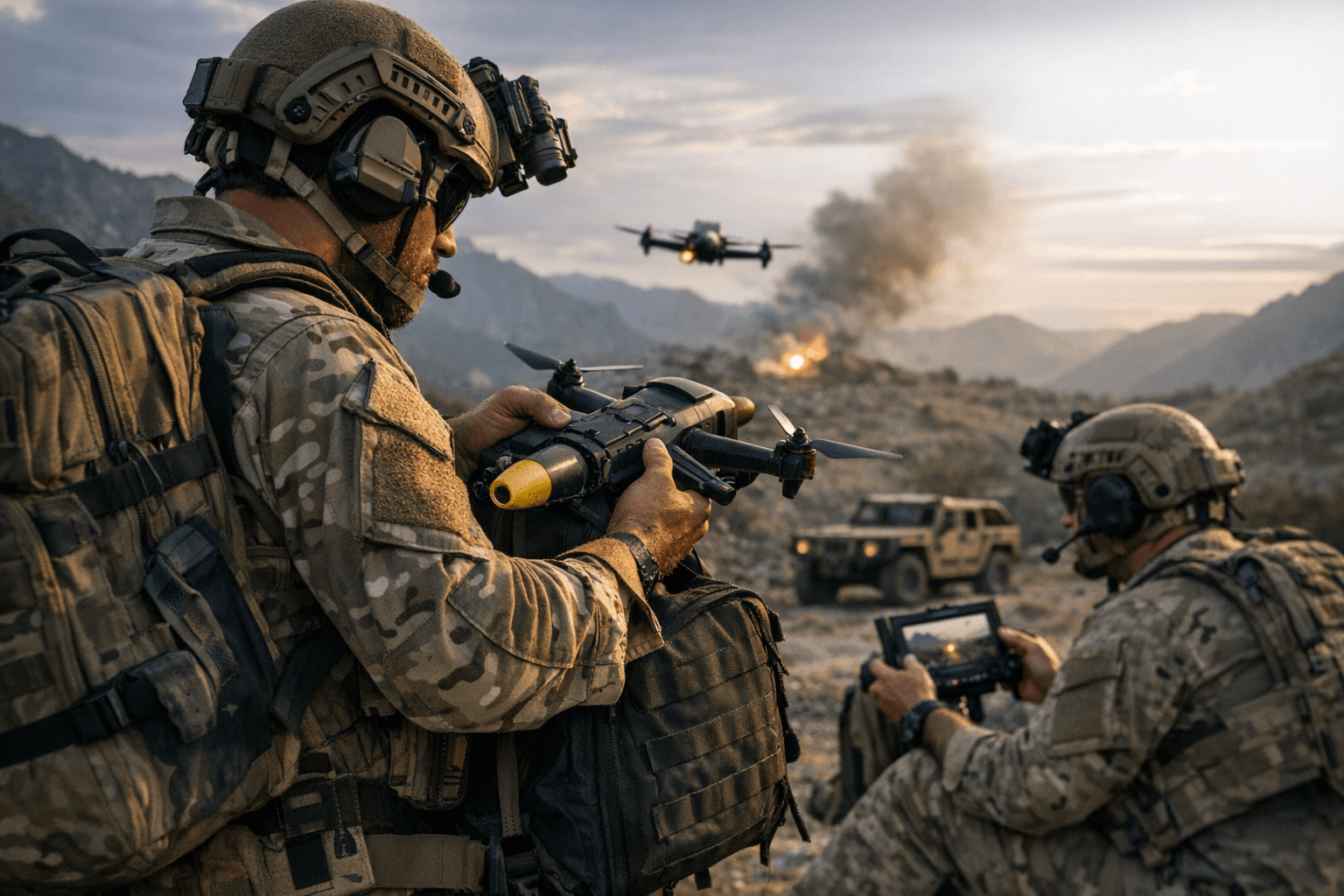
Portability specifications tell two slightly different stories depending on which metric is in view. Air and Space Forces, citing the Sam.gov posting, reported per-aircraft weights of roughly 15 pounds with a final goal of 5 pounds per drone. Defense News reported the total initial kit, covering two drones and a ground control station, must come in at no more than 30 pounds carried by two operators in backpacks, with a final objective of a 10-pound system manageable by a single operator. The two figures are not necessarily contradictory; they appear to describe different measurement frames, per-unit versus total kit, but the discrepancy is worth flagging pending the authoritative RFI text on Sam.gov. Controller interface is specified as the Android Team Awareness Kit UAS interface, a platform already embedded in special operations workflows.
Air and Space Forces noted the drones would fall into Group 1 under the Pentagon's five-tier UAS classification, the lowest rung, reserved for the smallest systems. That size bracket is precisely the point. The Air Force wants a drone a single operator can eventually carry alone into a denied environment, set up in under a minute, and fly FPV into a time-sensitive target without reliance on GPS or unencumbered radio frequencies.
Defense News framed the requirement in the context of Ukraine, where small FPV and one-way attack drones have reshaped close-combat strike for both sides. SOCOM's broader UAV push already includes small missiles launched from drones, drones designed for confined spaces such as caves, and programs to train special operations personnel to build and repair their own systems. The AFSOC RFI fits that arc directly, seeking to give Special Tactics teams organic strike capability they can integrate into Global Access, Precision Strike, and Personnel Recovery mission sets without waiting on higher-echelon fires.
This article was produced by Prism’s automated news system from verified source data, official records, and press releases, then run through automated quality and moderation checks before publishing. The system is built and supervised by the people who set the standards it runs under. Read our full AI policy.
Did this article answer your question?