U.S. Marines Test FPV Drone Training Platform During NATO Arctic Exercise
A crash-proof $2,530 FPV quad used by Marines in Norway's Arctic quietly bridged competitive drone hardware and NATO counter-drone sensor validation.
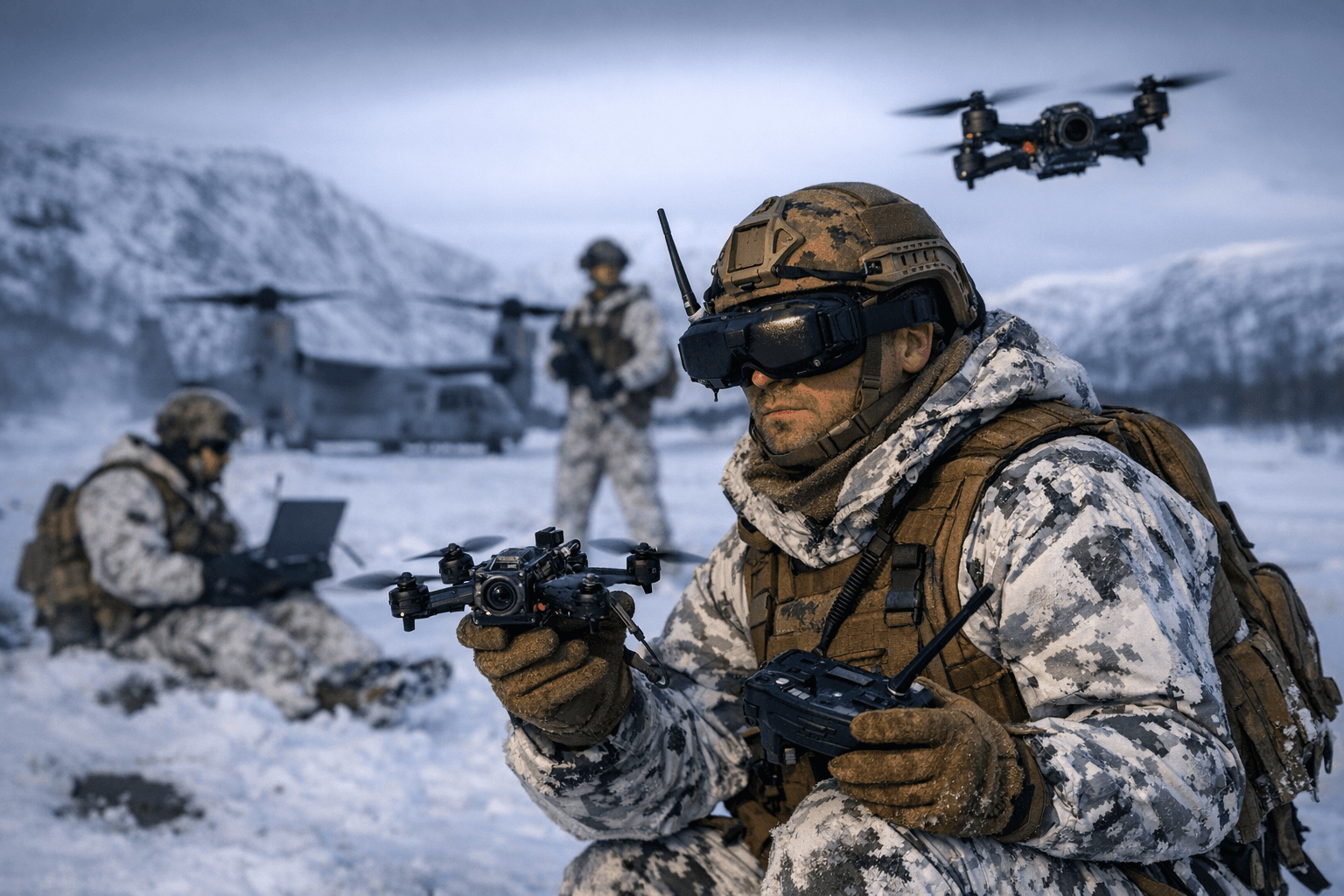
When the U.S. Naval Research Laboratory needed a small, fast, low-signature aerial target to stress-test its Arctic counter-drone sensors, the answer came in a 30-centimeter cage running three-inch props.
Marines from the 2nd Marine Division flew the Orb Jawbreaker FPV quadcopter on March 13 and 17 during Cold Response 26, Norway's large-scale NATO exercise that drew more than 32,000 troops from 14 allied nations. The flights served a dual purpose: pilots built FPV handling proficiency in a demanding operational environment while the NRL used the Jawbreaker as a moving target to validate event-based and low-light detection sensors under Arctic lighting conditions.
The Jawbreaker is purpose-built for high-repetition training. Its protective cage absorbs crashes and lets pilots relaunch without destroying the airframe, compressing what would otherwise be expensive, equipment-intensive training cycles. Depending on avionics configuration, including an NDAA-compliant variant, the platform costs between $2,530 and $3,248. It runs standard commercial off-the-shelf FPV hardware: the same transmitters, goggles, and controllers found throughout the racing and freestyle communities.
That COTS architecture is what makes the Jawbreaker significant beyond its military application. By adapting hobby-grade components wholesale into an institutional training pipeline, the platform reflects a growing convergence between competitive FPV and defense procurement. A pilot who has logged hours on a 3-inch racing quad transfers directly to the Jawbreaker's control profile. The cage geometry, at roughly 30 centimeters across, falls within the size class that defines indoor racing and proximity flying circuits.
Cold Response 26 gave the NRL a test environment that is genuinely difficult to replicate on a domestic range: sustained Arctic cold, variable and low ambient light, and the kinetic unpredictability of pilots still developing their stick skills. The sensor work focused on detection and tracking of small drones at night and in reduced-visibility conditions, precisely the scenario that poses the sharpest challenge for venue security at outdoor and twilight racing events.
The broader argument embedded in the Jawbreaker program is about pipeline economics. Crash-tolerant, inexpensive platforms can move more personnel to baseline FPV competency before transition to armed or reconnaissance variants, effectively industrializing the pilot training process. For manufacturers supplying racing and freestyle markets, that logic signals ruggedized cage designs and COTS-compatible electronics as increasingly viable entry points into institutional procurement; and the detection algorithms validated in Norway signal what race organizers can expect as counter-UAS infrastructure matures around competitive venues.
Know something we missed? Have a correction or additional information?
Submit a Tip