Vector Hammer F1 Military Drone Offers Foldable Design, 97 mph Speed for US Troops
Vector's Hammer F1 folds to 10 inches, hits 97 mph, and fits in a single bag — a battlefield quadcopter built with US troops at Vector's Utah factory.

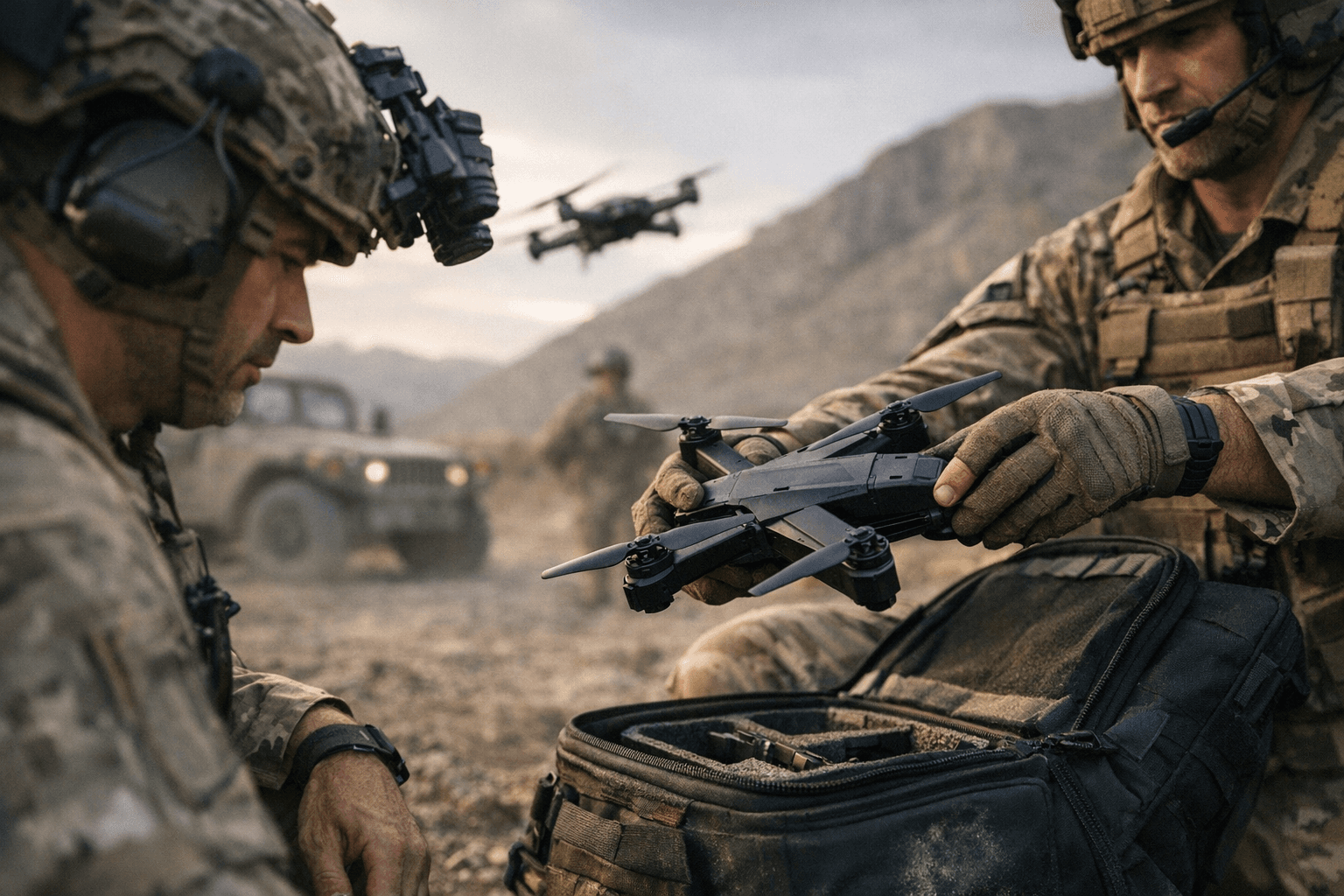
A quadcopter that folds smaller than a tablet computer and outruns most FPV racing builds just entered the US military supply chain conversation. Defense tech company Vector unveiled the Hammer F1, a foldable battlefield quadcopter designed specifically for frontline ground units, built around a performance profile that will raise eyebrows in both military procurement offices and the drone racing community.
The numbers Vector is claiming are legitimately striking. The Hammer F1 reaches top speeds of up to 97 mph and carries an operational range of up to 25 kilometers, giving troops the ability to scout or engage targets well beyond immediate visual range. That speed figure sits comfortably in the territory of competitive FPV freestyle builds, but the Hammer F1 is doing it in a 10-inch folded package that an entire unit can toss into a single bag before a fast-moving operation.
Vector says the drone was developed hand-in-hand with warfighters, targeting dual-mission capability across reconnaissance and precision strike roles. The company has not released specific payload details or weaponization specifications, and those claims require further confirmation before any technical conclusions can be drawn about its strike capability.
Portability was clearly the design anchor. At 10 inches folded, the Hammer F1 is built for the kind of rapid deployment where, as Vector frames it, speed and mobility can be the difference between success and failure. The modular camera system supports both day and night operations, with configurations swappable depending on mission requirements, which gives individual units flexibility without carrying redundant hardware.
Vector produced the Hammer F1 at its factory in Utah using American supply chains, and the company emphasizes the drone is fully compliant with National Defense Authorization Act restrictions that limit foreign-made drone components in military procurement. That NDAA compliance positioning is deliberate: it places the Hammer F1 directly in competition for DoD contracts at a moment when the Pentagon is actively scrutinizing its drone supply chain.
Cyber resilience was treated as a core engineering priority rather than an afterthought. Vector designed the system to operate in contested electromagnetic environments where adversaries may attempt to jam signals or interfere with drone operations, a capability increasingly essential in modern peer-conflict scenarios.
One detail from headline materials accompanying the initial coverage asserts ATAK integration, which would allow the Hammer F1 to connect with the Android Team Awareness Kit used widely by US ground forces for battlefield situational awareness. That claim does not appear in the source reporting examined and has not been confirmed by Vector in any available statement. Procurement specifications, endurance figures, unit cost, and fielding timelines also remain unreported, leaving significant gaps for any defense buyer evaluating the platform against existing systems.
Vector has not announced a government contract or program-of-record status for the Hammer F1 as of this reporting.
Know something we missed? Have a correction or additional information?
Submit a Tip