Bruce Eugene’s record-setting arm still defines Grambling State greatness
Bruce Eugene's 140 touchdown passes still tower over FCS history. His Grambling run was record-setting, championship-level production, not empty volume.
The number that still defines the standard
Bruce Eugene did not just break a record at Grambling State. He set a ceiling that still looks outrageous: 140 career touchdown passes, the FCS all-time mark, and more than 13,500 passing yards over four-plus seasons. In an era built around quarterback production, that combination still jumps off the page because it was not padded on a losing team or inflated by empty snaps. Eugene did it inside a winning program, in championship games, against championship stakes.
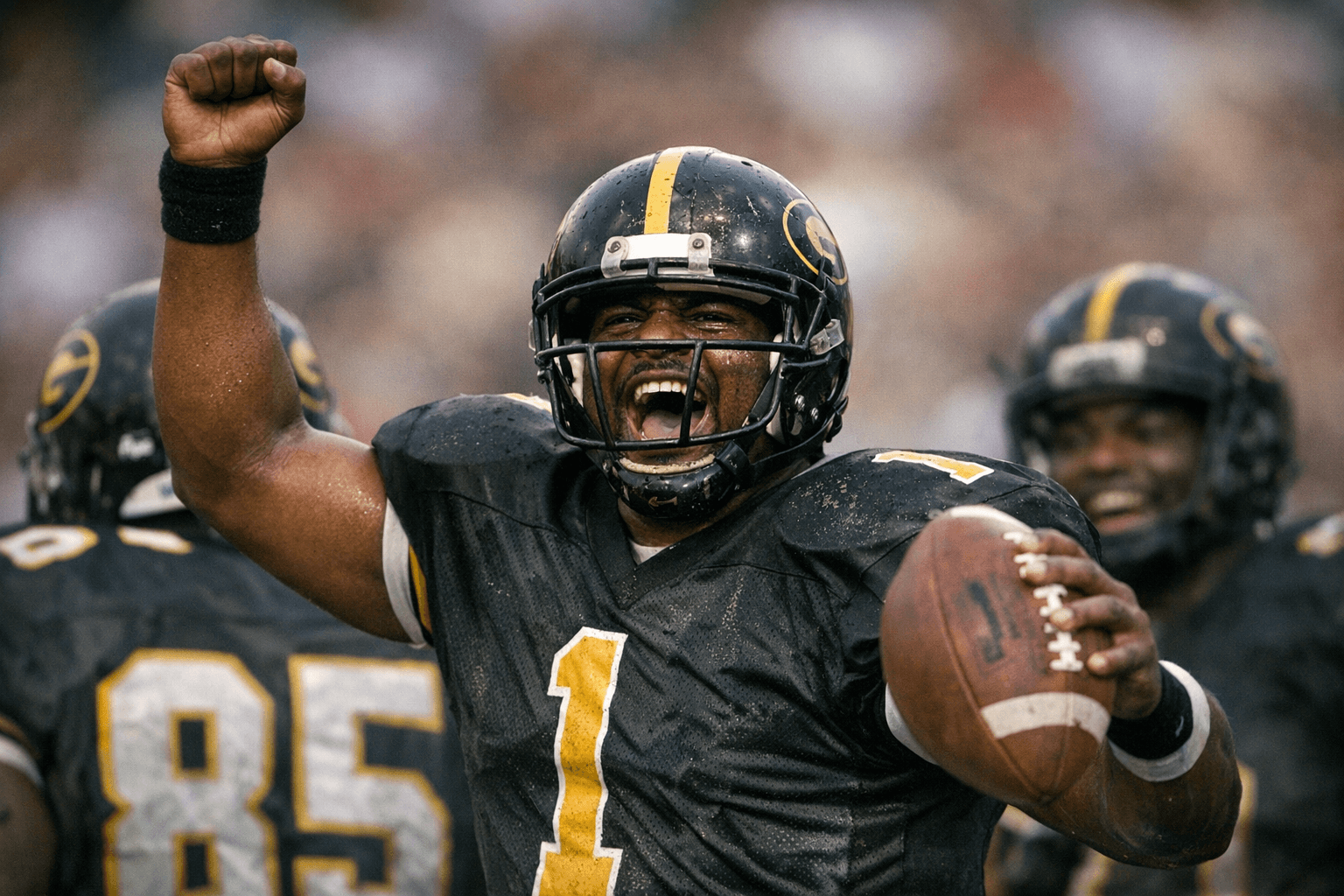
That is why his name refuses to fade from any serious conversation about the greatest passers in subdivision history. The touchdown total alone tells the story, but the full picture is even louder: SWAC records list him at 13,530 passing yards, 140 passing touchdowns, and only 38 interceptions. That is the profile of a quarterback who did not simply survive volume, but used it to overwhelm the league.
A star built inside a champion’s framework
Eugene’s rise makes more sense when you place it inside the Grambling machine around him. He was part of the 2001 Tigers team that went 10-1, won the SWAC, and claimed the Black College Football National Championship under Doug Williams. That matters, because Eugene was not learning how to win in a vacuum. He was growing inside a program that expected trophies, not moral victories.
He was born in New Orleans and grew up primarily in a single-parent household with his mother and younger siblings, a background that helps explain the edge in his game and the durability of his reputation. The nickname fit too well: “The Round Mound of Touchdown.” It sounded playful, but the production was ruthless.
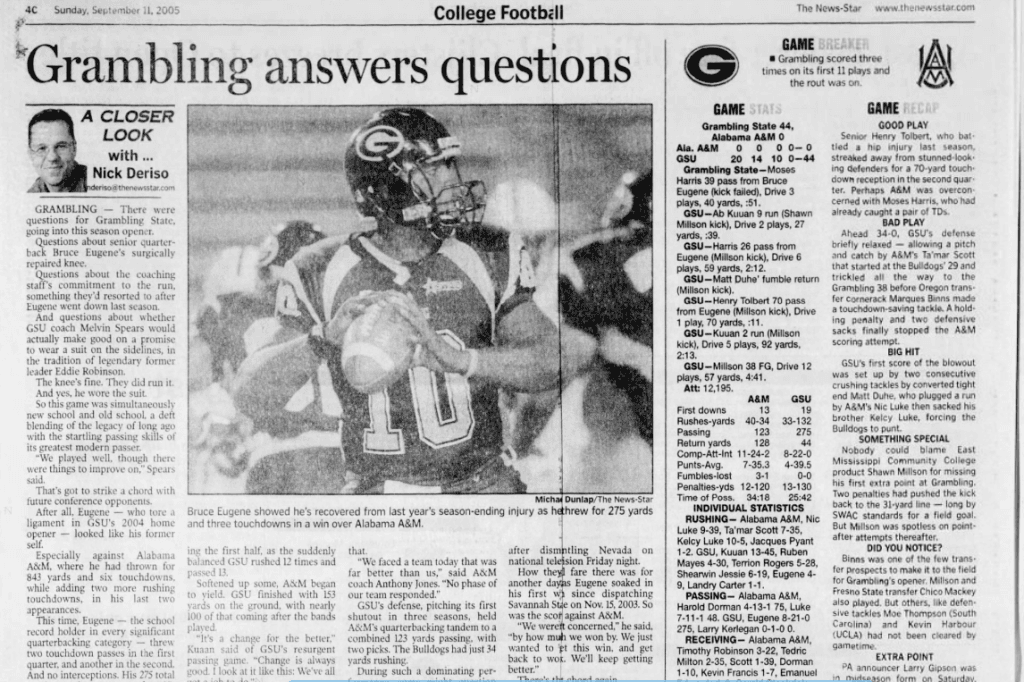
His first start of the 2002 season came in a 52-20 loss to eventual FCS runner-up McNeese State, a rough introduction that did not slow the bigger arc. The real signal arrived quickly. In his second game as a starter against Alcorn State, he was briefly benched, came back, and still delivered two late touchdown passes, including a 35-yard winner to D.J. Clay with 12 seconds left in a 41-35 Grambling victory. That is the kind of game that tells you the number in the box score is not the whole story. The quarterback had to rescue the night, then did it anyway.
The 2002 season was the warning shot
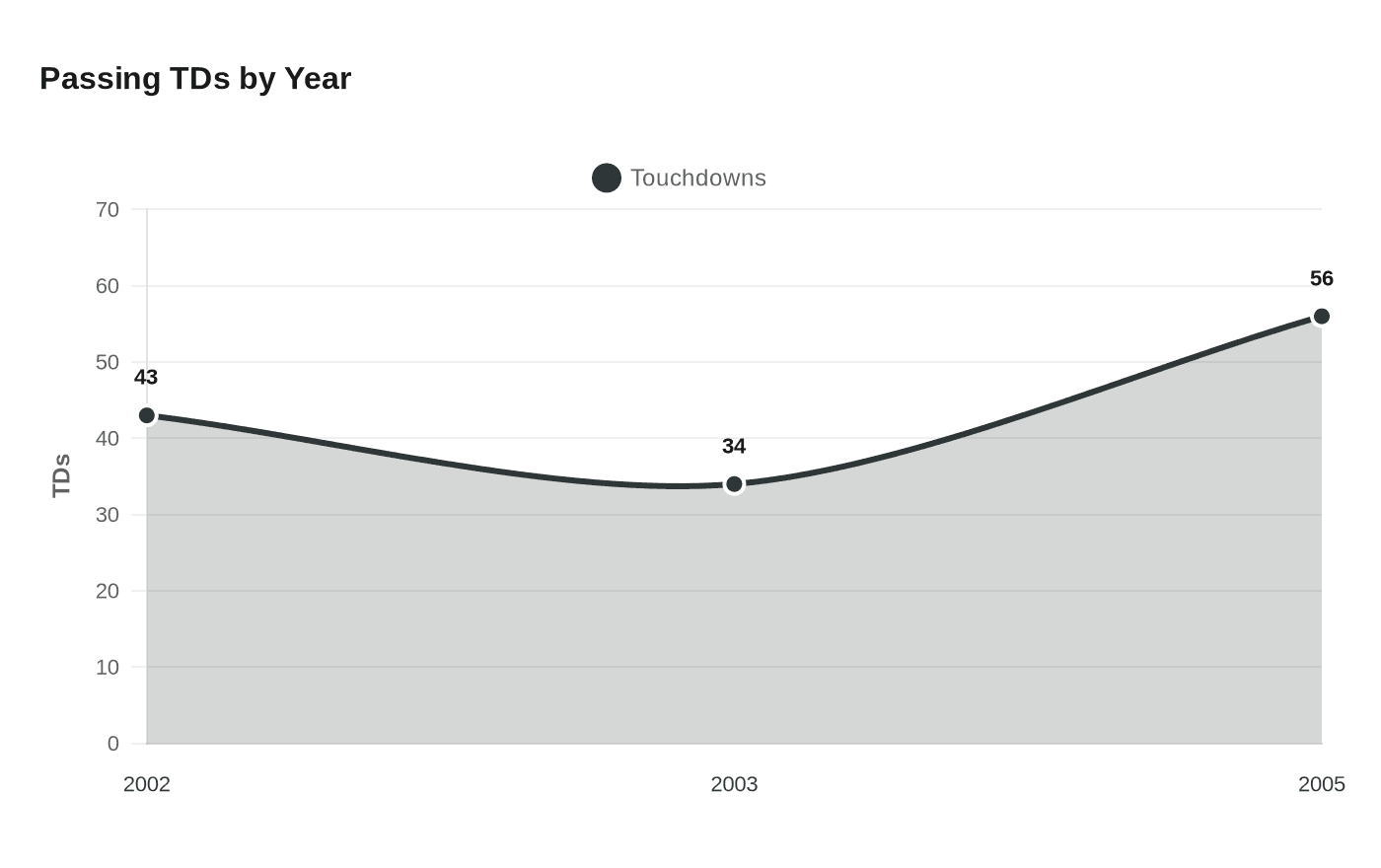
By the time 2002 ended, Eugene had become impossible to ignore. Grambling won the SWAC Championship Game 31-19 over Alabama A&M and was again named Black College National champion, while Eugene earned SWAC Offensive Player of the Year honors. He threw for 4,483 yards and 43 touchdowns and added 535 rushing yards and nine more scores. That is not just a big season. That is a quarterback carrying the offense with both his arm and his legs.
The modern comparison is easy to miss if you only look at the final totals. Today’s FCS stars are often judged by transfer value, explosive passing efficiency, and whether they can run an offense built on weekly volume. Eugene checked all of those boxes before the sport fully leaned into that style of quarterbacking. He was producing like a program’s entire identity depended on his right arm, because in many weeks it did.
His 2003 season kept the pace alive, with 3,808 passing yards and 34 touchdowns. That is the part that separates him from a one-year wonder. The record chase was not powered by a single hot stretch, but by sustained pressure on opposing defenses across multiple seasons.
The record game made the whole résumé official
The signature moment came on Dec. 10, 2005, when Grambling crushed Alabama A&M 45-6 in the SWAC Championship Game. Eugene completed 30 of 47 passes for 473 yards and six touchdowns, and in doing so he threw his 140th career touchdown pass to pass Willie Totten for the all-time FCS mark. Grambling finished 11-1, Eugene took team MVP honors, and NCAA and SWAC history got another permanent entry.
That championship performance also tied the NCAA single-season FCS record with 56 touchdown passes in 2005, which is the kind of number that still forces a second look. Willie Totten’s 1984 standard had stood as the old reference point for elite touchdown throwing, and Eugene matched that single-season benchmark while also owning the career record. That is rare air. Very few quarterbacks can say they were the best single-season touchdown thrower in one year and the best career touchdown thrower in the same stretch.
What makes the feat matter now is not nostalgia, but scale. Today’s quarterback-driven FCS offenses are designed to produce highlight reels and statistical spikes, yet Eugene’s career still holds up because it combined volume, efficiency, and winning. The Tigers were not chasing records while drifting through the calendar. They were collecting championships, and Eugene was the engine behind the best of them.
Why Bruce Eugene still belongs in the top-tier conversation
Some records age out when offenses change. Eugene’s do the opposite. His numbers still carry weight because they came against real stakes in the SWAC, in a subdivision that has always had to fight for national respect. He helped prove that an FCS quarterback could dominate nationally from a Black college stage and still leave behind a résumé strong enough to force inclusion in any all-time discussion.
That is the lasting value of Bruce Eugene. He was not just a great Grambling passer, and not just a SWAC star. He was a record-setting quarterback whose 140 touchdown passes, 56-touchdown season, and championship moments still define what greatness looks like at the FCS level.
This article was produced by Prism’s automated news system from verified source data, official records, and press releases, then run through automated quality and moderation checks before publishing. The system is built and supervised by the people who set the standards it runs under. Read our full AI policy.
Did this article answer your question?