FCS football has produced nine Pro Football Hall of Famers
Nine FCS alumni are in Canton, and the list proves elite NFL talent has always come from beyond the FBS spotlight.

FCS football has never been a consolation prize. Since the subdivision’s modern era began in 1978, nine former FCS players have reached the Pro Football Hall of Fame, and the list reads like a warning to anyone who still confuses visibility with ability. Five of those nine came through Historically Black Colleges and Universities, the first four names on the NCAA’s rundown all came from HBCUs, and the league’s first-round draft ledger already shows 24 FCS players taken in round one since 1978.
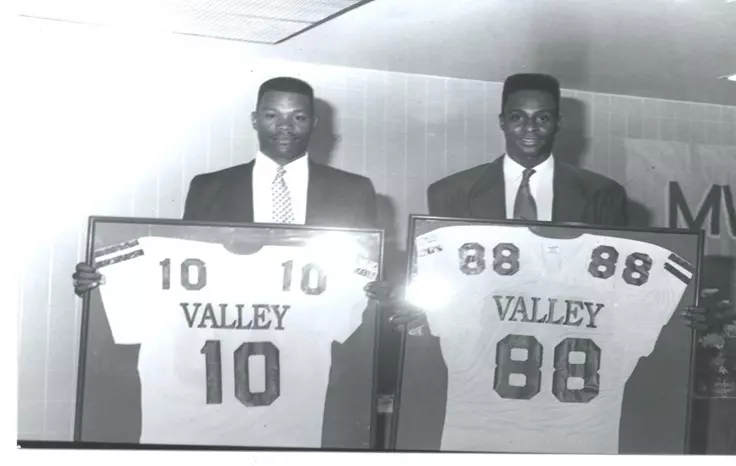
Jerry Rice
Rice is still the benchmark because his career made the size of the stage irrelevant. Mississippi Valley State produced a receiver whose dominance became so overwhelming that every modern evaluation of an FCS pass catcher still lives in his shadow.
That matters because Rice was not a curiosity or a novelty. He became the standard for route precision, separation, and production, and he turned one Mississippi Valley State name into the strongest argument that elite receiver play can emerge anywhere the ball is thrown.
Richard Dent
Dent’s path through Tennessee State keeps the FCS pass-rush case simple: if you can pressure the quarterback, the level of competition stops mattering. He came out of an HBCU program and built a Hall of Fame resume on the kind of disruption that translates on every field, in every era.
That is the part scouts still miss when they talk themselves into polish over power. Dent did not need a louder platform to prove he could wreck protection schemes, and Tennessee State gave him enough runway to show it.
Aeneas Williams
Williams gave Southern University another Hall of Fame back end, and he did it as a corner whose game was built on anticipation and toughness. FCS programs do not just produce big receivers and pass rushers; they produce defensive backs who can survive outside on Sundays against the best route runners in football.
Williams is also part of the broader HBCU thread that runs through this list. When five of the nine Hall of Famers come from HBCUs, it is not a footnote. It is proof that some of the cleanest defensive talent in NFL history developed outside the sport’s brightest television windows.
Michael Strahan
Strahan’s Texas Southern background is a reminder that edge talent is often discovered after it has already announced itself. He was too long, too explosive, and too productive to stay hidden, even if the national conversation took longer than it should have to catch up.
His Hall of Fame career pushed the FCS argument beyond sentiment. When a Texas Southern player becomes one of the league’s defining pass rushers, the league cannot pretend the pipeline is narrow. It only looks narrow to evaluators who are not watching closely enough.
Charles Haley
Haley turned James Madison into a national name long before the Dukes became a constant in the championship conversation. His Hall of Fame case is built on the kind of defensive violence FCS programs have always taught well: leverage, motor, and the ability to change a game without needing a dozen highlights to do it.

He also shows why FCS defenders are often harder to classify than they should be. Haley’s college logo never matched the size of his impact, and that mismatch is exactly why the subdivision keeps producing players who outgrow the labels attached to them.
Kurt Warner
Warner is the lone FCS quarterback in the Pro Football Hall of Fame, and that alone tells you how rare the position is at this level. Northern Iowa gave him the platform, but the lesson is bigger than one school: quarterback success is not always built on the most publicized stage, and it is not always linear.
Warner’s story remains one of the clearest rebukes to lazy quarterback sorting. A single strong college path, if it reveals command, accuracy, and timing, can still lead to an iconic pro career and a bronze bust in Canton.
Randy Moss
Moss is the only Hall of Famer on this list who also won an FCS national title, doing it at Marshall in 1996 as a redshirt freshman. That season matters because it shows the FCS can produce not just stars, but championship stars whose production is impossible to ignore even before they reach the NFL.
He is also the cleanest example of a player whose college dominance was so obvious that it barely needed translation. Marshall did not hide him. It put him on a title team, and then the league spent years trying to catch up to the speed and length it first saw in green.
Terrell Owens
Owens carried Tennessee-Chattanooga into the Hall of Fame conversation the same way he carried so many secondaries in the NFL, by forcing every defender to deal with his physicality. FCS football has always been fertile ground for receivers with NFL-caliber edge, and Owens is one of the loudest receipts that the separation between subdivision and superstardom is often thinner than people think.
His career also reinforces the larger pattern in this group: the league’s best evaluators are rarely the ones obsessed with pedigree. They are the ones who can identify production, size, and competitiveness before a player has the benefit of a national brand.
Jared Allen
Allen is the newest proof point, and maybe the cleanest one for modern scouting. The NCAA notes that he is the first major FCS award winner to make the Pro Football Hall of Fame, which links the subdivision’s awards culture directly to its pro legacy, and it starts to explain why so many front offices now treat FCS tape as a serious source of value.
That value is bigger than one pass rusher. With 24 FCS players taken in the first round since 1978, the pipeline has already produced the kind of players teams spend years trying to find, and Canton is the strongest receipt of all. FCS football does not need a smaller label. It already has the bigger one: proven.
This article was produced by Prism’s automated news system from verified source data, official records, and press releases, then run through automated quality and moderation checks before publishing. The system is built and supervised by the people who set the standards it runs under. Read our full AI policy.
Did this article answer your question?