Jerry Rice, Willie Totten powered Mississippi Valley State’s 1984 passing boom
Mississippi Valley State’s 1984 Satellite Express still reads like a glitch in the record book. Jerry Rice and Willie Totten turned tempo into an FCS template.
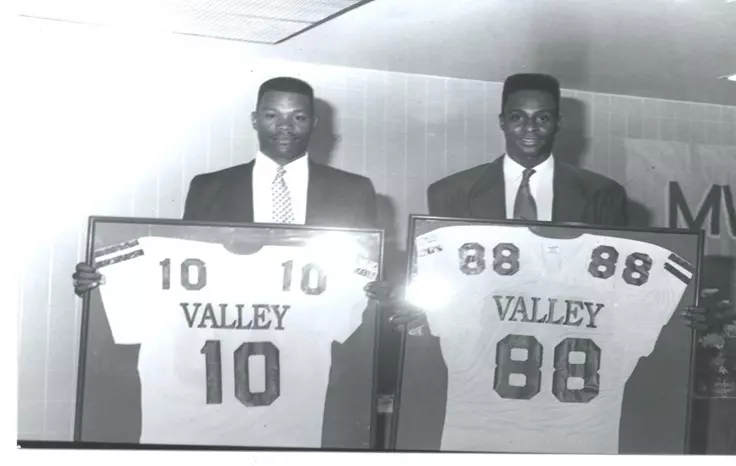
Jerry Rice and Willie Totten did not just put up numbers in 1984. They made Mississippi Valley State look like it had stolen football from the future, with an offense that scored at a rate that still looks fake and a passing game that turned the Delta Devils into the sport’s clearest early blueprint for modern FCS volume.
NCAA.com places that season among the greatest individual campaigns in HBCU football history, and the case starts with the math: Rice had 103 catches for 1,682 yards and 27 touchdowns, while Totten completed 324 passes for 4,572 yards and 56 scores. The Delta Devils finished 9-2, averaged 59 points per game, and sat at the center of a passing boom that still defines what elite FCS offense can look like.

The attack that ran ahead of its era
What made Mississippi Valley State so hard to process was not just output, but method. The College Football Hall of Fame describes Archie Cooley’s late-summer tweak to Willie Totten as the spark: start calling plays at the line, then let the quarterback operate in a no-huddle system built on quick throws, wide formations, and tempo. That is the part that still lands hardest today, because Valley was doing something that now feels common in spread football before it had become the default language of the sport.
The results were bigger than a single star or a single scheme. Totten’s 5,093 passing yards in 1984 set the Division I-AA single-season record, and the Hall of Fame says he twice led the nation in passing efficiency. The Delta Devils led Division I-AA, now FCS, in total offense, pass offense, and scoring, which is the cleanest possible definition of an offense that was not just explosive, but overwhelming.
The schedule that proved it was real
The schedule is where the hype turns into evidence. Mississippi Valley State opened with an 86-0 demolition of Kentucky State and a 77-15 win over Washburn, then kept pummeling people with a 49-32 win over Jackson State, a 63-45 win over Southern, and a 48-36 win over Grambling State. The official 1984 slate also shows a 55-42 win over Texas Southern, a 71-6 rout of Prairie View A&M, a 49-7 win over Alabama State, and an 83-11 obliteration of Langston.
That run left Valley 9-1 before the postseason, with the lone regular-season blemish coming in a 42-28 loss to Alcorn State on Nov. 4, 1984. The playoff opener against Louisiana Tech ended 66-19, but even that game fit the season’s theme, because the two teams combined for 1,321 yards in Ruston. Louisiana Tech treated the matchup like a landmark event in its stadium history; Mississippi Valley State, meanwhile, had already spent three months making every defensive coordinator in the region feel like he was solving the wrong problem.
Jerry Rice became the benchmark
Rice’s 1984 season is the reason the year still matters beyond Valley’s box scores. The National Football Foundation says his 27 touchdown receptions set the NCAA mark for all divisions at the time, and that he was named SWAC Player of the Year and Mississippi Offensive Player of the Year. He also finished ninth in Heisman Trophy voting, which remains one of the sharpest reminders that a dominant FCS player can force his way into the national conversation even without the usual platform.
The larger body of work is what turned him from a great season into an enduring measuring stick. NCAA.com lists his Mississippi Valley State career at 301 catches, 4,693 receiving yards, and 50 touchdowns in only 40 games. That production is why every serious comparison between FCS receivers and all-time college greats eventually comes back to Rice, because he did not merely dominate his level. He set the bar for how much a receiver could matter to an entire offense.
From Delta Devils to the NFL standard
The next chapter started almost immediately. The Pro Football Hall of Fame says the San Francisco 49ers drafted Rice in the first round in 1985 from Mississippi Valley State, and he went on to become the NFL’s all-time leader in receptions, receiving yards, and total touchdowns. Mississippi sports sources also note that he was the only first-round NFL draft pick in MVSU history, which is a striking program marker for a player who became the standard by which wide receivers are still judged.
That is the real through-line from Itta Bena to Canton. Rice won three Super Bowls and became the model for modern receiving greatness, but the college season that launched that ascent still matters because it showed how far an FCS offense could stretch the sport’s imagination. Once a program proves it can score like that, every later pass-heavy team inherits the comparison.
Why Mississippi Valley State still owns this corner of FCS history
Mississippi Valley State has never let the identity of that team fade. The school renamed Magnolia Stadium to Rice-Totten Stadium in 1999, and MVSU athletics continues to describe Totten as a legend who helped bring the program into the spotlight. That matters because the 1984 team was not a one-off novelty; it became part of the program’s permanent self-image.
The broader college-football lesson is still obvious. Valley showed that FCS football has never been just about underdogs and upsets. It has also been a laboratory for ideas, a stage for record-breaking production, and, in Rice and Totten’s case, the place where a revolutionary offense became the reference point everyone still uses.
This article was produced by Prism’s automated news system from verified source data, official records, and press releases, then run through automated quality and moderation checks before publishing. The system is built and supervised by the people who set the standards it runs under. Read our full AI policy.
Did this article answer your question?