FCS running backs seek NFL attention in 2027 class
The FCS backfield path to the NFL is narrow, but Eli Gillman, Dason Brooks and a few others have traits that can crack it if production holds.
The running back position has become one of the NFL’s most complicated projections, and the FCS version is even harder to read. Seven backs have gone in the first round since 2020, Ashton Jeanty just went No. 6 overall to the Raiders in 2025, and that kind of draft capital still arrives rarely enough to remind scouts how special the hit has to be. Inside the FCS, only three backs have been drafted since 2020, which is why the 2027 class matters less as a depth chart than as a test of who can translate to Sundays.
Why the position keeps forcing teams to make hard choices
The modern back has to do more than carry a full workload. Teams still want explosive runs, but they also value pass protection, receiving ability and the kind of week-to-week versatility that keeps a player on the field when game plans change. That is why Jeanty’s rise to No. 6 overall matters so much: it showed that elite talent can still force its way back into premium draft territory, even after years in which teams treated running back as a replaceable piece.
That same standard explains why FCS evaluation is such a projection challenge. The level produces real NFL runners, but the pool is small and the path is narrow. Isaiah Davis, Dylan Laube and Pierre Strong Jr. are the recent reference points, and their draft slots tell the story of how the league typically views FCS backs: Davis went to the Jets in Round 5 at No. 173 in 2024, Laube went to the Raiders in Round 6 at No. 208 in 2024, and Strong went to the Patriots in Round 4 at No. 127 in 2022. A back has to show enough burst, toughness and role value to rise above that baseline.
Eli Gillman gives Montana the cleanest pro-style case
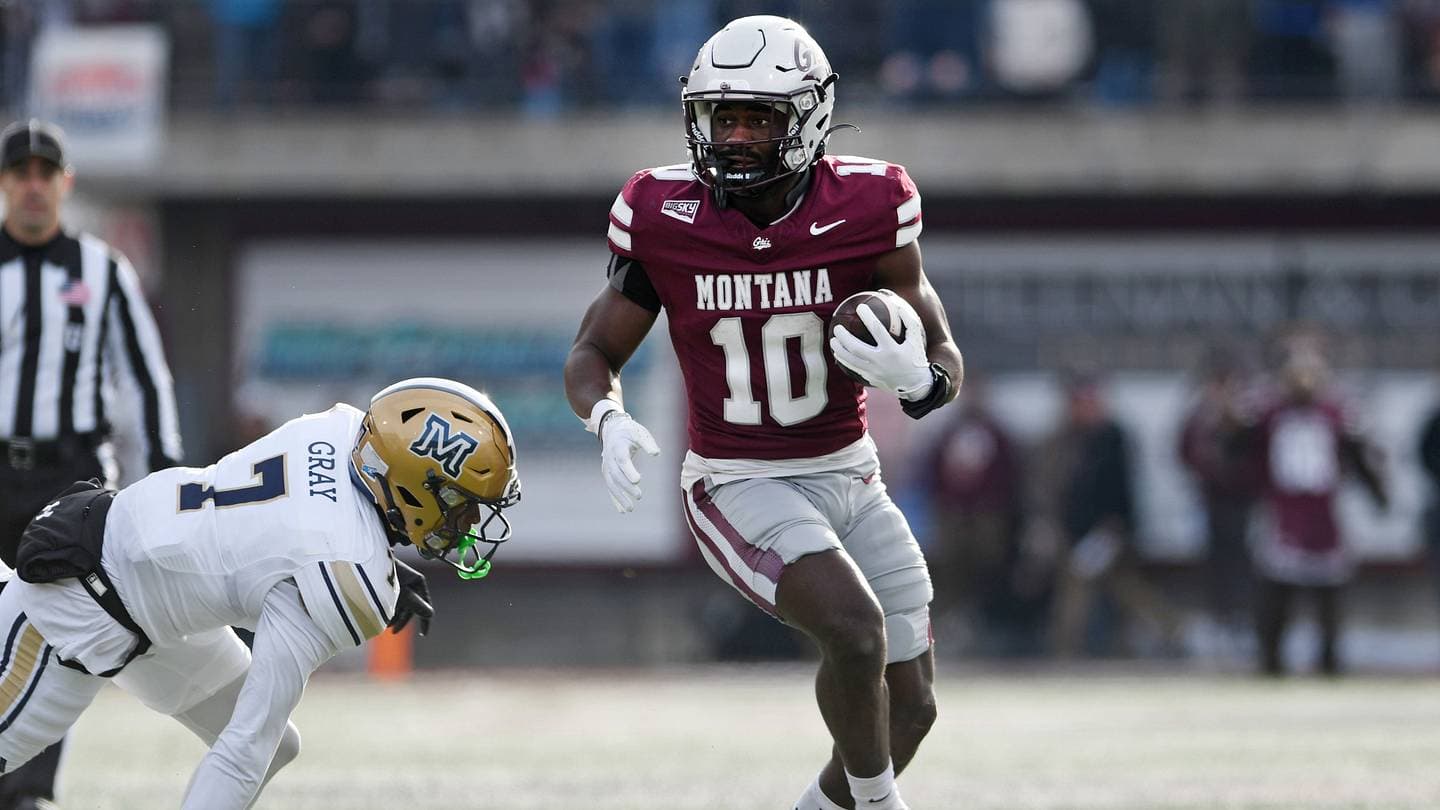
Eli Gillman is the headliner because he already carries the kind of production profile that forces NFL attention. Montana listed him entering his junior year at No. 7 in Grizzly history in career rushing yards with 2,137, No. 5 in rushing touchdowns with 28 and No. 7 in total touchdowns with 30. He also arrived on the 2025 Walter Payton Award Watch List, the 2025 Shrine Bowl 1,000 Watch List and the Stats Perform preseason All-America third team, with preseason All-Big Sky recognition as well.
The résumé matters because Gillman is not just padding numbers in a vacuum. Two years earlier, Montana said he had won the Jerry Rice Award as the top freshman in FCS football, which gives him a real track record of early production against college defenders. For NFL scouts, that combination of age, workload and awards makes him the most established name in the group, but the fall still has to answer the same questions every back faces: can he create explosive plays when defenses know he is the focal point, and can he hold up when protections and route work become part of the evaluation?
Dason Brooks shows how one breakout season can change the conversation
Dason Brooks brings a different kind of case because his 2025 season created hard numbers that are impossible to ignore. He rushed for 1,007 yards and 10 touchdowns in 11 games for Idaho State, averaged 6.4 yards per carry and produced the ninth-most single-season rushing yards in program history. That is the sort of efficiency mark that gets a back on the board quickly, especially when it comes with a 219-yard game at UC Davis on Nov. 1, 2025.
Brooks does not need to match Gillman’s career volume to matter in this class. What he needs is proof that his burst and production survive as the focal point of Idaho State’s offense, because a one-year spike is not the same thing as a sustained professional case. If he adds more pass-game work and shows he can stay on the field in all situations, his 2025 line will read less like a breakout and more like the start of a draftable profile.
Versatility is the common language for the smaller-projected names
Xaviah Bascon, Jaden Green and Luke Yoder each fit the NFL conversation in different ways, but all three are valuable because they hint at role flexibility. Harvard listed Bascon as a 2025 Phil Steele preseason All-Ivy League selection at running back, all-purpose and return specialist, and that trio of labels matters because it tells scouts he can help in multiple phases. In a class without obvious depth, a player who can run, catch and return kicks can separate from a pure ball carrier quickly.
Green and Yoder anchor the Patriot League side of the discussion. Green earned second-team All-Patriot League and Freshman All-American honors in 2024, which gives him both recognition and room to grow. Yoder pushed the strongest statistical case among that group, winning 2025 Patriot League Offensive Player of the Year honors, finishing as a Walter Payton Award finalist and earning Stats Perform third-team All-America status after rushing for 1,409 yards, eighth in the FCS and the second-highest single-season total in Lehigh history. Those are the kinds of numbers that keep a back in the conversation even when the league to NFL path is thin.
What scouts still need to answer this fall
The next stage of evaluation is less about whether these backs can produce and more about what kind of NFL job each one can actually win. Gillman has the best combination of history and recognition, but he still has to show that his receiving value and pass protection match his production. Brooks has the cleanest recent breakout, yet the key question is whether one huge year becomes a repeatable body of work. Bascon’s value depends on whether his all-purpose role holds up against better competition, while Green and Yoder have to show that award-level numbers can survive contact with faster fronts and more complex defensive looks.
That is the thread connecting this entire class to the recent FCS-to-NFL outcomes. Davis, Laube and Strong all gave teams enough evidence to spend draft picks, but none arrived with the kind of first-round certainty that follows Jeanty-type talent. The 2027 class is trying to push past that middle ground. If one of these backs can stack production, stay useful on third down and create explosive plays without sacrificing reliability, the FCS will have another runner who forces NFL teams to spend more than a late-round glance.
This article was produced by Prism’s automated news system from verified source data, official records, and press releases, then run through automated quality and moderation checks before publishing. The system is built and supervised by the people who set the standards it runs under. Read our full AI policy.
Did this article answer your question?